
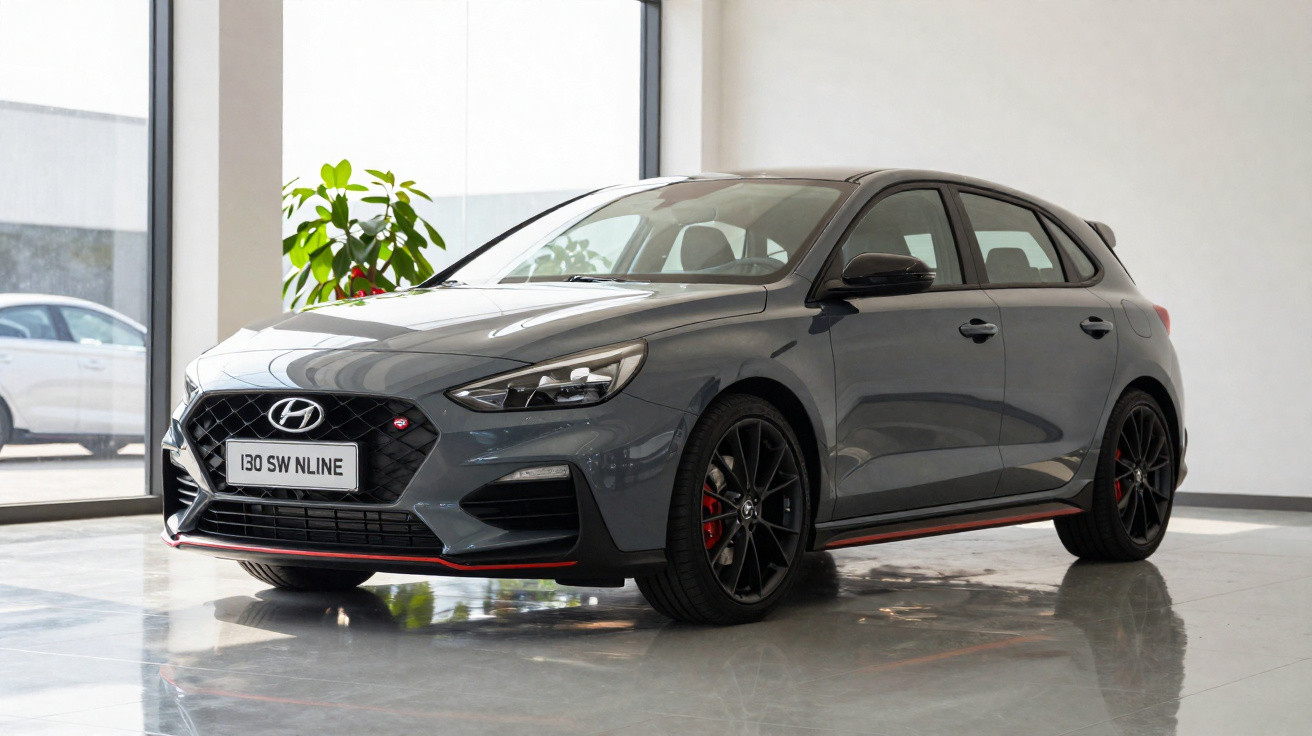
After four years on sale, the Hyundai i30 SW has received a welcome facelift, sharpening its image and helping it stay competitive in a segment that is increasingly under pressure from SUVs.
Given that the updates appear more extensive than you might expect at first glance, has the i30 SW genuinely strengthened its case? Or were the changes largely cosmetic, simply masking the model’s age?
There is only one way to find out. To do so, we tested the Hyundai i30 SW in its most “hard-edged” look: the N Line, here paired with the 1.0 TGDi with 120 hp and a manual gearbox.
Change without revolution
You do not need exceptional powers of observation to spot where the key exterior updates to the i30 SW have been made.
Following an evolution rather than revolution approach (as you would expect from a facelift), Hyundai has nonetheless managed to give the i30 SW a more modern, more assertive look-particularly in this N Line version, which brings its own bumpers and a distinctive grille.
It is at the front where the differences stand out most. In my view, they give the car a more dynamic, less understated character that helps the South Korean estate stand apart, especially when finished in the striking red of our test car.
Improving only what needed improving
Inside the i30 SW, the changes are more modest. Hyundai seems to have stuck to the familiar rule that “if it works, don’t change it”. As a result, the cabin retains strong ergonomics and a design that still feels current, even if it is slightly let down by the extensive use of dark colours.
Even so, there are updates. These include 7-inch and 10.25-inch screens, serving as the instrument display and the (also new) infotainment system screen, respectively.
As for build quality, I have nothing to criticise on the Hyundai i30 SW. Assembly is of a good standard (highlighted by the lack of unwanted squeaks and rattles), and while most of the materials are hard plastics (here it loses some ground, for example, to the new SEAT Leon), they are solid and feel well chosen.
Dynamically it hasn’t changed… and that’s a good thing!
Although Hyundai says it has made improvements to the suspension and steering, the reality is that the Hyundai i30 SW behaves much as it did before-and it is better for it.
As Guilherme Costa reminded us when he tested the pre-facelift i30 SW 1.6 CRDi, this South Korean model has one of the strongest chassis in the class, and you feel it the moment the road starts to twist.
While the i30 SW is consistently stable and reassuring on motorways and open roads, it is on more flowing, tightly linked sections that it really shines, with direct, accurate steering and a chassis that makes you forget the saying that the quickest way between two points is a straight line.
In a way, it also underlines Hyundai’s progress on the dynamic front (thank you, Mr Biermann): the i30 SW stands out as one of the best in the segment here, matching cars such as the Ford Focus SW or the Honda Civic-and even managing to be… fun.
It could be more so, though, if it had more “firepower” than the 120 hp and 171 Nm of torque available between 1,500 and 4,000 rpm. They are not jaw-dropping figures, but they do not disappoint either, allowing a pace that at least fits the N Line badge.
Helping matters is the six-speed manual gearbox. It is not only sensibly geared, but also offers a pleasingly mechanical shift action-almost as satisfying as the gearboxes found in cars like the Mazda3, the Ford Focus or the Honda Civic.
Finally, on fuel consumption, whether in “Normal” driving mode or in “Sport” (which seems to sharpen the already good engine response), the results proved more than acceptable.
On the road and motorway it did not go beyond 5 l/100 km at a steady speed, even while taking full advantage of the space the i30 SW offers. In mixed use it hovered around 5.6 l/100 km, and only when I leaned harder on the i30 SW N Line’s dynamic strengths did it rise towards figures close to 7 l/100 km.
Is it the right car for me?
With the i30 SW N Line, Hyundai shows that even a winning team can be tweaked-so it can keep on winning. To the i30 SW’s already recognised strengths, such as the comfort/handling balance, the interior space and the generous equipment levels, Hyundai has added the technological upgrades that were starting to feel necessary.
It is true the cabin continues to favour a more restrained style, but it is equally true that it still delivers quality that is hard to fault, and it has gained a meaningful technology boost that helps raise the i30 SW’s competitiveness.
With a seven-year warranty with no mileage limit, a price starting at €25,520, more than enough room for a family, and the sportier look of this N Line that suits it “like a glove”, the Hyundai i30 SW remains an option worth serious consideration in the segment.


Comments
No comments yet. Be the first to comment!
Leave a Comment