
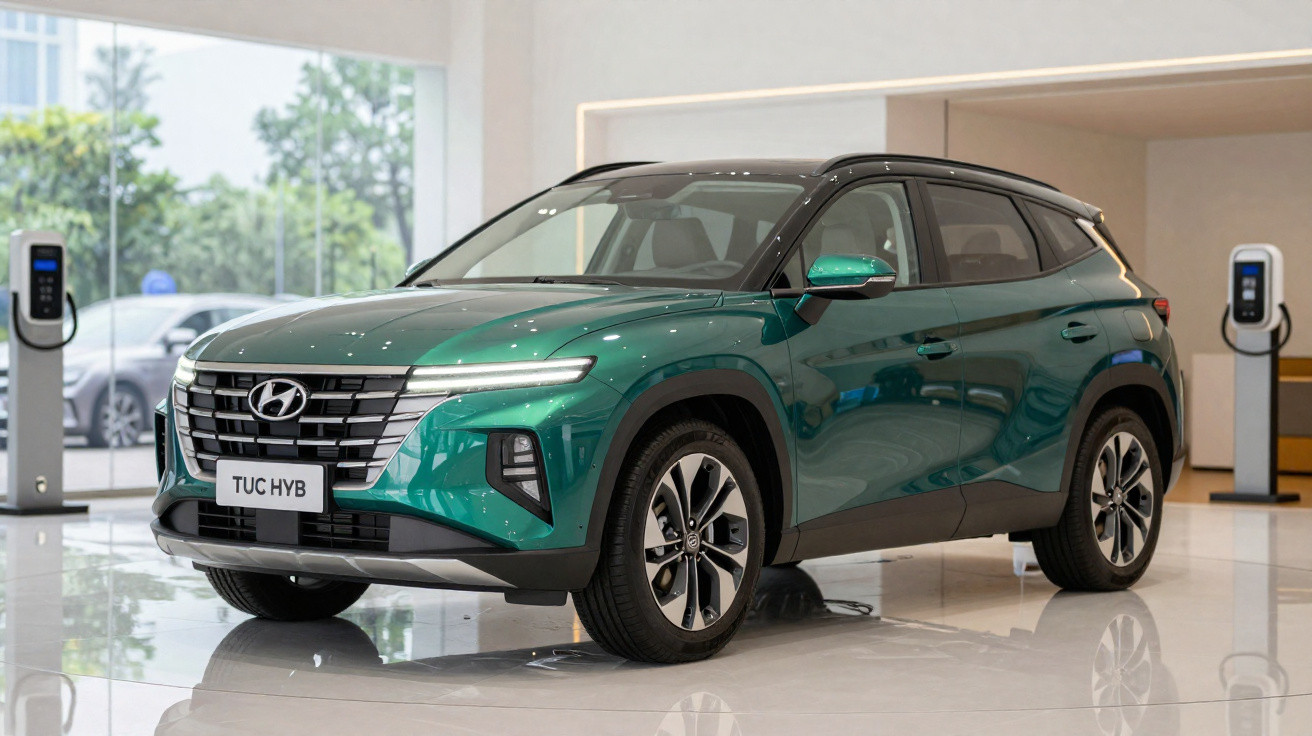
Nothing about it feels like a continuation of the model it replaces. Whether you’re a fan or not, the latest Hyundai Tucson takes a clean break with the past and turns an already successful SUV into one of the segment’s most distinctive offerings - plenty of people looked twice as it went by, particularly when they noticed the unusual front light signature.
This SUV’s new look is bold and characterful, with a strong sense of movement in the surfacing, though I wouldn’t go as far as Hyundai’s own label for it, “Sensuous Sportiness” - “sensuous” doesn’t strike me as the most fitting adjective…
Style, however, is only part of what’s new in this fourth-generation Tucson. Underneath, it moves to a fresh platform (N3), and has grown slightly in every direction, which translates directly into roomier dimensions inside than the previous model.
A family car first and foremost
The generous cabin space gives the new Hyundai Tucson a convincing case as a family vehicle. And despite the dramatic exterior design, Hyundai hasn’t sacrificed outward visibility. Even rear passengers shouldn’t struggle to see out - something that, on some modern models, is no longer a given.
The one disappointment is the lack of rear air vents, even though this is the range-topping Tucson, the Vanguard - although you do at least get two USB-C ports.
An interesting detail: the new Hyundai Tucson Hybrid is the version with the biggest boot in the line-up, at 616 L. It may be a rare example in the market where the hybrid actually offers more luggage space than its simpler petrol and diesel siblings. That’s only possible because the battery sits beneath the rear bench rather than in the boot.
The cabin doesn’t shout for attention in the same way the exterior does, but it’s just as big a departure from earlier Tucsons. There’s a stronger emphasis on horizontal lines, paired with soft transitions that lift the sense of elegance. And even with two large digital displays, the overall mood feels warmer - even a little “zen”.
What’s more, in this Vanguard trim you’re surrounded by materials that, for the most part, look and feel good, with leather covering the surfaces you touch most often. Everything also feels tightly assembled, in keeping with what Hyundai has delivered in recent years, and it’s easy to point to the new Tucson as one of the strongest propositions in the class on this front.
Even so, there is one caveat: the touch controls spread across the centre console. They’re integrated into a glossy black panel, which helps the cabin look cleaner and more upmarket, but usability suffers - they demand more time with your eyes off the road and there’s no haptic feedback, although they do emit a sound when pressed.
Electrify, electrify, electrify
The powertrain story is another area where the new Hyundai Tucson has moved on: every engine on sale in Portugal is electrified. The “regular” petrol and diesel versions are paired with a 48 V mild-hybrid system, while the Tucson Hybrid tested here is an all-new addition to the range, with a plug-in hybrid variant due to join it later.
This Hybrid pairs a 1.6 T-GDI petrol engine producing 180 cv with a 60 cv electric motor, for a combined maximum output of 230 cv (and 350 Nm of torque). Drive is to the front wheels only - there’s a four-wheel-drive Hybrid in other markets - and it uses a six-speed automatic gearbox (torque converter).
As a conventional hybrid, you can’t plug the Hyundai Tucson Hybrid into a socket to charge it; the battery is replenished by harvesting energy during deceleration and braking. That’s sufficient, because capacity is just 1.49 kWh - around 7–8 times smaller than most plug-in hybrids - and Hyundai doesn’t even bother quoting an electric-only range (typically, in hybrids like this, it won’t extend beyond 2–3 km).
That also explains why there’s no dedicated EV-only driving mode - and, truthfully, it isn’t missed. What stands out instead is how often you find yourself travelling using only the electric motor, even though it makes just 60 cv… helped, of course, by its 264 Nm of “instant” torque.
Treat the right-hand pedal gently and you can pull away and build speed up to 50–60 km/h in urban or suburban driving without waking the combustion engine. At higher speeds, too - provided conditions allow (battery charge, accelerator demand, and so on) - it’s possible even on the motorway at 120 km/h for the electric motor to be the only one working, albeit for short stretches - something I ended up confirming in the real world.
It should be economical…
Potentially… yes. I say “potentially” because the fuel consumption I saw at the beginning was higher than expected. It’s worth noting that this test car had covered very few kilometres, and combined with the cold snap at the time, that seems to have played a part in the unusually poor results - especially in the WLTP era we now live in, where the gap between official and real-world figures is typically smaller.
This particular car felt like it needed a proper running-in. Said - and (almost) done. The best way to add miles and settle the question was a long stint on A-roads and motorways. After several hundred kilometres, the consumption readings did improve, but unfortunately my time with the Tucson Hybrid was nearly up.
Even so, I still recorded figures ranging from the high fives to the low sixes in litres per 100 km in town, and at steady, moderate speeds the consumption settled slightly below 5.5 l/100 km. That’s respectable for 230 cv and close to 1600 kg, and with more mileage and more test time there appeared to be further room to improve - perhaps on another occasion. These later figures also line up more closely with what we’ve seen from other hybrid SUVs in the class, such as the Toyota RAV4 and the Honda CR-V.
Smooth in operation, but…
Leaving consumption aside, you’re dealing with a complex drivetrain that has to co-ordinate the combustion engine, the electric motor and the automatic gearbox in a cohesive way - and, broadly speaking, it succeeds. The new Hyundai Tucson Hybrid is refined and easy-going to drive.
However, in Sport mode - and alongside it the Tucson Hybrid only offers Eco - the setting that encourages you to make fuller use of the available 230 cv, the gearbox can feel out of step when you press on along a twistier road. It tends to hold a particular ratio for too long, or it will downshift unnecessarily as you exit corners. It’s not a quirk unique to this car; you’ll often find this modus operandi in many other models from other brands with automatic transmissions.
Eco mode suits the gearbox better, where it generally seems to make the right choice, though I’d happily pair it with the steering weight from Sport, which becomes pleasingly heavier than in Eco - but not excessively so.
More of a cruiser than a sports SUV
First, it’s important to note that when you ask for the 230 cv, they all show up: the new Tucson accelerates strongly when you apply the throttle with intent - performance is genuinely impressive.
But combine that performance with a more winding road and it becomes clear the Hyundai Tucson prioritises passenger comfort over trying to be the sharpest SUV in its class. After all, it remains a family SUV - and for those who want still more pace and dynamic bite, a Tucson N is due later this year.
Even so, the handling remains fundamentally sound: responses are progressive, it’s effective, and it doesn’t develop bad habits, even if the body moves around a little more when you’re in a hurry. This Tucson’s real strength is long-distance driving on open roads.
On main A-roads and motorways, the new Hyundai Tucson feels most in its element, showing excellent stability and a very capable ability to absorb most imperfections. Comfort is helped by the seats, which don’t wear you down even over extended periods and still provide decent support. As you’d expect of an SUV, the driving position is higher than usual, but it’s easy to dial in a good set-up thanks to generous adjustment for both seat and steering wheel.
The one weak point in its long-distance armour is sound insulation, particularly aerodynamic noise, where wind roar is noticeably more present than, for example, in a Volkswagen Tiguan.
Is it the right car for me?
The new Hyundai Tucson Hybrid comes across as one of the most capable and competitive options in the segment.
I also had brief time with the Tucson 1.6 CRDi 7DCT (Diesel), and I found it more engaging to drive than the Hybrid thanks to a greater sense of lightness, agility and connection with the car - even though the Hybrid is mechanically more refined. Objectively, though, the Hybrid “crushes” the Diesel.
Not only does it deliver performance on another level - that’s 94 cv more - it’s even a little… cheaper. On top of that, the scope for low consumption is significant, especially in town where the electric motor often takes centre stage. It becomes hard to justify choosing any other Tucson.
This competitiveness doesn’t fade when you place it next to the Toyota RAV4 and Honda CR-V, its closest hybrid rivals, because the new Hyundai Tucson Hybrid is more affordable than both. Love or hate the Tucson’s bold styling, it unquestionably deserves a closer look.
Comments
No comments yet. Be the first to comment!
Leave a Comment