
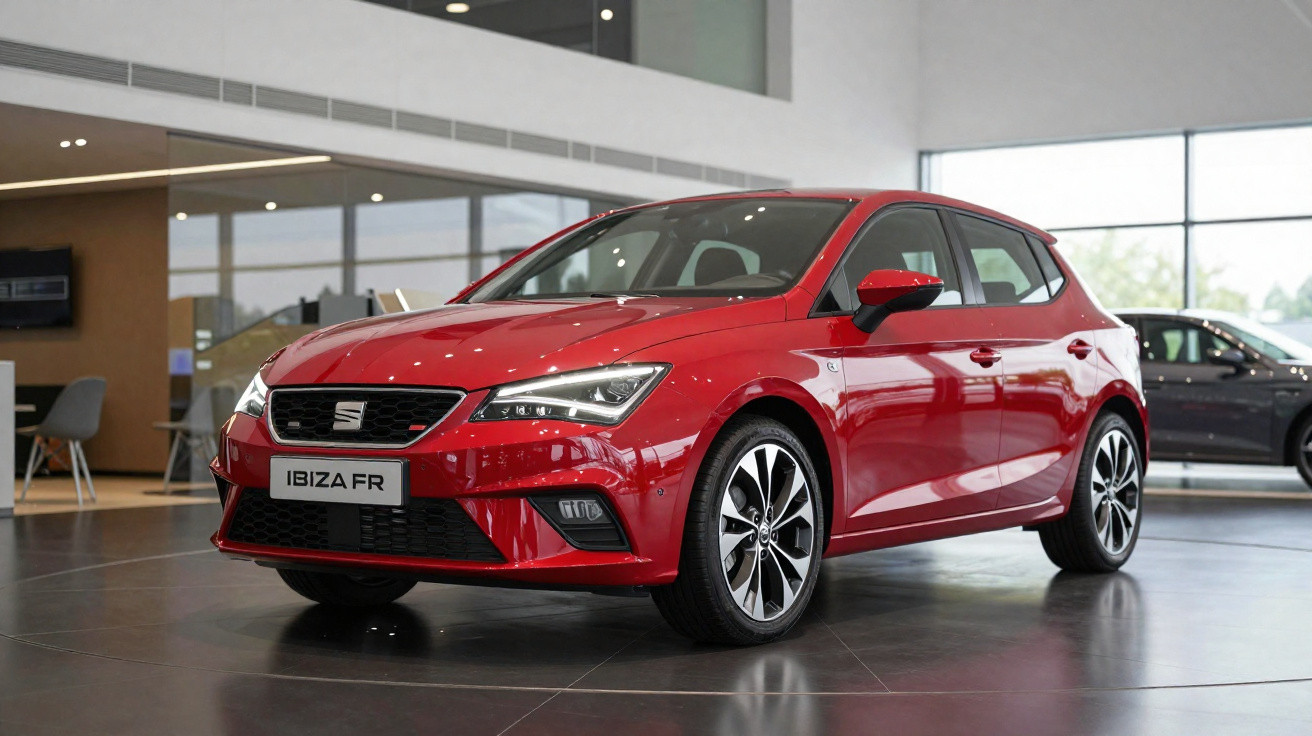
The suspicion that there won’t be a CUPRA Ibiza has now been confirmed, which means the job of the Spanish supermini’s “spicier” version falls to the SEAT Ibiza FR, paired with the slightly modest 1.0 TSI producing 115 hp - yes, even the 1.5 TSI with 150 hp still isn’t on sale in Portugal…
With that in mind, after having driven it with the 1.6 TDI delivering 95 hp, it was time to find out what the… most powerful SEAT Ibiza FR currently available is worth, with 115 hp and a DSG gearbox.
Visually, I’m still a fan of the Ibiza’s styling. It looks restrained and grown-up, and in FR trim the SEAT Ibiza gains a few sportier touches - 18-inch alloy wheels, more aggressive bumpers and twin exhaust finishers - yet it never “gives in” to becoming flashy or overly embellished.
Inside the SEAT Ibiza FR
On the cabin, everything I could say here has already been covered in previous drives of other Ibiza versions, including the Diesel model and the one fitted with a CNG engine.
Even so, at the risk of repeating myself, it’s hard not to praise the ergonomics, the easy-to-use infotainment system with clear graphics, and the overall sense of sturdiness it gives off.
As for space, the key point is that the SEAT Ibiza FR’s interior room remains among the segment benchmarks - the Ibiza is one of the largest B-segment cars currently on sale - and there’s enough room for four adults to travel in comfort. The 355-litre boot, meanwhile, “casts a shadow” over some offerings from the class above.
Behind the wheel of the SEAT Ibiza FR
Static introductions done, it’s time to get into what is probably the most important part of assessing the most powerful SEAT Ibiza: how it drives.
Starting with handling, it comes across as safe, predictable and effective. The Ibiza FR benefits from its firmer, sportier suspension set-up to stay “glued” to the road, even when you decide to push on. Still, when you dial back the pace, ride comfort remains at a good level.
The steering has an appropriate weight and feels quick and accurate, with the Ibiza FR in this respect edging closer to unexpected references such as the Hyundai Kauai.
Finally, the engine. With four driving modes available (“Eco”, “Sport”, “Normal” and “Individual”), the Ibiza FR can take on a range of “personalities”, largely thanks to how the throttle is mapped in each mode.
In “Eco”, the gearbox shifts up sooner (sometimes perhaps too soon), the throttle feels more muted, and you also gain access to the transmission’s coasting function - easily the best argument for choosing “Eco”.
Switch to “Sport” and the throttle response becomes far more immediate, as if it wakes up all 115 hp and unlocks the full 200 Nm, to the point it can even feel like a little more. It not only lets you maintain a quicker pace, but also makes overtakes feel more assured without having to rely on the gearbox (which can be operated via the steering-wheel paddles).
In this mode, the seven-speed DSG holds on to the chosen gear for longer before upshifting, and the three-cylinder is happy to rev keenly towards the upper reaches of the dial - which, interestingly, is where it seems most at ease, as at low revs it shows a certain “lack of lungs”.
When it comes to fuel consumption, over the course of the test I recorded averages between 6.0 and 6.4 l/100 km, achieved without much effort and with a few moments spent more deliberately exploring what the SEAT Ibiza FR can do.
Is it the right car for me?
Having now driven the Ibiza with every engine currently available, it’s only fair to congratulate SEAT. In this fifth generation, the Spanish supermini feels more mature than ever and leans above all on rational strengths - such as interior space and the equipment on offer - to present itself as a credible option in the segment.
On the other hand, against rivals like the Opel Corsa GS Line, Peugeot 208 GT Line or the Renault Clio RS Line 1.3 TCe, the SEAT Ibiza FR loses out on power - all of them offer 130 hp and 1.2 or 1.3 engines versus the Spaniard’s 115 hp from the smaller 1.0 TSI - but it makes up ground with its cabin room.
Price-wise, they all play a very similar “game”, which, considering the small but noticeable performance gap to those competitors, doesn’t particularly help the SEAT Ibiza FR’s case.
Solidly built, (very) roomy and well equipped, the SEAT Ibiza FR is a strong choice for anyone who wants a model with a more “sporty” look but who also has family responsibilities or simply needs space - more than a supermini, it feels like a small family car…
Comments
No comments yet. Be the first to comment!
Leave a Comment