
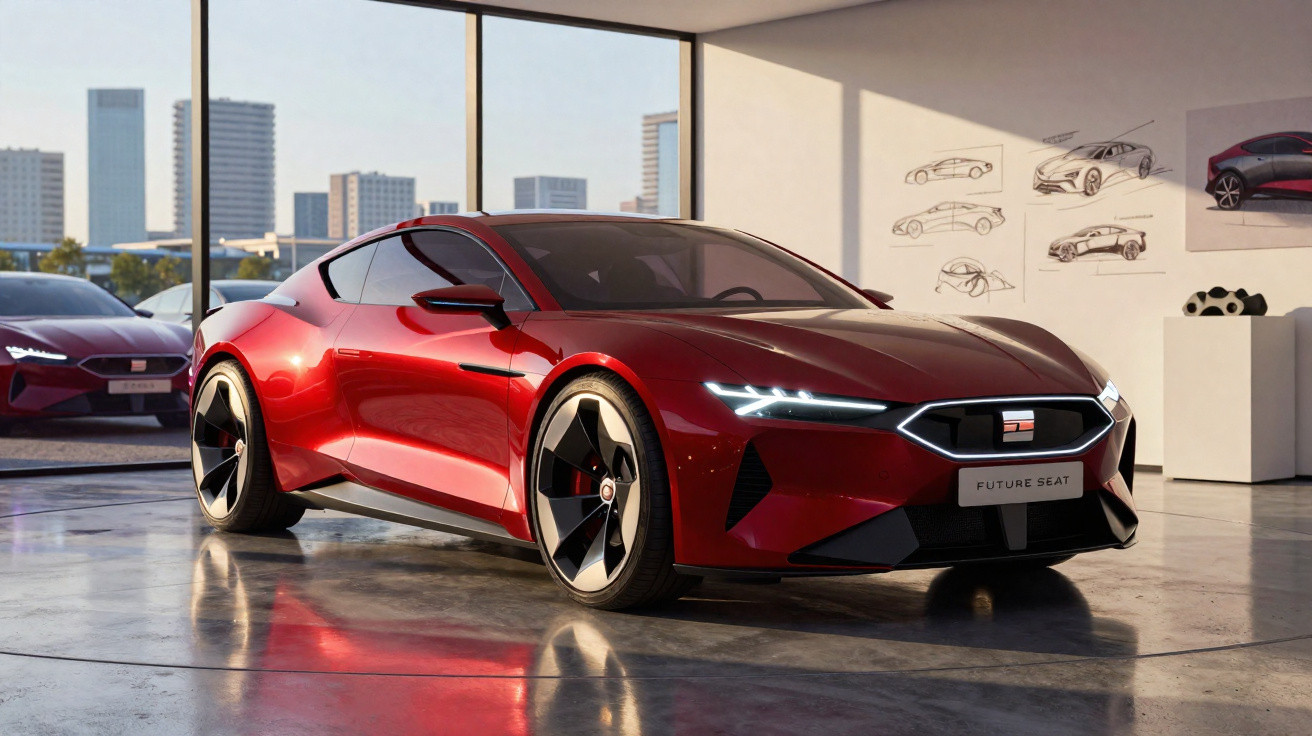
SEAT’s new place within the Volkswagen Group
SEAT’s future has been under scrutiny in recent years. Within SEAT S.A., attention has largely centred on expanding CUPRA, yet the Spanish brand is now showing fresh signs of momentum, helped by a revised position inside the Volkswagen Group and the promise of several upcoming changes.
“SEAT remains a fundamental pillar for the Volkswagen Group,” said Sven Schuwirth, the sales and marketing director. “It is the group’s entry brand, designed to attract both young customers and more mature generations. We will cover more entry-level segments and offer lower purchase prices.”
It is an intriguing reshuffle, particularly as this role had long seemed more naturally aligned with Škoda. Under the updated approach, SEAT is set to focus its efforts on the lower end of the market-while Škoda currently has a strong foothold in the mid-range-and CUPRA will continue to serve the segments above.
Updated Ibiza and Arona, new Leon in 2029
With that strategy in mind, SEAT has confirmed several developments for the coming years, starting with refreshed versions of the Ibiza and Arona. These updates-originally expected last year-will bring styling revisions and, for the first time, introduce a 48 V mild-hybrid powertrain.
It is not yet confirmed whether SEAT will opt for the four-cylinder 1.5 eTSI already used in the Leon, or bring back the three-cylinder 1.0 eTSI that has powered a range of Volkswagen Group models, including the Golf.
As for the Leon, the current generation launched in 2020 will stay on sale for a few more years, running through to 2029, when an all-new generation is due. Before that happens, the existing Leon is set to gain a new hybrid version in 2028 that does not require plugging in (a full hybrid).
This is the same hybrid system the new Volkswagen T-Roc is expected to debut next year. It pairs a 1.5 TSI petrol engine with an electric motor, with two planned output levels: 136 cv and 170 cv.
Very little is known about the next Leon beyond that. It is expected to move to the Volkswagen Group’s new SSP (Scalable Systems Platform), which is also planned for future fully electric versions of the Volkswagen Golf and T-Roc. However, it has emerged that the electric Golf-also initially targeted for 2029-has been postponed.
Even if the Leon is built around SSP (originally intended to replace all Volkswagen Group EV platforms), that would not automatically mean an electric-only Leon. A recent development will enable SSP to accommodate combustion engines as well.
Ateca and the absence of a fully electric SEAT
Outside these announcements sits the Ateca, currently SEAT’s oldest model still on sale. The SUV, introduced in 2016, is no longer available under CUPRA, and there are no indications that SEAT will replace it with a direct successor.
Fully electric models were also absent from SEAT’s update. Today, SEAT is one of the few brands without a 100% electric vehicle in its range (if CUPRA is excluded). That situation is expected to continue for the next few years, at least until the arrival of the next-generation Leon.
According to what Markus Haupt, SEAT’s chief executive, shared at the Munich Motor Show 2025, there is currently no viable way to offer a SEAT on an electric platform profitably.
Comments
No comments yet. Be the first to comment!
Leave a Comment