
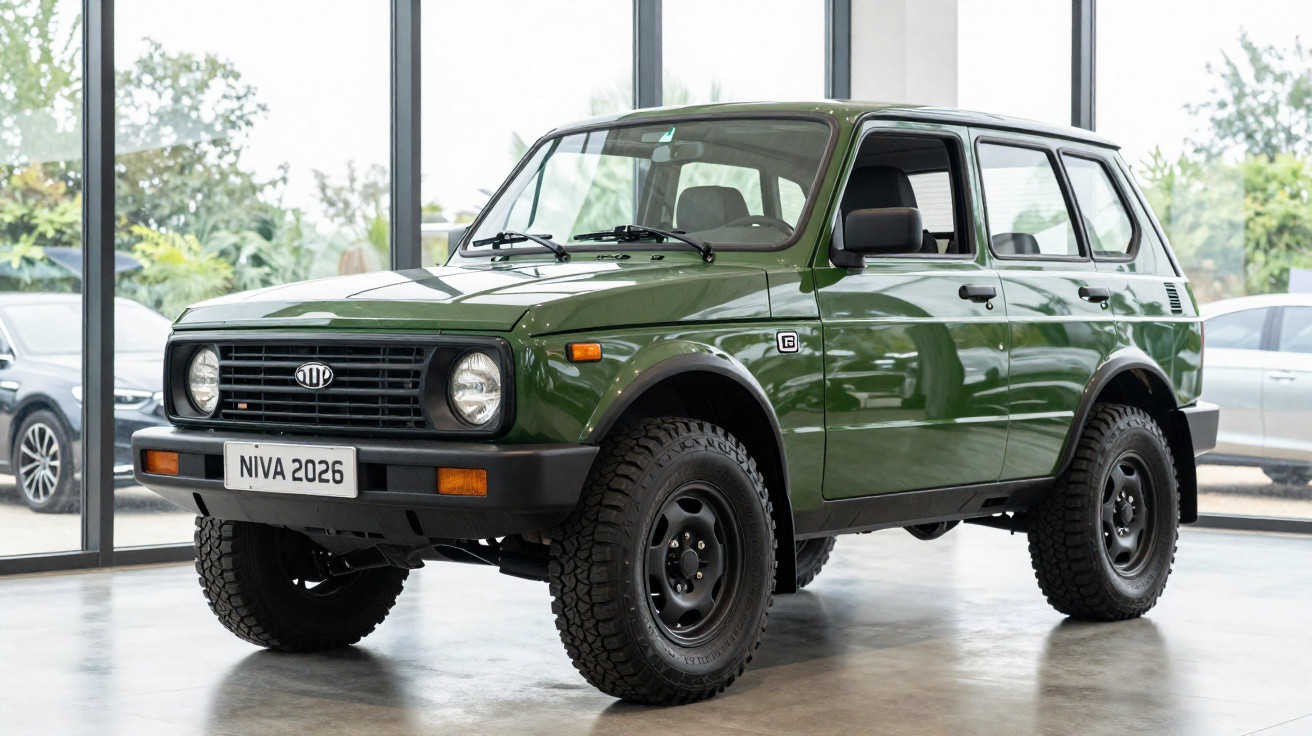
Some cars move on to a new generation every seven or eight years. Then there is the Lada Niva: it is on the verge of turning half a century old while staying loyal to the same architecture, styling and mindset as the original. The 2026 iteration, known as the Niva Legend, is not about to change that.
Electric? Only in the starter motor. Everything else remains basic, straightforward and tough. There is no need to lament that - and there is a reason for it, which comes at the end.
From the outside it is still instantly recognisable, even though the biggest modernisation in the model’s history sits beneath the bodywork. AvtoVAZ, the Russian car maker behind Lada, says it has introduced more than 350 new or revised components.
Production of this version began in July 2026 at the Togliatti plant in Russia, and the first cars are already reaching customers. The revisions touch almost every area of the Niva: engine, transmission, suspension, brakes, structure, ergonomics and safety.
At last, a new petrol engine
The headline change is under the bonnet. The old 1.7-litre unit makes way for a naturally aspirated 1.8-litre petrol engine already used in the Lada Niva Travel. It is created by pairing the AvtoVAZ 1.8 EVO block with an eight-valve cylinder head (two valves per cylinder). There is no turbocharging, no electrification and no attempt to reinvent the Niva as a modern SUV.
The aim is still to provide a simple, durable powertrain that can cope with harsh conditions. Output is 90 bhp and 153 Nm of peak torque (up by 5 bhp and 24 Nm versus the previous engine).
More telling than the peak figure is where that torque arrives. According to Lada, around 80% is available from just 1000 rpm, which is especially valuable for a vehicle designed for off-road use. Stronger low-rev pulling power should help with moving off on slippery ground, tackling steep climbs and crawling at low speeds.
To accommodate the new engine, the Niva receives redesigned intake, exhaust, cooling and fuel-delivery systems. Even so, the spare wheel remains mounted under the bonnet, one of the model’s most distinctive solutions.
Revised suspension and transmission
The extra torque also required a tougher drivetrain. AvtoVAZ has reworked items such as the differential gears, the rear half-shafts and the fifth-gear set.
Up front, the suspension has been updated too. The anti-roll bar has been moved further forwards, while the springs and the upper shock absorber mounts have been recalibrated.
The company says these tweaks should sharpen steering accuracy and improve on-road comfort, without compromising the strength needed when the tarmac ends.
The transfer case now uses a single selector lever, replacing the previous two-control arrangement. A third mounting point has also been added, along with new engine mounts, in order to cut vibrations transmitted into the cabin.
A solitary airbag
The most symbolic addition in this update is a driver’s airbag. It may sound commonplace in 2026, but it forced AvtoVAZ to reinforce the front structure of the bodyshell and fit a new steering wheel sourced from the Niva Travel.
The Lada Niva is still a long way from the safety standards of modern cars, yet this is a meaningful step for a design whose structure dates back to 1977.
From Russia to Russia
The new Lada Niva is not expected to be officially sold in the European Union. AvtoVAZ has announced production of this version only for the Russian market, and current European sanctions prevent the commercial import of cars originating from the country.
On top of that, the simplicity of the 1.8-litre petrol engine in this model is unlikely to meet Europe’s stringent environmental rules. So even without sanctions, it would be hard to imagine a Lada Niva Legend on European roads.
Even so, fans of the model can breathe easily from afar: the Lada Niva remains true to the original concept. Electric? Perhaps in another 50 years.
Comments
No comments yet. Be the first to comment!
Leave a Comment