
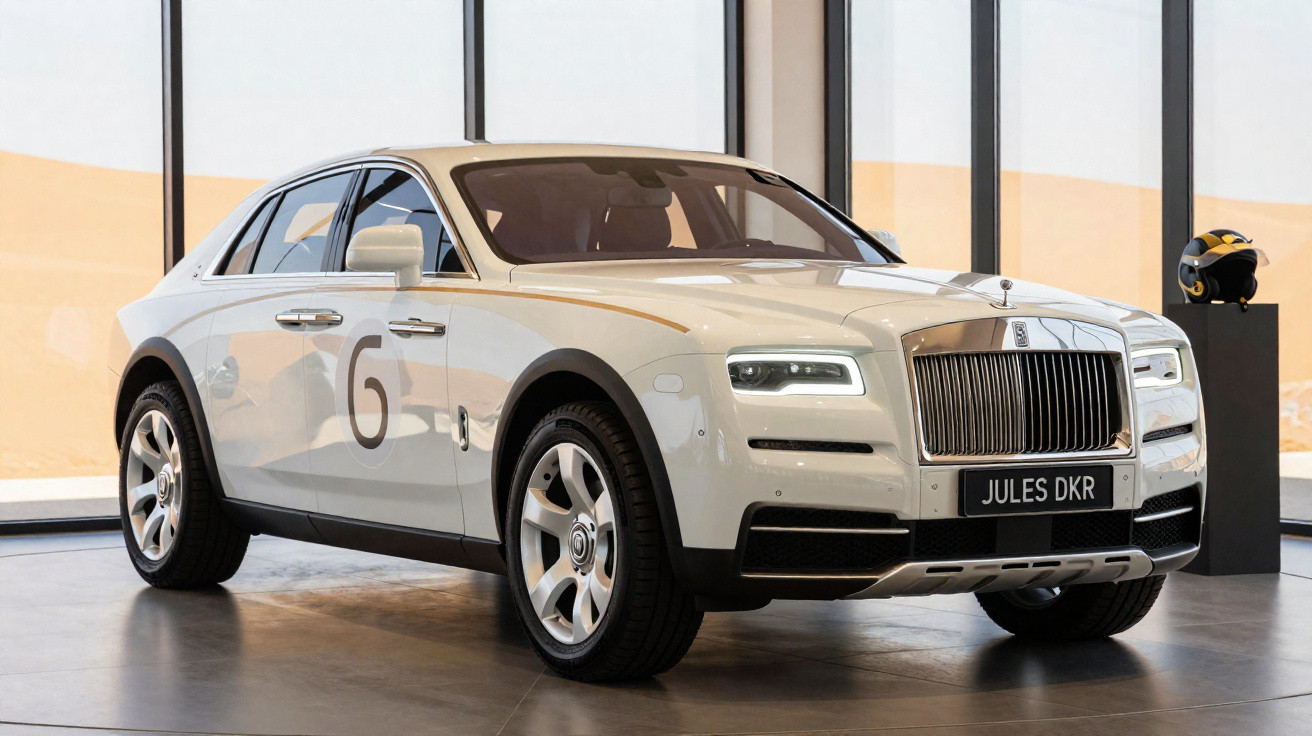
The Rolls-Royce Corniche is British luxury through and through: a 6.75-litre V8, rear-wheel drive, and a three-speed automatic gearbox. The perfect recipe for the Paris-Dakar, right? Not even close… Yet, as the story goes, the Rolls-Royce Jules began as a wager between friends-one of those dinners everyone knows how they start, but nobody can predict how they will end.
A dinner bet that refused to die
That evening, Jean-Christophe Pelletier, the owner of the Rolls-Royce Corniche, was complaining to his friend Thierry de Montcorgé-an amateur rally driver-that the car was always breaking down. Faced with that moan, Montcorgé came out with something completely outrageous: “Let’s enter the Dakar in your Rolls-Royce Corniche!”.
The idea was debated late into the night, and everyone assumed it would be forgotten by morning. It wasn’t…
By the next day, Thierry de Montcorgé had thought it through and decided it might actually be doable. The friends met up again and, two days later, Montcorgé had a cheque in his hands covering 50% of the amount needed to get the project moving.
Building the Rolls-Royce Jules for the Dakar
The English car’s “heart” was swapped for something more affordable-and, crucially, more durable: a Chevrolet engine, specifically the accessible Small Block 5.7-litre V8 producing a respectable 335 hp.
The drivetrain and 4×4 running gear would also need an external donor. A Toyota Land Cruiser willingly provided its transmission, including a four-speed manual gearbox.
Taking on the Dakar-the toughest rally in the world-in a Rolls-Royce was, in truth, a slightly skewed claim. Not only were the engine and transmission no longer Rolls-Royce items, but the tubular chassis they sat in had been designed from scratch for the job. Even so, the bodywork and interior still largely came from the Corniche.
To round out the package Thierry de Montcorgé needed for a credible Dakar attempt, the car gained raised suspension and off-road tyres. A colossal fuel tank was also fitted, with a capacity of no less than 330 litres.
Naming the car was the easy part: the main sponsor was fashion designer Christian Dior, who had just launched a perfume line called “Jules”. That name ended up christening the Rolls-Royce.
Did it survive?
Then came the moment for this machine to face the Dakar, and the reality was that it went… surprisingly well. The Rolls-Royce Jules was regularly placed in the top 20, and by the halfway point it had climbed to an excellent 13th overall.
But 13 can be an unlucky number. Everything was on track until a steering problem (a break in one of the mounts) delayed the French driver. That setback ultimately led to disqualification: they arrived 20 minutes late to parc fermé and carried out the repair outside the permitted time.
The bet, however, was about reaching the end of the Paris-Dakar in a Rolls-Royce-nobody had said anything about whether it had to be officially classified. So Thierry de Montcorgé and Jean-Christophe Pelletier carried on regardless, focused on one goal: crossing the finish line in Dakar.
Out of the 170 cars entered in the 1981 Paris-Dakar, only 40 made it to the finish-and the Rolls-Royce Jules, driven by Thierry de Montcorgé, was one of them.
The Rolls-Royce Jules never competed again, but it was often requested for appearances at motoring festivals and exhibitions. After being restored, this English “winner” with a truly quirky backstory was put up for sale for €200,000. It certainly isn’t short on history.
Moral of the story: be careful what you bet on over dinner with friends.

Comments
No comments yet. Be the first to comment!
Leave a Comment