
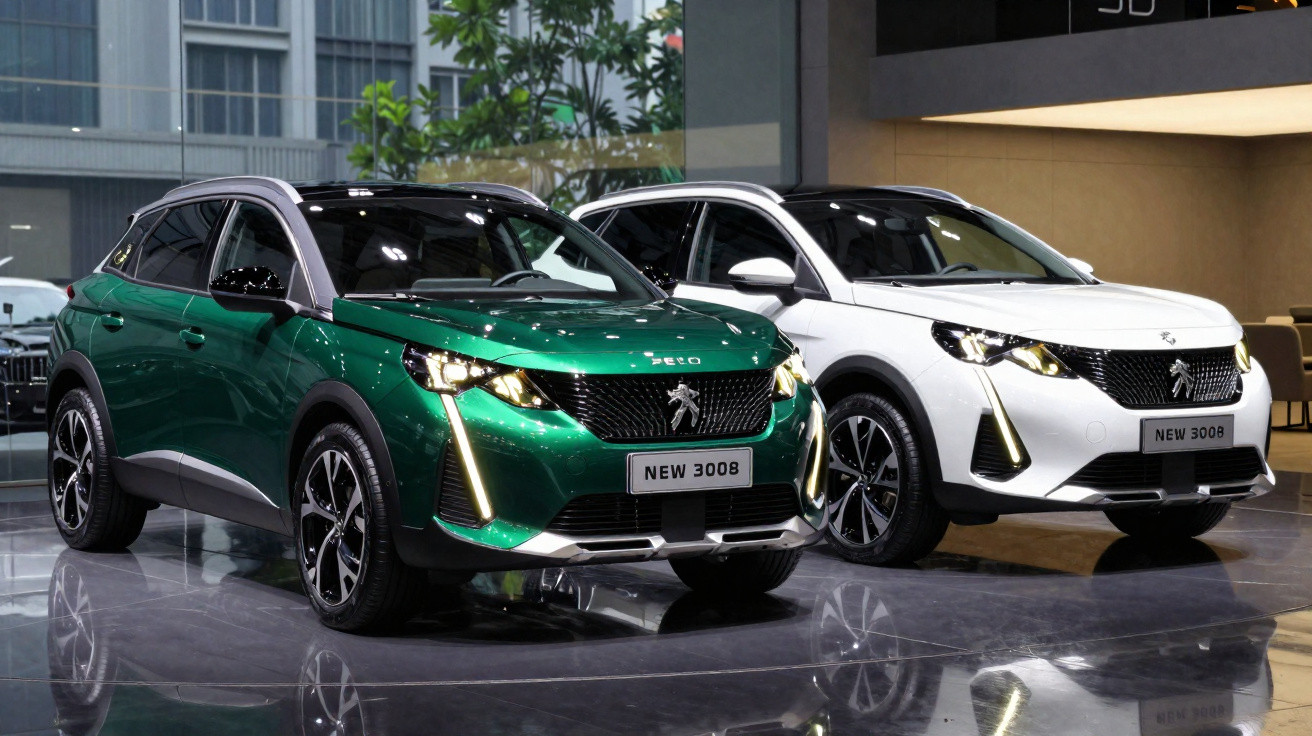
The Peugeot 3008 and 5008 have become two of the French brand’s biggest success stories. In their second generation, they capitalised perfectly on the crossover and SUV “boom” that swept (and continues to sweep) across Europe, wiping away any outward trace of the MPV silhouette of their predecessors - and ever since, they have simply kept on selling.
Since the current-generation 3008 and 5008 arrived (in 2016 and 2017 respectively), more than 1.1 million units have been sold. That success has been repeated in Portugal, where it has even helped Peugeot become the country’s best-selling brand in the crossover and SUV space. The 5008 positions itself as the outright leader among seven-seat SUVs in Portugal, while the 3008 is only beaten by the Nissan Qashqai.
Success, however, does not mean “resting on your laurels”, which brings us to the point of this update: both models have arrived with a “freshened face” and a stronger technology equipment list.
We have already gone through what has changed on the updated 3008 and 5008, but in short it is the front end that carries the most obvious differences. Both now feature a completely new face, more aligned with the rest of the Sochaux range, as you can see in the new lighting signature and the model name positioned above the grille.
Elsewhere there are new colours, wheels, and trim options, plus a sharper digital instrument cluster, a 10-inch touchscreen, and additional equipment. From Night Vision to adaptive cruise control, along with more advanced driver assistance systems, it all culminates in the option of semi-autonomous driving on versions fitted with the automatic gearbox (EAT8).
On the engine front, the only new addition is the 1.6 PureTech with 180 cv (petrol) paired with the EAT8 automatic. The rest of the line-up - petrol, diesel and plug-in hybrid options - carries over unchanged from the models we already knew, albeit updated to meet the latest emissions standards.
Peugeot 3008 HYBRID4
For this first dynamic drive on Portuguese roads, I had access to a Peugeot 3008 GT HYBRID4 - the most powerful, quickest and… most expensive version in the range - as well as a Peugeot 5008 Allure 1.5 BlueHDI EAT8.
Even though the 3008 HYBRID4, one of the two plug-in hybrids in the range, is not entirely new - not even to the Razão Automóvel garage, as João Delfim Tomé had the chance to test it almost half a year ago, before the facelift - it was new to me, as I had not yet driven it.
The first thing that stands out is this SUV’s performance. It hurls you towards the horizon with real conviction, no question… Yes, I know it has 300 cv and 520 Nm, produced by combining the 1.6 PureTech with 200 cv and two electric motors (110 cv and 113 cv) - one of them mounted on the rear axle - but it is also an SUV weighing around 1900 kg. That seemingly does not matter. The instant torque from the electric motors delivers a responsiveness that ranges from pleasantly brisk to “blimey, that felt more like a kick”, with the combustion engine then joining in almost immediately.
Beyond the outright pace, the refinement is what really impresses. A short stint on the motorway confirmed how effectively road noise and aerodynamic noise are subdued, aside from a slight turbulence around the area between the A-pillar and the door mirror.
At steadier, more moderate speeds, you begin to notice the other qualities of the 3008 HYBRID4 and its drivetrain. I did not have the opportunity to verify the claimed 59 km of electric range - there simply was not time - but I could confirm that Hybrid mode seems to manage the balance between the combustion engine and the electric motors more evenly than what I experienced in the Citroën C5 Aircross Hybrid (one electric motor and 225 cv), which leaned too heavily on electric power and drained the battery quickly.
In this mode, achieving consumption around 5.0 l/100 km is not difficult, while on the motorway, running only on the combustion engine, the figure rose to around 6.5 l/100 km.
During the time I spent behind the wheel of the 3008, it was easy to recognise the high level of comfort on board, both from the suspension and the seats. That said, in this HYBRID4, perhaps because of its extra mass, the suspension seems to struggle more with sharper bumps, reacting in a noisier and more abrupt manner - something I did not notice in the larger, but lighter, 5008.
Peugeot 5008 1.5 BlueHDI
Speaking of the 5008, which I also had the chance to drive (albeit for a shorter period), the car I drove combined the Diesel engine with the EAT8 automatic gearbox and came in a more modest Allure Pack specification. Not only does it look and feel more understated than the 3008 HYBRID4 in GT trim, both outside and in, it also does not come as generously equipped.
The 5008 stands out thanks to its longer wheelbase and overall length, which make it possible to add a third row of seating with two folding seats. While those two extra seats may be the core reason the 5008 exists, it was in the second row where I discovered the biggest advantages the 5008 has over the 3008.
Instead of a bench, you get three individual seats, and they slide fore and aft, offering a level of flexibility that the 3008 cannot match - along with a huge amount of legroom. Fold the third row down and you also gain a boot that, in usable floor area, must rival some studio flats…
For anyone who needs space - whether you are regularly carrying people or hauling lots of kit - the Peugeot 5008 is clearly the better tool for the job. That is what led me to have a few reservations about this 1.5 BlueHDI. Not about the engine itself - it is an engine I rate highly - but about the 130 cv it produces. While it moves the almost 1600 kg 5008 competently enough, the reality is that I was the only person on board.
Looking in the rear-view mirror at the length of car behind me and picturing it full of passengers, would it still feel up to the task? That is something we are keen to confirm on a longer test drive in future. The 5008 has other engines available that are better suited to that role, such as the more appealing 2.0 BlueHDI with 180 cv - unlike the 3008, there are no hybrid versions of the 5008 - although in our market that translates into an absurd €7000 increase in price.
In conclusion
Even with the “facelift” and the technology upgrades, from behind the wheel the refreshed Peugeot 3008 and 5008 still feel very much like themselves - no chassis changes were announced - with comfort continuing to take priority over sharp, sporty responses.
For some people, the i-Cockpit remains a challenge, as seeing the instrument cluster requires looking over the top of the small, non-round steering wheel. It does not bother me, and I actually like the concept, but I understand why others may find it impossible to achieve a satisfactory driving position. I would only ask for a little more weight in the steering, as in “Normal” mode it feels too light. At times, that can create extra body movement, because the lack of resistance and the wheel’s small size can lead to more sudden inputs than intended.
Neither of Peugeot’s two offerings is among the cheapest, but their prices are not far off what is typical in the segment. The Peugeot 5008 Allure Pack 1.5 BlueHDI EAT8 comes to almost €43,000, while the Peugeot 3008 HYBRID4 GT goes beyond €54,000. Those are hefty figures, but they are offset by a distinctive look that sets them apart from more conventional alternatives, decent perceived quality, and an enjoyable environment on board.
In the case of the plug-in hybrid offering, the HYBRID4 in GT trim is only available to private buyers - for companies, the HYBRID4 can only be ordered in Allure and Allure Pack.
Comments
No comments yet. Be the first to comment!
Leave a Comment