
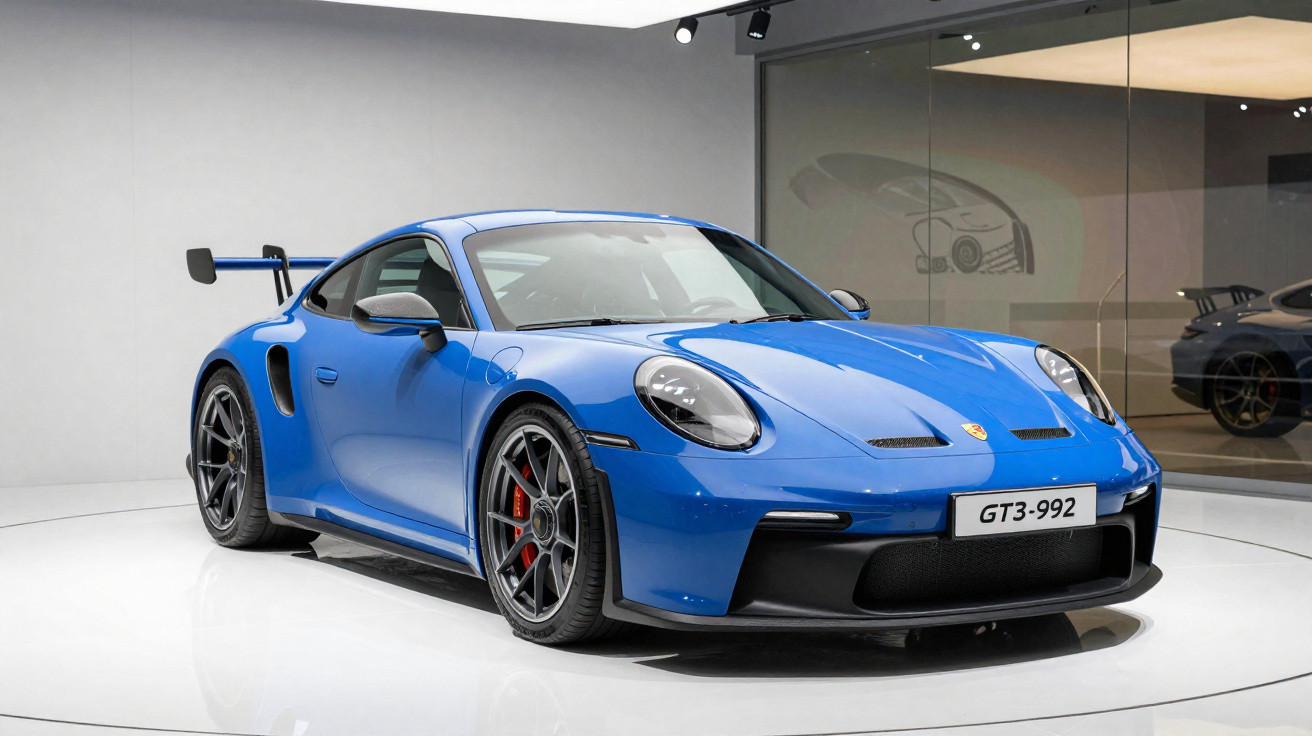
Mission accomplished. After more than half a million kilometres covered in an intensive development programme under the watchful eye of Porsche Motorsport - the German brand’s racing division - the new Porsche 911 GT3 (992) is finally ready.
There is plenty to celebrate. The most defining GT3 traits remain untouched: a naturally aspirated engine, a manual gearbox and… you know the rest.
Not a “normal” Porsche 911
In this seventh generation, the Porsche 911 GT3 draws on Porsche’s motorsport expertise more than ever. We spoke to Andreas Preuninger, the man responsible for developing Porsche’s GT model family, who has no hesitation in calling it the “most sensory Porsche 911 ever”.
That increase in feedback through every control is partly down to a comprehensive reworking of key components. For the first time, it features a front axle with double wishbones, plus a “swan-neck” rear wing and a diffuser taken from the 911 RSR.
Porsche 911 GT3 naturally aspirated? Of course.
According to Andreas Preuninger, keeping the new Porsche 911 GT3 purely naturally aspirated was “one of the biggest engineering challenges our team has faced. Emissions and noise regulations are getting ever more restrictive, but we managed to meet them without compromising the driving pleasure everyone associates with 911 GT3 models”.
This generation uses a 4.0-litre, six-cylinder boxer engine producing 375 kW (510 hp), based on the 911 GT3 R powertrain that has been proven in endurance racing. It is, in fact, the very same engine used in the new 911 GT3 Cup.
On performance, the new 911 GT3 reaches 320 km/h (318 km/h with PDK), making it quicker than the 991-generation 911 GT3 RS. The sprint from 0 to 100 km/h takes 3.4 seconds.
Manual gearbox for purists
Alongside the familiar PDK dual-clutch automatic transmission, Porsche also offers the new model with a six-speed manual gearbox.
Andreas Preuninger concedes the manual option is aimed solely at driving purists. That is why Porsche did not use the seven-speed manual found in other 911 models: “it would add weight and I don’t think anyone is interested in a GT3 with an ‘overdrive’ gear”.
Under 7 min. in the “Green Hell”
At the Nürburgring Nordschleife - traditionally Porsche’s benchmark for all its sports cars - the new Porsche 911 GT3 set an impressive record. During final set-up work, the 911 GT3 became the first series-production model with a naturally aspirated engine to break the seven-minute barrier.
Development driver Lars Kern needed just 6min59.927s to lap the full 20.8 km circuit. On the shorter 20.6 km version previously used as the reference, the 911 GT3 recorded 6min55.2s.
For Jörg Bergmeister, Porsche ambassador, it “is, by far, the best production car” the experienced professional driver has ever driven in the “Green Hell”.
Weight kept in check. A strict diet
With no form of electric assistance, the Porsche 911 GT3 continues to do without help from electric motors and batteries. Despite a wider body, wider wheels and additional technical elements, the new GT3’s weight is on a par with its predecessor.
With the manual gearbox it weighs 1418 kilograms; with PDK it weighs 1435 kilograms.
A CFRP (carbon-fibre-reinforced plastic) front bonnet, lighter glass, optimised brake discs and forged wheels all help keep weight under control, as does the cover over the rear-seat storage area.
A lighter sports exhaust system cuts the weight by no less than ten kilograms. With electronically adjustable exhaust valves, it blends a highly emotive sound experience with the Euro 6d ISC FCM (EU6 AP) emissions standard. Combined fuel consumption for the 911 GT3 is 12.9 l/100 km (PDK 13.0 l/100 km).
Cabin designed for track days
Inside, the cockpit aligns with the current generation of the model. One new feature is the Track Screen: at the press of a button, it reduces the digital displays to the left and right of the central rev counter - which runs to 10,000 rpm - to key information such as tyre pressure, oil pressure, oil temperature, fuel level and coolant temperature.
In other words, it shows exactly what matters on a track day. It also includes a gear-shift indicator with coloured bars to the left and right of the rev counter, plus a motorsport-derived upshift light.
Porsche Exclusive Manufaktur options for the Porsche 911 GT3 (992)
Particularly with Porsche’s GT models, customers are increasingly choosing bespoke equipment. For that reason, the Porsche Exclusive Manufaktur range is also available for the new 911 GT3, enhanced with GT3-specific options such as an exposed-carbon roof.
Further highlights include carbon mirror caps, darkened LED Matrix headlights, and Exclusive Design rear lights with a light strip free of any red element. Wheel rim rings painted in Indian Red or Shark Blue accent wheels finished in black. Inside, equipment details such as the rev-counter and Sport Chrono stopwatch dials, the seat belts and trim strips create elegant highlights in the body colour or any other desired shade.
A success story
The first 911 GT3 arrived in 1999. Based on the 996 generation, it delivered 265 kW (360 hp) from a 3.6-litre engine.
With Walter Röhrl at the wheel, it became the first road-legal sports car to lap the Nürburgring Nordschleife in under eight minutes. The second-generation GT3 followed in 2006. Built on the 997-generation 911, it launched with 305 kW (415 hp).
In 2013, its successor appeared, initially introduced with 3.8 litres and 350 kW (475 hp). Two years later, displacement rose to 4.0 litres and output increased to 368 kW (500 hp).
Price of the new Porsche 911 GT3 in Portugal
Porsche is offering the 911 GT3 from €221,811 (manual) and €222,072 (PDK), including taxes in force at the time of this announcement. Deliveries are scheduled to begin in May 2021.
Could this be the last Porsche 911 GT3 in history?
Comments
No comments yet. Be the first to comment!
Leave a Comment