
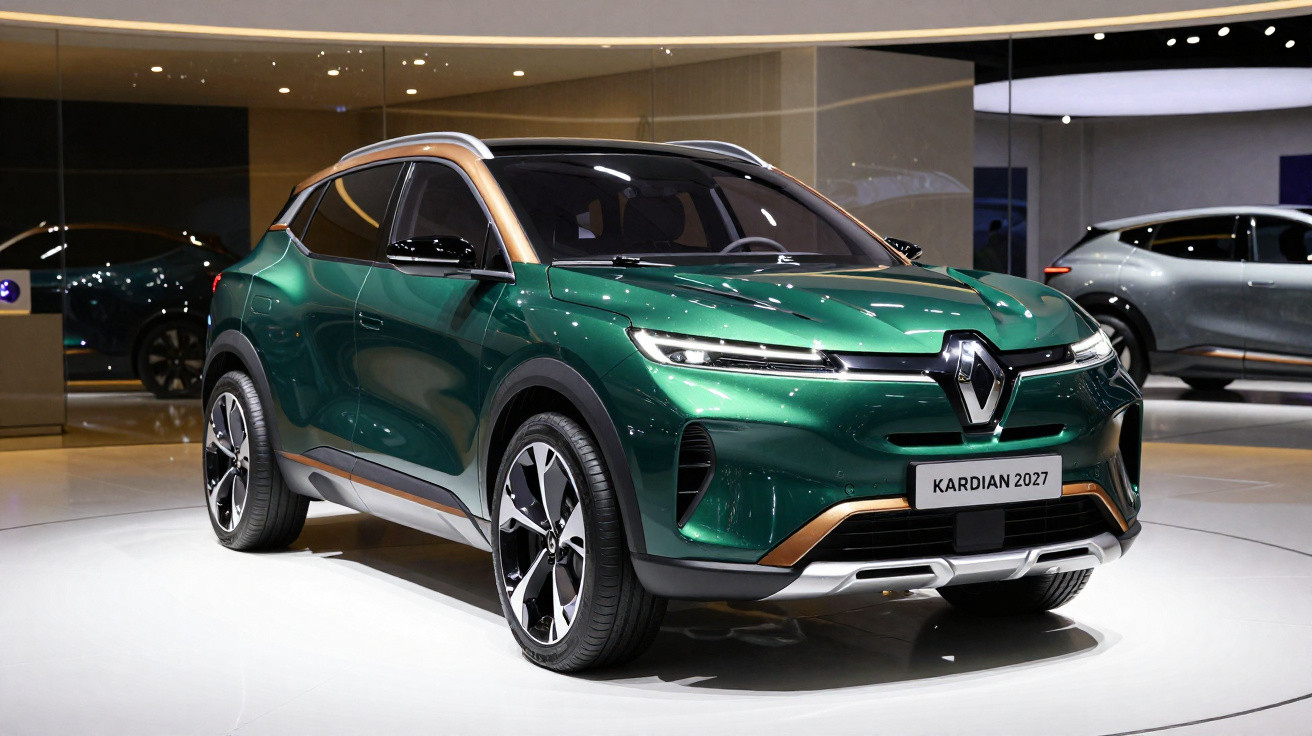
Renault has just set out its international growth plan (outside Europe) running through to 2027. The roadmap includes eight all-new models, with the new Kardian - a compact SUV - set to be the first to spearhead this push.
To underline how seriously Renault is taking the strategy, the company is putting around €3 billion into the programme, on top of the Renaulution plan that is already under way.
At present, Renault sells in 80 countries beyond Europe. These markets account for 43% of the French brand’s worldwide sales - a share that in 2022 equated to 634,124 vehicles.
Renault now wants not only to grow those volumes, but also to lift profitability per vehicle substantially: the target is for profit per unit in 2027 to be twice the 2019 level.
To reach that goal, the manufacturer plans to streamline its platform offering in markets outside Europe and to tighten its model line-up around two new modular architectures.
Eight new models by 2027
Those two next-generation platforms will underpin eight new models for global markets by 2027, with five of them positioned in the C and D segments.
The aforementioned Kardian (the only one Renault has named so far) will sit lower down, in the B segment. Among the remaining two models, at least one will be larger, placed in the E segment (above the Espace).
Renault has not yet shared many specifics about body styles. However, judging by the small silhouettes shown during the strategy presentation, one appears to be a hatchback and five look set to be SUVs.
On top of that, there will also be a light commercial vehicle and a pick-up, which has already been previewed by the Niagara prototype (see the gallery below).
As for powertrains, Renault’s ambition is that by 2027 one in every three cars it sells outside Europe will be either hybrid or fully electric.
Partnership with Geely in South Korea
As mentioned earlier, Renault intends to build this global-model offensive on two fresh platforms. The first comes from a partnership between Renault and Geely focused on South Korea.
This is the well-known CMA (Compact Modular Architecture) platform, already used across several Geely-controlled brands including Volvo, Polestar and Lynk & Co. It underpins models such as the Volvo XC40 and the Polestar 2.
For Renault, CMA will support the rollout of hybrid-powered models, offered with either front-wheel drive or all-wheel drive.
Vehicles based on this platform will be manufactured at the Renault Korea Motors plant in Busan, South Korea.
And the second platform?
The second architecture will be called the Renault Group Modular Platform - and it is the basis of the small Kardian. Renault says it will be highly adaptable, able to accommodate bodies between 4 and 5 metres in length, with three different wheelbase options.
In addition, the platform will be compatible with petrol, LPG, flex fuel (very common in Brazil, for instance), mild-hybrid and full-hybrid powertrains, while also allowing either front-wheel drive or all-wheel drive configurations.
Models using this platform will be built at Renault Group factories in India, Morocco, Turkey and Latin America.

Comments
No comments yet. Be the first to comment!
Leave a Comment