
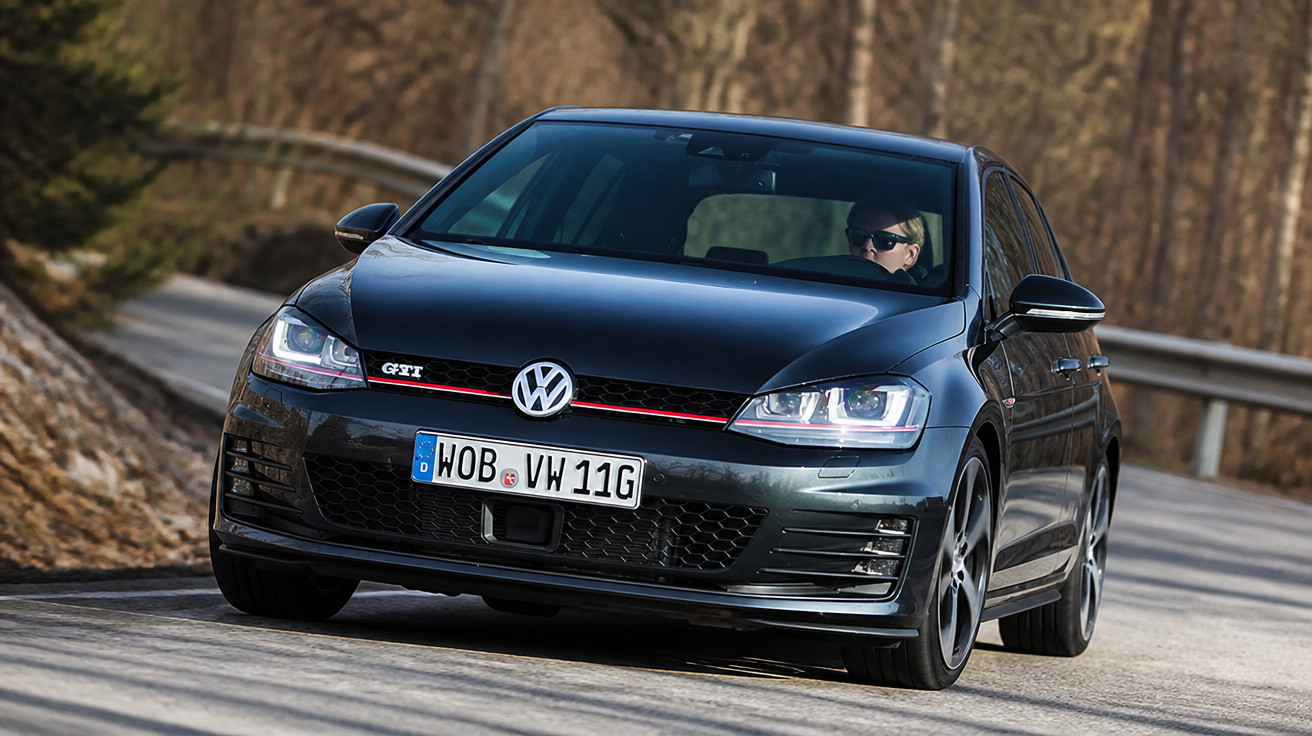
A familiar GTI tale
How much is Volkswagen prepared to gamble with the GTI this time around? From the trailblazing, featherweight original of the 1970s to the rather portly 1990s iteration, the GTI has long been the everyman’s prize-fighter-one that lost its edge, then found a way back. The 2004 Mk5, especially, still stands out as a Top Gear darling: the single car that truly earns that time-worn, almost Confucian line from car journos-“the only car you’ll ever need.” It is. Or at least, it was.
Volkswagen’s official pitch reads: “New Golf GTI: faster, more efficient and cheaper to insure”. Right. Times are tight, but that doesn’t exactly set the pulse racing. A claimed 47.1mpg combined (about 6.0L/100km) and 139 CO2s doesn’t sound like the sort of thing meant to fizz in the lower abdomen-which, surely, is what a GTI ought to do. Still, add £980 to the £25,845 price of the ‘base’ car and you get the Performance pack: roughly 10 extra bhp from the 2.0-litre turbo four (taking it to 229), larger brakes, and-most importantly-a smart new limited-slip differential. Suddenly, things start to tingle.
Click here for more pictures of the new Golf GTI
Volkswagen Golf GTI: Performance pack and the limited-slip differential
Volkswagen has brought us to a private race circuit in the south of France for a closed-door appraisal, and the company is taking its new diff so seriously that the number of engineers present to explain it seems to exceed the number of journalists available to listen. “The Golf GTI is a car that everyone, regardless of their ability, should be able to drive to maybe 90 per cent of its maximum within a few minutes,” says Karsten Schebsdat, manager of passenger car chassis tuning. A blizzard of graphs, wavy lines and talk of slip angles makes a strong case that the car is designed to endure plenty of punishment. “We did a slalom test in the GTI at 140mph, and as you can see there are no sharp curves on the graph,” Karsten adds. A slalom at 140mph (about 225km/h)? He can keep that job.
The differential itself is an electro-hydraulic unit capable of locking to 100 per cent, built around a multi-plate coupling-50 per cent of the Haldex system Volkswagen has been using for years-mounted on the diff housing and the right-hand driveshaft. The objective is straightforward: less steering input, cleaner accuracy, higher cornering speed, and exit pace that feels like a sling-shot.
On track: speed, calmness and front-axle wizardry
Time to find out. The layout starts with a long, quick straight that is sensibly broken up by a chicane marked with cones, before feeding into a long-ish right-hander. One glance tells you what it is: understeer central. The sort of corner that chews tyres, lasts longer than an entire run of 24, and leaves whoever’s driving dissolving into frustrated tears.
Even the run-up reveals the Golf’s general personality. It glides along-silky, composed-and it’s certainly brisk, but without any sort of punch in the crotch. Thread the chicane at 90mph (roughly 145km/h) and the steering only asks for a brief wrist-flick. Brake with a bit of restraint and, as you peel down through the gears, the exhaust surprises with a gruff rasp before you turn in. The responses are neat, predictable and linear-and, yes, whisper it: slightly dull…
Halfway through the bend, though, you can simply pin the throttle and then mentally queue up all eight seasons of 24 while the front axle performs its torque-shuffling trickery to drag you around. It’s impressively effective, but it needs full commitment before it really does its thing. The GTI has never been famous for a particularly lively rear end, and now the slip angles are harder than ever to sense. Even if you drive like an idiot, the Golf still clings on. I’m partial to a bit of movement from the back, but that’s clearly out of fashion. Because it operates so smoothly, the chassis set-up encourages a driving style that is undeniably efficient-yet also rather distant. Still, fit the clever diff and the GTI is eight seconds quicker around the Nordschleife than a GTI without it. Perhaps the computers have triumphed; they’re just not the most entertaining company.
Modes, ride quality and real-world pace
Every GTI gets Driver Profile Selection (DPS), letting you alter steering ‘feel’, throttle response and-if you’ve specified it-DSG shift times. To take charge of suspension and damping you’ll need to add Adaptive Chassis Control, at a further £795.
On rough, patchy French country tarmac, I ran Sport for everything except the suspension. With the 18in wheels, the Normal setting already feels firm enough, and I’d bet it’ll be the same in the UK. (There are 19in wheels available, but I wouldn’t bother.)
In Performance specification, the GTI runs 0-62mph in 6.4 seconds (around 0–100km/h) and tops out at 155mph (about 250km/h). That’s plenty for most sensible people-and a fair few who aren’t. It covers ground with more subtlety than a Focus ST, Megane Sport, Astra VXR or the fantastically capable BMW 135i, and it manages crests and sudden direction changes with genuine ease. The brakes deserve praise as well.
Which raises the question: has the GTI become too polished for its own benefit? Possibly. It’s designed to make the average driver look good-clearly the intention-but it doesn’t quite burn with enough hunger.
Click here for more pictures of the new Golf GTI
Interior, styling cues and options
And yet, it remains a Volkswagen Golf GTI. However hard rivals try, nobody else quite puts together this sort of car the way Volkswagen does. The understated red grille stripe introduced on the Mk5 has now spread everywhere: it features in the bi-xenon headlights, on the brake callipers, and on a neat little GTI wing badge. As always, it looks robust and well made-sharper of line in this latest shape, but still defined by its big wheels, chunky C-pillars and satisfyingly tight shut lines.
The red theme continues inside: along the door sills, across the Alcantara seat centres, on the door armrests, and-naturally-in the longstanding tartan ‘Jacara’ upholstery. You also get a thick, three-spoke flat-bottom steering wheel; a golf-ball gear knob mounted on an oddly supported structure; black roof lining; and red ambient lighting.
The touch-screen multimedia set-up is also class-leading. DAB comes as standard, and the sat-nav functions-if you’ve specced them-uncannily appear as your hand approaches the display.
The infotainment system is excellent, though it’s optional. Other extras include larger 19in ‘Santiago’ alloys (standard wheels are called ‘Austin’, for no obvious reason), leather trim, the adaptive chassis, Park Assist (absurd, yet it does work-although if you can’t bloody park properly you’re either a) irredeemably lazy or b) unlikely to be shopping for a Golf GTI), and a Dynaudio audio upgrade with a 10-channel amplifier and eight speakers.
Pricing starts at £25,845 for the 219bhp three-door, and climbs to £28,895 for the 229bhp five-door with DSG-uncomfortably close to the BMW 135i’s £29,950. As you’d expect, the GTI brings state-of-the-art active and passive safety kit, and it has never been more rationally tempting.
But. There’s a faint sense of stiffness to it. Volkswagen hasn’t taken the risk quite far enough. It’s an excellent car, and you won’t ever regret buying one. The new GTI, then: the hot-hatch equivalent of a good accountant.

Comments
No comments yet. Be the first to comment!
Leave a Comment