
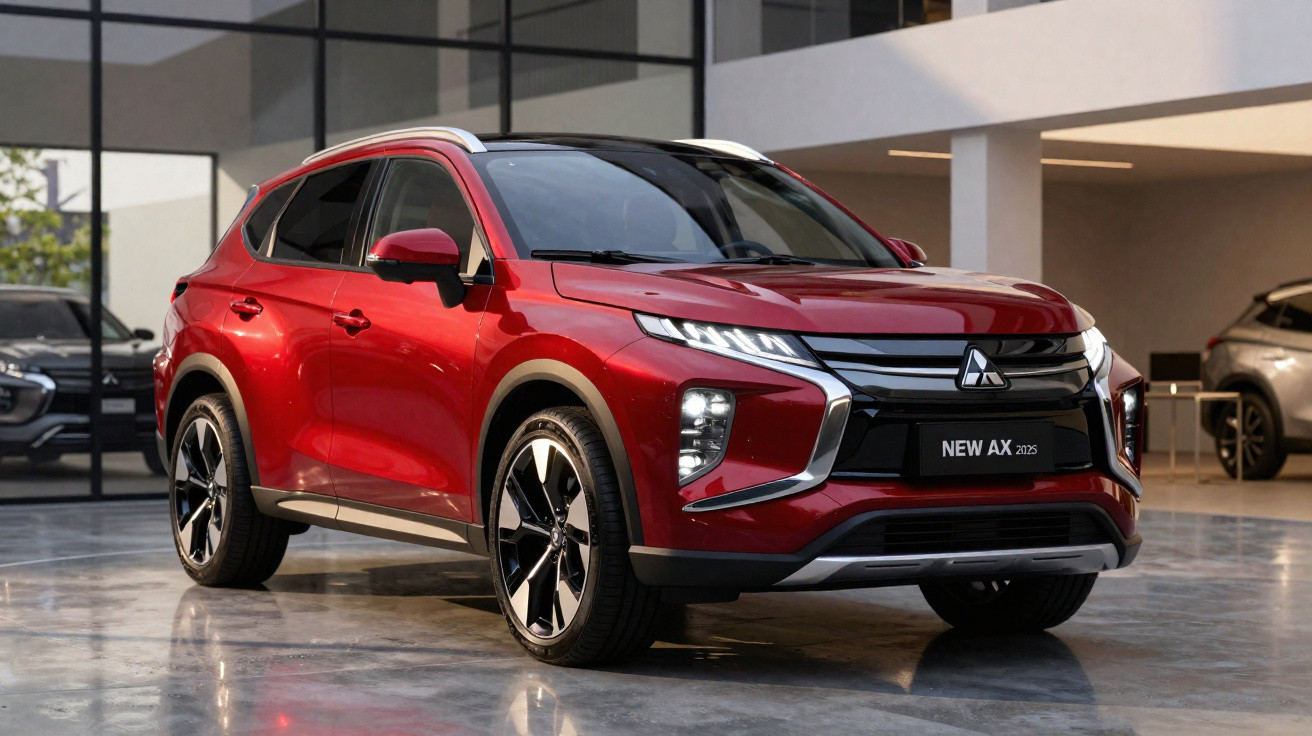
Mitsubishi has just unveiled the next generation of the ASX, a B-SUV that shares its platform (much of its engine line-up and the overall styling) with the Renault Captur and is due to reach Europe in 2023.
After selling around 400,000 units in Europe since its original launch, the ASX has at last been renewed and is now set to become a key model in the Japanese brand’s European range.
Its close links with the Renault Captur are hard to miss from the outside, and they extend to the underpinnings too: the Renault–Nissan–Mitsubishi Alliance CMF-B platform. This has brought clear gains in connectivity, safety and even powertrains-where the strong focus on electrification stands out.
ASX, you look familiar…
Starting with the design, as mentioned above it has plenty in common with the Renault Captur. In fact, almost everything is the same, except for the front end-shaped by Mitsubishi’s signature Dynamic Shield identity-along with the badge up front and the “Mitsubishi” lettering on the tailgate.
From the side, it is genuinely difficult not to mistake this new ASX for the French SUV, as even the alloy wheel designs are shared between the two. Naturally, Mitsubishi’s three-diamond emblem sits prominently in the centre of the wheels, which come in two sizes: 17” and 18”.
Digital, connected cabin
Inside, the overall layout also feels instantly familiar, with the obvious exception of the Japanese manufacturer’s logo placed in the middle of the steering wheel.
Highlights include a 10” digital instrument display (though there are more basic alternatives: an analogue cluster with a 4.2” screen, and a 7” digital cluster), a 9.3” central infotainment screen (with a smaller 7” option), and the many storage areas that we previously praised on the Captur.
On top of that-and as you would expect-the new Mitsubishi scores highly for connectivity. Alongside multiple USB ports, it offers wireless Android Auto and Apple CarPlay compatibility, and can be specified with a Bose sound system and 3D navigation.
As for the boot, Mitsubishi quotes 332 litres of luggage capacity, increasing to 401 litres with the sliding rear seats moved to their most forward position.
Engines for (almost) every taste
When it comes to powertrains-first previewed by the three-diamond brand around four months ago-the strong electrification push is confirmed, with the ASX offered with both a hybrid and a plug-in hybrid option.
However, the entry point to the range will be a 1.0-litre, three-cylinder turbo petrol engine called the 1.0L MPI-T, producing 91 hp and 160 Nm, paired with a six-speed manual gearbox.
One step up is a 1.3-litre, four-cylinder turbo unit known as the 1.3 L DI-T, available in two outputs: 140 hp and 260 Nm (six-speed manual) and 158 hp and 270 Nm (a 7DCT dual-clutch transmission). In both cases, this four-cylinder engine is combined with a 12 V mild-hybrid system.
The main focus for this B-SUV-built at Renault’s Valladolid plant in Spain, alongside the Captur-will be its hybrid versions. Indeed, it becomes the first Mitsubishi model in Europe to feature a conventional hybrid (HEV) powertrain, meaning there is no need to plug in to recharge the battery.
This is the same set-up used in the Renault Clio-which we have already had the chance to test-pairing a naturally aspirated 1.6-litre combustion engine with two electric motors powered by a 1.3 kWh battery. This allows the ASX to drive in 100% electric mode in specific situations.
The outcome of this combination is a maximum total output of 145 hp and a maximum combined torque figure of 148 Nm.
160 hp plug-in hybrid
The ASX will also be offered with a plug-in hybrid (PHEV) powertrain, using the same system found in the Renault Captur E-Tech, which we have also tested.
This version still uses the same 1.6-litre engine as the HEV model, as well as the same two electric motors, although here the battery is significantly larger at 10.5 kWh, and the maximum combined output rises to 160 hp and 144 Nm. The 100% electric driving range has not been announced, but it should be around 50 kilometres.
As expected, the new Mitsubishi ASX will not be offered with any diesel engine, and there are no plans for a fully electric variant either.
A broad range of driver assistance systems
The new ASX can be specified with a long list of Advanced Driver Assistance Systems (ADAS). All versions come as standard with Front Collision Mitigation with Pedestrian Protection, Distance Warning, Lane Departure Warning, Lane Keep Assist, Traffic Sign Recognition, Cruise Control, Parking Sensors and a Rear Camera.
Higher-spec versions additionally offer Blind Spot Warning, Lane Centring Assist, Overspeed Prevention, Adaptive Cruise Control (with deceleration and acceleration resume), and Automatic High Beam activation.
On HEV and PHEV versions with an automatic gearbox and higher equipment levels, the ASX includes the MI-PILOT (Mitsubishi Intelligent – PILOT) system, which combines Adaptive Cruise Control with Lane Centring Assist.
When does it arrive?
The new Mitsubishi ASX will arrive in Portugal in March 2023, with all powertrains available from launch.
Prices for the national market are not yet known, but Mitsubishi has confirmed that the ASX will come with a standard warranty of 5 years or 100,000 kilometres.
Comments
No comments yet. Be the first to comment!
Leave a Comment