
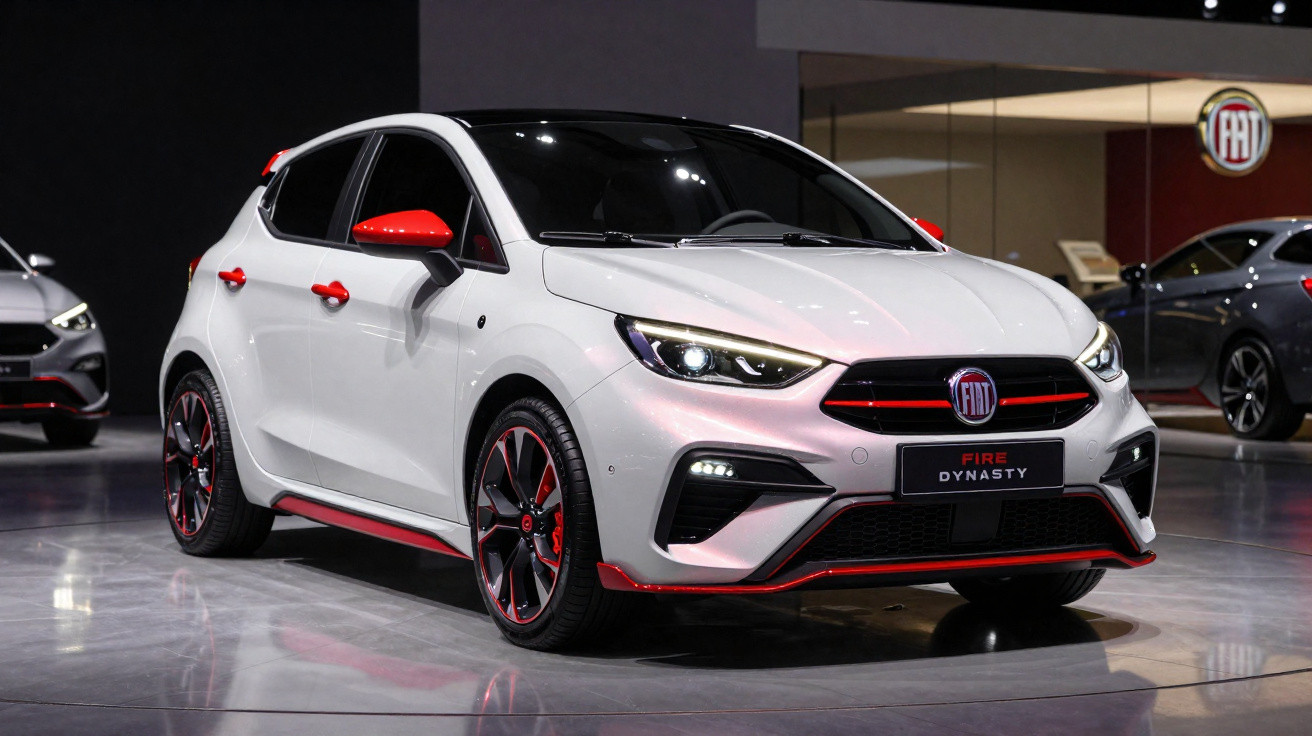
The history of the car industry is packed with forgotten “heroes”. That’s hardly surprising: most of the time, only the noblest engines - the ones with the most jaw-dropping figures - ever make it to the “Engine Olympus”.
It isn’t fair, and today we’re going to push back against that idea. This Automotive Reason Autopaedia article is devoted entirely to a small “super engine” - or, if you prefer, to an engine dynasty that held its ground for decades.
We’re talking, of course, about FIAT’s FIRE engines.
In the next lines, we’ll show why this engine family, born in the 1980s - and produced for more than 30 years - deserves recognition as one of the best ever.
It’s a trip back in time, written in the very week European institutions chose to sign the death warrant for combustion engines. From us… long live combustion engines.
FIRE engine. An over-ambitious brief
In March 1985, after almost five years of intense, uninterrupted development work in Mirafiori (Turin), the FIRE engine finally reached the public for the first time.
The model selected to launch this new engine was the Lancia Y10.
Back then, the specification sheet for this project was demanding - not to say outrageously ambitious.
It had to be at least as reliable as the engine it was replacing (the FIAT 903), it needed to use less fuel, deliver better performance, and last for at least 30 years - yes, there was a time when engines were designed to last “a lifetime”.
And that wasn’t the end of the requirements. Beyond all that, it also needed to be cheaper and quicker to build.
As if that still weren’t enough, FIAT’s management added another hurdle: the brand’s engineers had to pull it all off without sacrificing the final build quality.
Later on, we’ll see how FIAT’s engineers managed to achieve that target.
A contagious success
It almost goes without saying that the Italians succeeded, against all expectations - otherwise, you wouldn’t be reading this Autopaedia entry today. So, after the small Lancia Y10, the FIRE engine quickly appeared in the Fiat Uno as well.
And once it started spreading across Fiat Group products, it never really stopped: Panda, Tipo, Punto, and so on - name them. You could find FIRE engines in virtually every FIAT model.
Overnight, this engine family became one of the core pillars of the FIAT Group brands. In plain English, they were a real “do-it-all workhorse”.
Still, rather than dwelling on the well-known end result, it’s worth revisiting the middle chapters of this story - the parts that left competitors seriously rethinking their plans.
Cutting-edge technology in FIAT’s service
The FIRE acronym may look simple, but it stood for something genuinely new: Fully Integrated Robotized Engine.
For the first time in automotive engineering history, an engine was largely developed in a digital environment, using computer programs based on finite element design.
With these finite element design tools - which made it possible to simulate stress and material strength - FIAT’s engineers could push mechanical component development further than ever before.
The first engine in the FIRE family had one litre of capacity and four cylinders in line.
It was the results obtained from computer simulation that allowed the team to design an engine block with wall thickness of only 4 mm.
That choice had major consequences for the finished product. Even though the block was made of cast iron, it weighed just 18 kg. Fully assembled and ready to run, the complete engine came in at only 69 kg. At the time, only Suzuki could beat that figure, with a three-cylinder block weighing 63 kg.
As well as being light, the FIRE engine was also simpler. It consisted of just 273 components, which greatly strengthened its mechanical reliability.
When it first arrived, the FIRE’s power figures didn’t look remarkable - at least at first glance. We’re talking about a modest 45 cv, exactly the same output as the FIAT 903 engine FIAT intended to replace.
Even so, FIAT wanted more from the outset, and during development the brand prepared this block for bigger ambitions, as you can see in this image.
In its final production form, the power may not have been headline-grabbing - that’s true. But the torque produced by the FIRE Mille was far stronger than its predecessor: 80,5 Nm versus 67 Nm.
Computers didn’t just reshape how the FIRE engine was designed. Manufacturing itself became largely computer-controlled too, thanks to robotic assembly lines - something truly groundbreaking in the 1980s.
After Henry Ford’s contribution, this represented one of the biggest leaps in the history of car production.
From that point on, nothing was quite the same. Robots enabled manufacturing that was faster, more consistent, and cheaper.
With all these production advances, FIAT was able to take a 43 kg steel billet and produce the following components: the engine block, crankshaft, camshaft, connecting rods and valves.
Do the maths: at peak FIRE production, FIAT could turn out 3000 units per day - running 12-hour shifts.
That means a new engine every 20 seconds.
You might assume that kind of pace would harm quality, but FIAT planned for that. Using laser technology, it became possible to check every production parameter with precision.
The end result of this investment was revolutionary technology, embodied in an engine that was simple, affordable, reliable and efficient. Perhaps more importantly, it transformed the way engines were manufactured.
We can say that today there’s a little bit of FIRE technology in every engine we know.
Spending big to save even more
If there was one area where FIAT didn’t hold back, it was in developing FIRE technology - which, as we’ve just seen, went beyond the engine itself and reshaped production.
FIAT validated every solution it created at one of the most advanced facilities of the era: the Fiat Auto Laboratories in Turin (Mirafiori).
Even the FIRE Mille intake manifold showcased the manufacturing progress FIAT was bringing to the automotive sector.
For the first time in a mass-production engine, the Policast casting system was used, employing a disposable expanded polystyrene mould.
The automation and production optimisation introduced with FIRE technology cut manufacturing times in half, using the FIAT 903 - the FIRE Mille’s predecessor - as the benchmark.
FIAT Group and PSA Peugeot Citroën. A long-standing courtship
What many people don’t realise - documentation is limited - is that this revolutionary technology initially had support from PSA Peugeot Citroën.
Under an agreement signed between the FIAT Group and PSA Peugeot Citroën at the end of the 1970s, Italians and French worked together on the development of various solutions, including FIRE technology.
For reasons that remain unclear - perhaps someone in our reader community can shed light on it - PSA Peugeot Citroën chose to walk away from this technology, and never fitted this new engine family to any of its models.
Or was it FIAT that kept the benefits of this investment for itself?
The two groups “moved in together” on several occasions, whether in the development and production of commercial vehicles (Fiat Ducato, Peugeot Boxer, etc.) or in their entry into the MPV segment (Citroën Evasion, Fiat Ulysse, etc.). Even so, it took almost 40 years before the relationship became truly serious.
As we know today, the FIAT Group (ex-FCA) and the PSA Group are now joined under Stellantis, led by the Portuguese executive Carlos Tavares.
FIRE engines: a long FIAT dynasty
Despite the reputation - often unfair - for unreliability that was linked to Italian engineering for years, FIRE engines proved themselves and won over a loyal following.
The biggest and toughest test was time. First launched in 1985, FIRE engines have lasted right up to the present day, surviving every change the car industry has gone through since.
Even now, you can still find FIRE engines in the Abarth range, in the form of 1.4-litre Turbo units, with outputs above 180 cv in the most powerful versions - a world away from the original 45 cv that opened this technology’s story.
That’s why - for what they meant technologically, for the millions of cars they powered, and for the many stories that so many of you surely have behind the wheel of FIRE-powered models - we have no doubt the FIRE engine has earned a special place in the “Engine Olympus”.
We know full well it’s a modest engine. But even the biggest war can’t be won without “foot soldiers”. So today we’re recognising this pioneering engine, which you can still find in various models running on our roads.
It’s also an engine that helped write one of the earliest chapters of a courtship that has now become a marriage: the Stellantis Group.
Off-topic: still here?
If you’ve made it this far, there are only two possibilities: either you genuinely love cars, or you’ve got a lot of free time. Thanks for being with us.
If the answer is “yes” to both, then you really should head over to Automotive Reason on YouTube and subscribe to our channel. There’s plenty of exclusive content waiting for you:
Your shares and subscriptions help Automotive Reason continue producing special content, in English, for free.
Deal? Then share it. That’s the best compliment you can give our team.

Comments
No comments yet. Be the first to comment!
Leave a Comment