
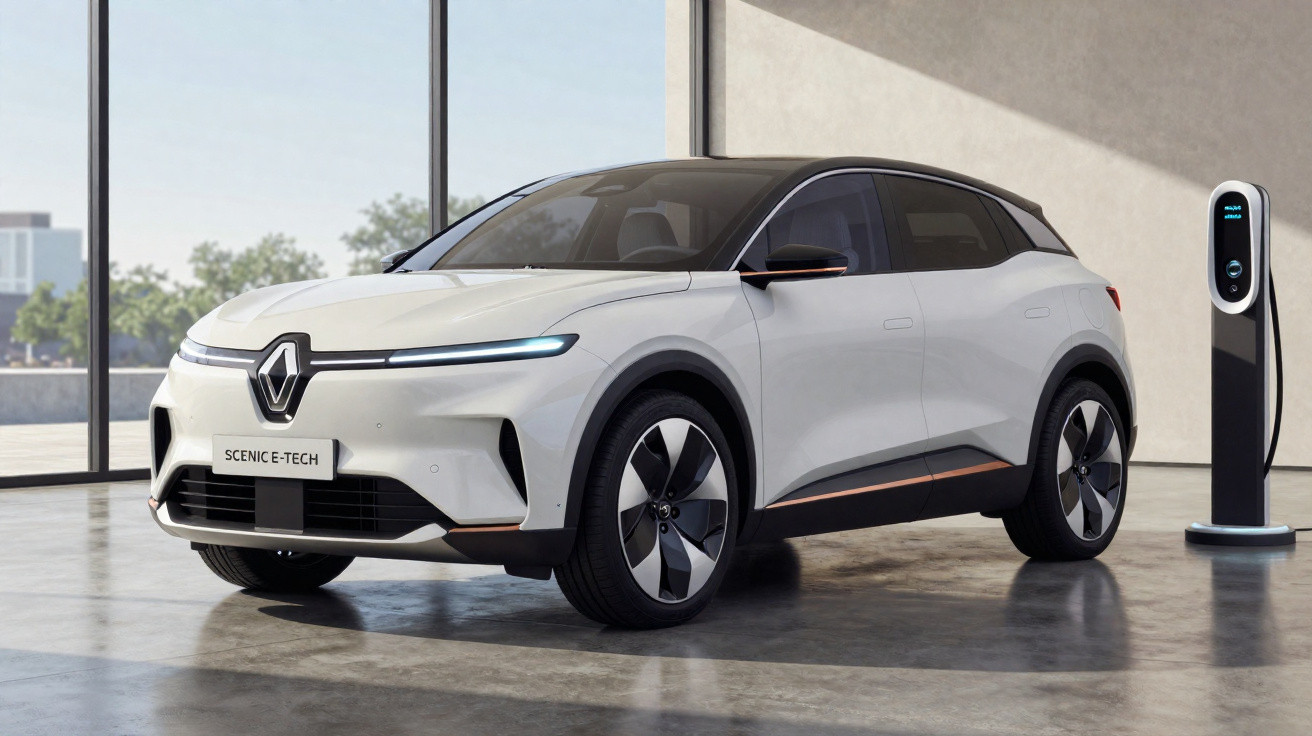
After the Mégane E-Tech, it is now the Renault Scénic that undergoes a genuine transformation, positioning itself as the spearhead of the French brand’s new generation of electric models.
We travelled to Paris, France, to see it first-hand at an event that previewed this model’s public debut at the Munich Motor Show in Germany.
27 years on, the revolution
Introduced in 1996, the Renault Scénic reshaped the European market at the time by becoming Europe’s first compact MPV. It quickly established itself as an obvious choice for many families and went on to secure its place as one of the most important names in Renault’s range.
That story then spanned 27 years and more than five million units sold, until market realities demanded a change of direction.
As had already happened with another historic Renault model, the Espace, the Scénic has swapped its MPV proportions for a crossover body style. What is more, it has abandoned combustion engines entirely to become an exclusively electric offering.
Even so, this shift in format has not come at the expense of the space, comfort and versatility that long ago made the Scénic name synonymous with a “family car”.
27 cm longer than the Mégane E-Tech Electric
Sitting right in the “heart” of the C-segment, the new Renault Scénic E-Tech is positioned a step above the Mégane E-Tech Electric-something that becomes obvious the moment you look at its footprint.
At 4.47 m long, the Scénic E-Tech is 27 cm longer than the Mégane E-Tech Electric, and its wheelbase is 10 cm longer (2.78 m). On top of that, the Scénic is also around 10 cm wider.
Despite the differences in width and length, the two models are similar in height. That is explained by aerodynamics being a central concern during the design process, with the aim of maximising efficiency and driving range.
In the style of Gilles Vidal
The new Scénic E-Tech adopts Renault’s latest visual language, introduced by Gilles Vidal, and features details that immediately bring to mind the refreshed Clio and the new Rafale-particularly in the front lighting signature.
What arguably stands out most is the front grille, which uses a diamond motif-Renault’s logo-that subtly changes as it moves towards the edges. Seeing this solution up close in person, I can say I really liked the visual effect it creates.
Also worth highlighting are the sharp creases and the very precisely defined surfaces of this model-something previously hinted at by the Scénic Vision, a concept shown in 2022 that previewed many of the styling cues now present on the production car.
From the side, beyond the flush door handles and the 20-inch wheels on the Esprit Alpine version (19-inch wheels are also available), which underline the focus on aerodynamics, the most noticeable feature is the low roofline. It finishes with a prominent spoiler that helps emphasise the dynamic look of this model’s silhouette.
At the rear there are two separated tail-lights-buckling the trend for a full-width LED light bar-with an “arrow” design. This choice helps visually widen the Scénic. The robust-looking bumpers also deserve a mention.
Technology built around the user experience
Moving inside, it is clear there are plenty of familiar elements, already seen in other recent Renault offerings such as the Mégane E-Tech, the Austral and, more recently, the Espace.
That is most evident in the centre console and dashboard, where Renault’s OpenR Link system sits. It combines a 12.3-inch digital instrument cluster with a 12-inch vertical central screen.
Once again, there is a Google-based operating system, notable for delivering an experience very close to an Android smartphone/tablet. It also includes, natively, many of the apps we use day to day: Waze, Google Maps and Spotify, among others.
As you would expect, the system supports smartphone integration via Android Auto and Apple CarPlay, either wired or wirelessly. The choice is up to the user.
I have said it-and written it-more than once: this is one of the best infotainment systems you can buy today. And in the brief time I spent with the Scénic, nothing gave me reason to change that view.
As roomy as the Scénic name demands
Even so, what surprised me most was the amount of space on board. Not so much up front, because I was expecting that (it is already the case in the Mégane), but rather in the rear seats, which are particularly generous.
You can seat three average-height adults in the back, although the middle seat is a little higher and firmer. The knee room (278 mm) impressed me most: with the driver’s seat set for my height (183 cm), I could sit very comfortably in the rear.
Headroom also scores highly, especially in cars fitted with the optional Solarbay opening roof. It uses liquid crystal technology and, at the touch of a button (or by asking the voice assistant), you can switch the roof from transparent to opaque.
Besides being lighter than a conventional blind, this solution is far more practical and faster; in a matter of seconds it can completely change the light inside the cabin. It also has the advantage of being adjustable in sections: the front can be transparent while the rear is opaque, and vice versa.
According to Renault, this setup delivers an extra 30 mm of headroom compared with a car not equipped with Solarbay.
As for the boot, the Scénic offers 545 litres of capacity, a benchmark figure in the segment. With the rear seats folded, that grows to 1670 litres.
Seats made from recycled plastic bottles
On average, the ferrous components of the new Scénic E-Tech are made up of 37% recycled materials, while the bonnet and doors are produced using up to 80% recycled aluminium.
But the environmental focus does not stop there. Only 50% of the roof glass is manufactured from primary raw materials, and there is no animal leather of any kind on board.
With the steering wheel, for instance, 51% of the covering is bio-based; the cockpit uses 26% recycled plastic; and the floor mats are made from 54% used plastic bottles.
The seat upholstery is 100% recycled fabric, while the trim in Esprit Alpine versions uses fabric made from recycled plastic bottles (80%) and recycled seatbelts (20%).
Up to 620 km of range
Built on the CMF-EV platform (the same one used by the Mégane E-Tech Electric and the Nissan Ariya), the new Scénic E-Tech is offered with two motors (it does not use rare earths) and two distinct versions:
- 125 kW motor (170 hp) and 280 Nm, 60 kWh battery, up to 420 km range, 0–100 km/h in 9.3s, 150 km/h top speed;
- 160 kW motor (220 hp) and 300 Nm, 87 kWh battery, up to 620 km range, 0–100 km/h in 8.4s, 170 km/h top speed.
Despite their different capacities, both battery packs (supplied by LG Chem) use a metal casing that takes up the same volume. The differences come down to energy density (higher on the 87 kWh version) and the height of the modules, which is slightly lower on the 60 kWh version.
Each battery contains 12 modules and, in the event of a fault, they can be replaced individually. That simplifies repairs and helps keep costs lower.
As with the Mégane E-Tech, when you plan journeys in Google Maps you can rely on battery pre-conditioning as you approach charging stops selected in the app, so the battery reaches the ideal temperature (25 °C) and can deliver an improved charging curve.
Unfortunately, and according to what Renault representatives explained during the presentation, battery pre-conditioning will only work with Google Maps. With services such as Waze, for example, it will not be possible.
When does it arrive?
The new Renault Scénic E-Tech will only reach the Portuguese market at the start of 2024, so pricing for Portugal is not yet known.
However, orders should open well before then, with the 60 kWh and 87 kWh versions being sold side by side from launch.


Comments
No comments yet. Be the first to comment!
Leave a Comment