
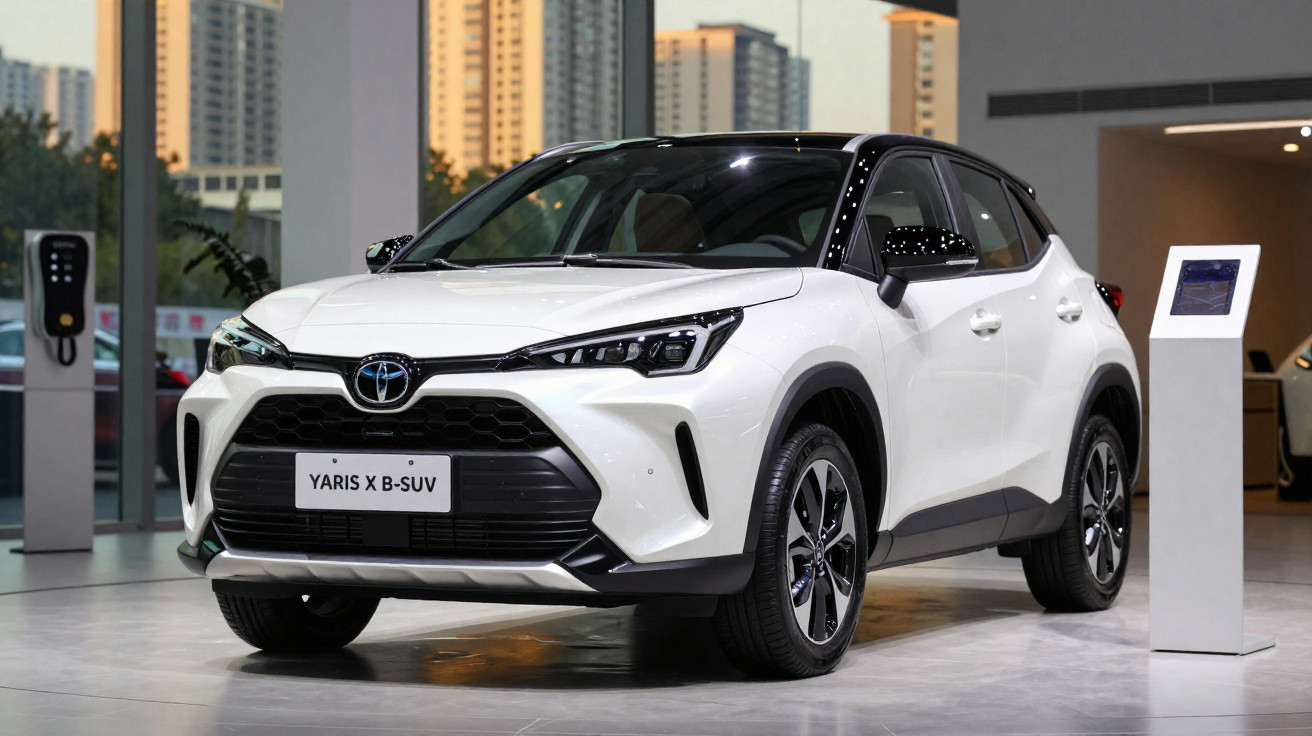
Sitting below the C-HR in the range, the Toyota Yaris Cross is the Japanese brand’s entry into one of Europe’s fastest-growing categories in recent years: the B-SUV segment.
In some ways it is a slightly late move - which is notable, given Toyota helped to blaze the trail for this type of vehicle. Back in the 1990s it introduced the first RAV4 (yes, it began life as a small SUV), and in 2009 it launched the “forgotten” Urban Cruiser, a year before the Nissan Juke - the B-SUV that went on to define the segment.
With that extra time to get the Yaris Cross ready, does Toyota’s new contender have what it takes to challenge the class benchmarks? To find out, we put it to the test.
More than just a “Yaris on stilts”
Although it shares its name with the successful supermini, the Yaris Cross manages to stand out with an identity of its own - especially in the two-tone gold and black paintwork of the test car, which I find particularly appealing (in my opinion, of course). Also worth highlighting is its ground clearance (160 mm), which gives it a notably adventurous stance.
Cabin layout, storage and infotainment
Inside, the dashboard is effectively identical to the Yaris’s, with robustness and plenty of storage spaces taking centre stage. It is also a plus that Toyota has kept physical controls for the climate system, along with shortcut buttons for its latest infotainment system. Even though it works better than what we have seen in other Toyota models, it could still be more responsive.
Up to this point, the Yaris Cross feels broadly on par with its rivals - both in terms of equipment provision and in the perceived sturdiness and materials used (mostly hard plastics). Where it cannot say the same is in cabin space.
Despite the increase in overall dimensions compared with the Yaris translating into more interior room, the Yaris Cross feels tighter in the rear seats than its competitors. That is not helped by the limited door opening angle, which also makes fitting child seats in the back more awkward.
Speaking of the rear seats, while they are comfortable, their head restraints are fixed and tall, which ends up harming rearward visibility.
At the back, however, the Yaris Cross makes up ground: the boot offers 397 litres of capacity - a very strong figure. Its versatility also deserves mention, with a two-piece adjustable boot floor that allows you to lower only one side of the load area.
Toyota’s “new normal”
Increasingly focused on building cars that are “not boring” - as Akio Toyoda, Toyota’s President, has regularly repeated - Toyota has succeeded in making the Yaris Cross one of the more engaging B-SUVs to drive.
The combination of firmer damping (without becoming uncomfortable) and 18-inch wheels with lower-profile tyres gives the Yaris Cross a very capable - and even… fun - feel on the move.
OK, the steering is light and not as polished as the Puma’s, but it is accurate and direct. And the truth is that, dynamically, the Japanese model is not actually that far behind Ford’s offering.
That said, there is no “perfect without a catch”: refinement could be better. The lower-profile tyres are clearly audible, as are wind noises and the sound of the combustion engine - especially at motorway speeds.
The value of experience
1.5 Hybrid drivetrain, performance and smoothness
As for the engine, the 1.5-litre three-cylinder is paired with an electric motor and an e-CVT transmission, creating the hybrid system. It is far from a performance benchmark (nor would you expect it to be with its combined 116 hp), yet it stands out above all for its efficiency and the smoothness of its operation when driving in town.
Seemingly demonstrating Toyota’s experience in the hybrid “world”, this 1.5 Hybrid - already familiar from the Yaris - returned an average of 4.7 l/100 km for me (interestingly, over journeys mostly made up of motorway and main-road driving). In town, my figures sat between 5.5 l/100 km and 5.7 l/100 km.
A large part of that comes down to the fact that, according to Toyota, this engine can run in the city for up to +70% of the time in 100% electric mode. Clearly, I could not track the exact percentage of kilometres covered on electric power alone, but I can say that in urban use I rarely heard the combustion engine.
Compared with rivals - most of which rely purely on combustion engines (sometimes paired with a mild-hybrid system) or even plug-in hybrids - the Yaris Cross positions itself as a “middle-ground solution”, and that is not meant negatively.
This hybrid set-up delivers genuine savings without “demanding” frequent battery charging, as tends to be the case with plug-in hybrids.
Is it the right car for you?
Toyota took its time to dive fully into the B-SUV segment, but when it did, it applied all of its SUV know-how to its smallest model.
Even though it is not the roomiest option in the class, the Toyota Yaris Cross makes up for that with a powertrain that turns it into one of the more appealing choices for drivers who spend most of their time in town.
Away from urban use, this Japanese SUV does not disappoint either - it is only “let down” by its sound insulation, particularly the engine at higher revs. Still, once you glance at the trip computer and see the fuel consumption recorded, that detail quickly fades into the background.


Comments
No comments yet. Be the first to comment!
Leave a Comment