
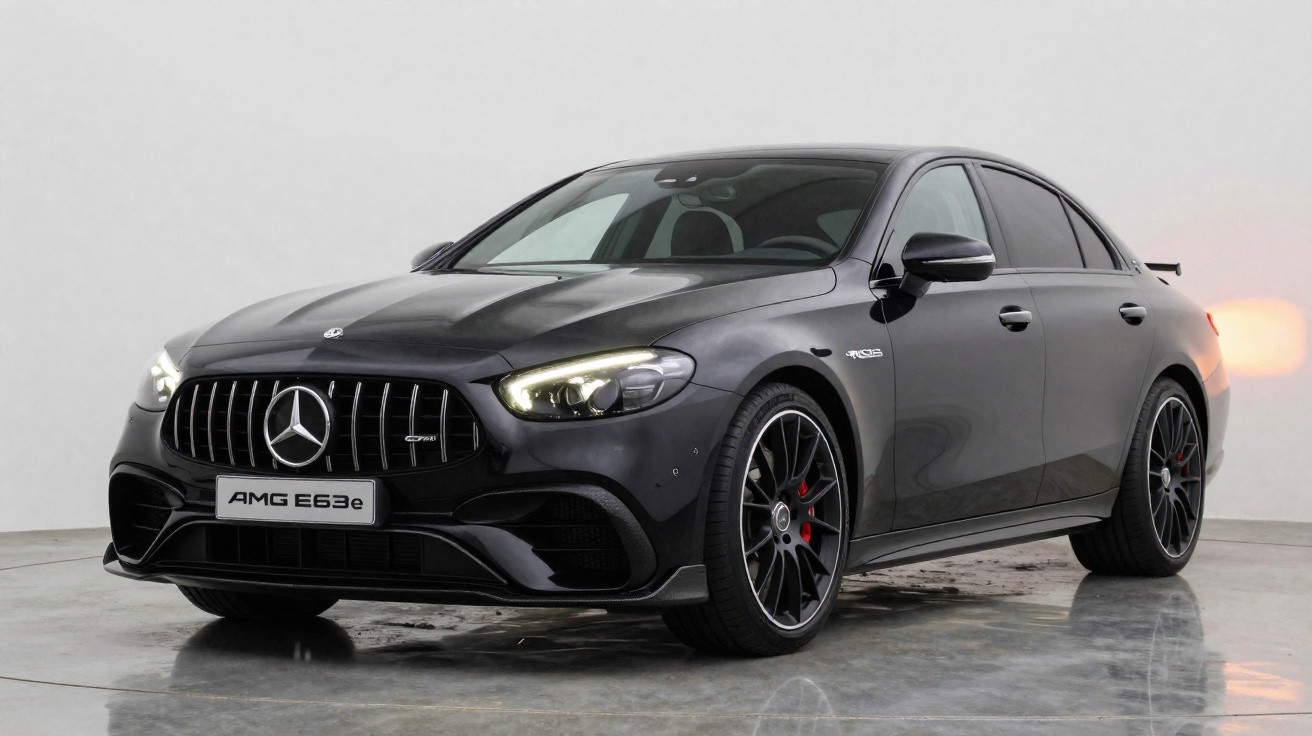
The Mercedes-AMG E 63 continues to use the 4.0 V8 biturbo engine with unchanged peak figures: 571 hp and 750 Nm, or 612 hp and 850 Nm in the Mercedes-AMG E 63 S. Even so, official consumption has edged down slightly from 12.0/12.1 to 11.6 l/100 km (with emissions dropping from 272 g/km to 265 g/km, and from 273 g/km to 267 g/km, respectively).
Even among AMG, M or RS models, the current direction is to hold on to maximum engine output while shifting the spotlight towards cutting emissions, however small the gains may be. The reason is the threat of extremely heavy penalties for environmental breaches - every extra g/km of CO2 from the exhaust above the regulated limit will come at a high price.
The headline performance figures, however, remain intact: 3.4 s from 0 to 100 km/h and 300 km/h top speed for the fastest versions.
Optimised airflow
As before, when driving in “Comfort” mode, half of the cylinders shut down under low or no throttle load and at engine speeds between 1000 and 3250 rpm. That means the minor reduction in consumption is better explained by bodywork aerodynamic tweaks that have lowered drag.
There is now a discreet gloss-black flap integrated across the full width of the front apron, extending to the outer edge of the so-called “jet-wing” - the element that splits the lower section of the bumper into three functional air intakes - before curving outwards and towards the sides.
The wheel arches also look more assertive, having grown by 2.7 cm to accommodate the wider tracks and larger front-axle wheels.
At the rear, a redesigned apron helps visually set this new generation apart while also contributing to improved aerodynamics. The lower section carries the same gloss-black finish seen at the front, and it is also used on the new rear diffuser, which incorporates two longitudinal aerodynamic profiles.
Difference in the details… and more
On the saloon, the more horizontal rear lights are immediately noticeable, extending into the boot lid where they are visually linked by a bright chrome strip along the upper area - a strip that is even larger on the estate.
These are the sort of changes that may only stand out to the most attentive (and knowledgeable) eyes, unlike the new and larger front air intake. Above it sits the AMG-specific radiator grille with twelve vertical slats and the star (now larger as well) positioned in the centre.
The more purposeful overall stance is rounded off by lower-set front headlamps and a more domed bonnet with power bulges that hint at the muscle beneath, ready to be unleashed.
Enhanced appearance
Further individual accents can be specified via the optional AMG Night Package, made up of several gloss-black inserts.
The AMG Carbon Fibre Exterior Package I, available exclusively on the 63 Series models, adds a front lip and carbon-fibre inserts at the front and rear. Meanwhile, Carbon Fibre Exterior Package II turns up the drama with carbon-fibre mirror caps and a carbon-fibre spoiler on the boot lid (on the saloon).
The steering wheel is the key interior update
The cabin remains every bit as charged, with leather, aluminium and carbon fibre to the fore, plus seats with pronounced side bolstering and integral head restraints, particularly in the top versions.
The familiar MBUX infotainment system is present, combining a touchscreen and touchpad, along with voice control and a wide range of AMG-specific menus, graphics and functions. The two side-by-side displays measure 10.25” on the entry version and 12.25” on the E 63 S, while the instruments offer three display styles: “Modern Classic”, “Sport” and “Supersport”. The latter is especially elaborate, featuring a round central rev counter and horizontal graphics shown in perspective to the left and right, creating a spatial impression of depth.
Via the AMG menu, the driver can call up a range of special pages, including engine data, an rpm indicator, a “g” force meter and lap-time recording. The central display also assists by presenting the driving programmes and telemetry data.
And, of course, the main new feature for the driver is the fresh steering wheel: smaller, with twin spokes, trimmed in leather or Dinamica microfibre (or a mix of both). Behind it sit the aluminium paddles for manual control of the nine-speed automatic gearbox; they have been enlarged and positioned slightly lower to improve ergonomics.
The transmission now uses an oil-bathed multi-plate clutch in place of a torque converter - a solution found in supercars because it enables faster gear changes.
Dynamic optimisation
Other advanced hardware - including the engine with dynamic mounts, multi-chamber air suspension (with three spring stiffness settings), active variable damping (also with three levels), an electronic rear limited-slip differential and independent elements controlling each wheel - is vital to ensuring the Mercedes-AMG E 63 can be regarded as an AMG through and through.
The same applies to the sophisticated all-wheel-drive system which, for the first time, allows torque distribution between the front and rear axles to be fully variable.
That, in turn, underpins a “Drift” (“power-slide”) mode on E 63 S versions, which can be activated in “Race” mode (one of six available, each shaping the car’s character), with stability control switched off and the gearbox in manual mode. In this configuration, the Mercedes-AMG E 63 S 4MATIC+ becomes rear-wheel drive only.
In addition to the Dynamic Select driving modes, there is also AMG Dynamics, which acts more specifically on stability control and the 4×4 system through four separate programmes (Basic, Advanced, Pro and Master).

Comments
No comments yet. Be the first to comment!
Leave a Comment