
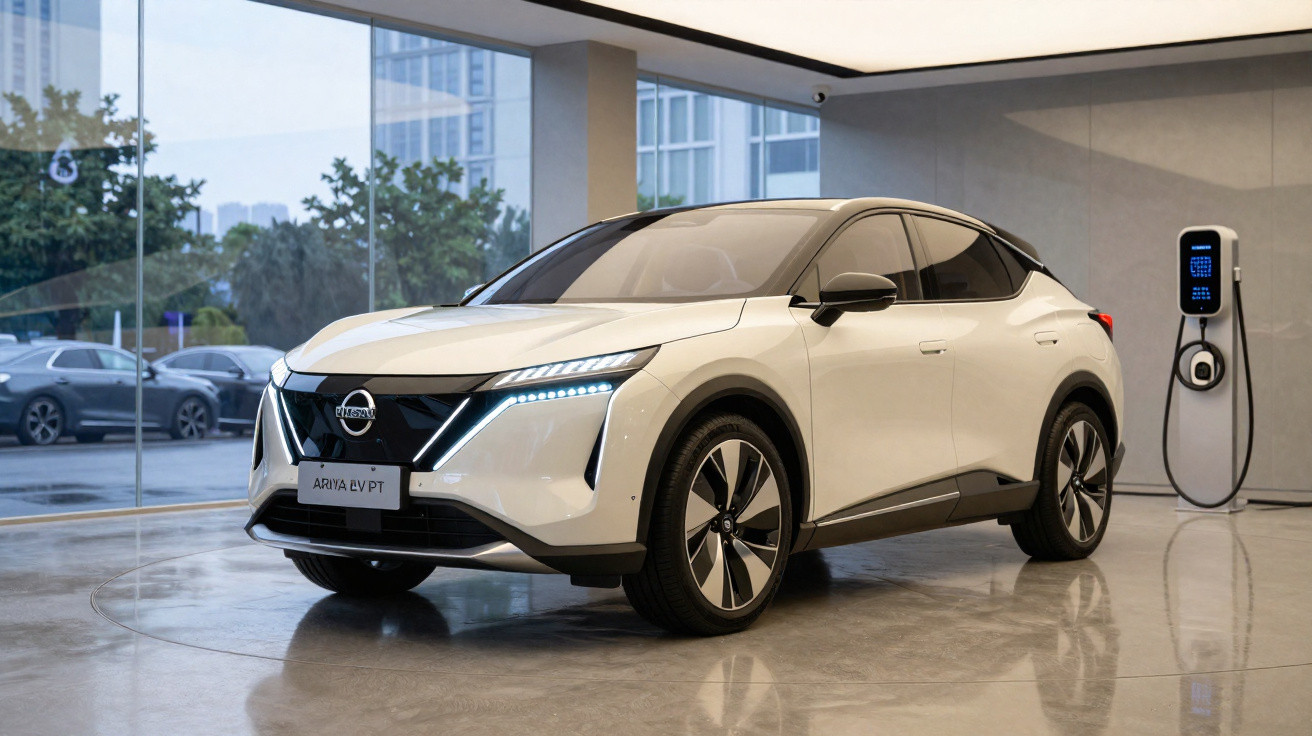
Nissan is making its debut in the 100% electric SUV class with the Ariya, and we travelled to Stockholm, Sweden to see it in the metal and get behind the wheel.
Expectations were high, especially given the years of know-how the Japanese brand built up with the Leaf. The big question was simple: does the Ariya deliver on the road?
This was only a short first drive, but it was enough to show that Nissan has put together a very robust package and has entered the electric-only SUV segment in a confident, convincing way.
There’s no shortage of space
Built on the CMF-EV platform-the same architecture used by the Renault Mégane E-Tech Electric-the Nissan Ariya sits 17 cm taller and 3.5 cm longer than the Nissan Qashqai. You notice that extra size immediately inside, particularly in the rear seats, where this EV feels notably roomy.
The one less impressive point here is the boot. It offers 468 l in front-wheel-drive versions and only 415 l in all-wheel-drive models.
Either way, those figures trail the key rivals. The Volkswagen ID.4, for instance, provides 543 l, while the IONIQ 5 offers 588 l.
A minimalist, well-balanced cabin
From the outside, the Ariya stands out thanks to its smooth, dynamic surfacing. The sloping roofline, the more rounded rear end and the slim front light signature-cleanly integrated with the front “grille”-are the details that most naturally catch the eye.
Those clean panels and cohesive lines help deliver an aerodynamic coefficient (Cx) of just 0.29, and the same theme continues inside, where the design leans heavily on horizontal, pared-back forms.
It’s also clear Nissan has been careful with the choice of materials and the overall finishing, which come across at a very high standard.
Notable highlights include the seat upholstery (a leather developed specifically for this model), the wood trim on the dashboard and the centre console (which can slide forwards and backwards), the microfibre covering sections of the door panels and, of course, the digital set-up: two 12.3-inch displays plus a head-up display that simulates a 10.8-inch screen.
Three versions available
In Europe, the Ariya will be sold in three distinct versions:
- Ariya 63 kWh, 160 kW (218 hp), 403 km range;
- Ariya 87 kWh, 178 kW (242 hp), 533 km range;
- Ariya e-4ORCE (two motors and all-wheel drive), 87 kWh, 225 kW (306 hp), 500 km range.
During this first drive on Stockholm’s streets, I only had the entry-level front-wheel-drive version with the 63 kWh battery-but it never felt short on “firepower”.
This Ariya consistently felt brisk and easy-going, with a very pleasant ride and, above all, a composed, stable attitude. To unsettle it and push it “off balance”, so to speak, you really have to raise the pace significantly.
(Really) very low consumption
If the Ariya’s performance, comfort and smoothness won me over, what probably surprised me most on this first drive in northern Europe was the energy use.
I finished the road test with an average consumption of 13.4 kWh/100 km, which is well below the 17.6 kWh/100 km Nissan quotes (WLTP cycle). That said, there is an important caveat.
Stockholm is largely flat, and its speed limits are enforced far more strictly than those we’re used to back home. As a result, I ended up driving at relatively low speeds most of the time, which inevitably helped the consumption figure.
Even so, it wasn’t purely an urban run. I also drove the Ariya on secondary roads and on the motorway, and the electric SUV still came out well-helped by the fact that Swedish motorways are limited to just 110 km/h.
Range in Portugal
In Portugal, the Nissan Ariya will be offered in two equipment levels: Advance and Evolve.
Advance comes as standard with features such as the ProPILOT c/ Navilink system, 19-inch alloy wheels, a 360º camera, a wireless charger for your smartphone and a hands-free powered tailgate.
With Evolve, standard equipment includes a Bose 10-speaker audio system, an opening panoramic roof, an intelligent rear-view mirror and a sliding centre console.
In addition, there will also be the Evolve 87 kWh e-4ORCE version, which will be the most expensive and best-equipped in the line-up, taking pride of place in the catalogue of the brand’s first 100% electric SUV.
And the prices?
As for pricing, the Nissan Ariya will be available in Portugal with prices starting at €49,200:
- Ariya 63 kWh Advance - from €49,200;
- Ariya 63 kWh Evolve - from €53,700;
- Ariya 87 kWh Advance - from €55,200;
- Ariya 87 kWh Evolve - from €59,700;
- Ariya 87 kWh Evolve e-4ORCE - from €63,200.
Deliveries of the first units will take place in August, in the versions with the 63 kWh battery. The 87 kWh variants will follow shortly afterwards, while the range-topping e-4ORCE will only arrive closer to the end of the year.

Comments
No comments yet. Be the first to comment!
Leave a Comment