
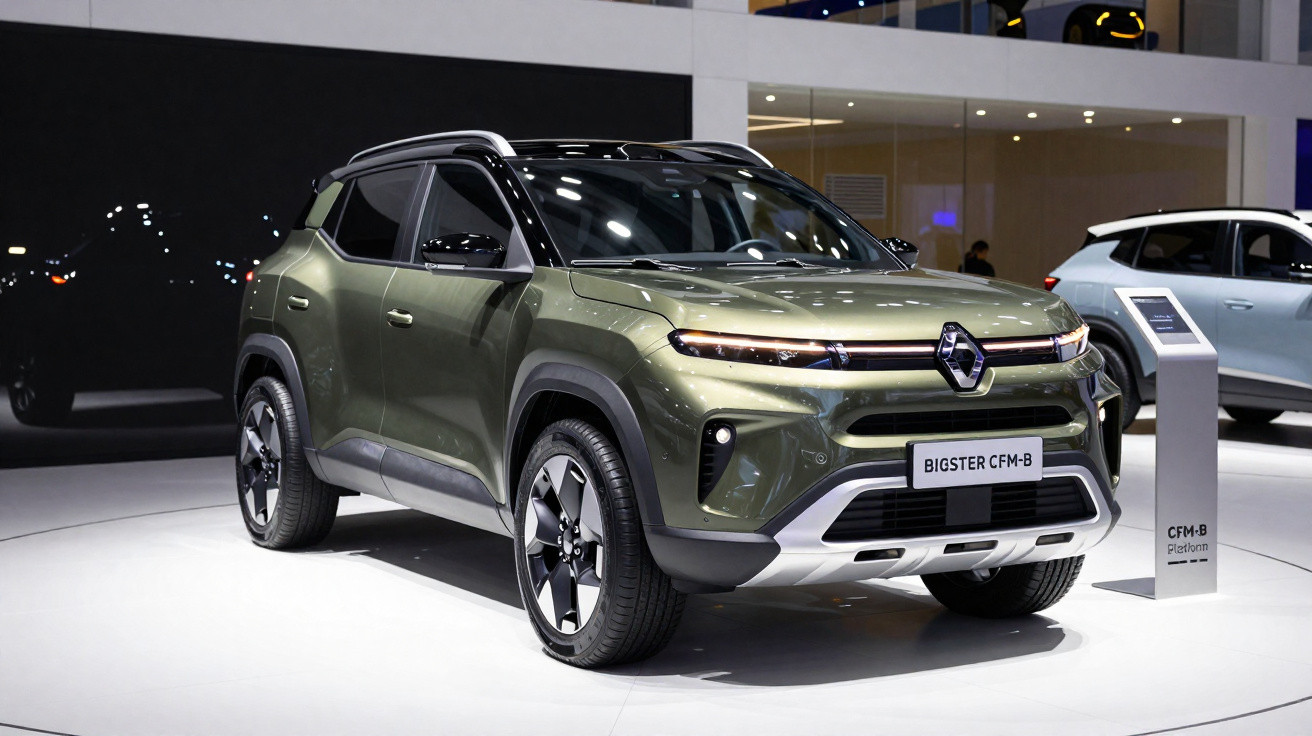
Renaulution and the Dacia Bigster Concept
Back in January, during the unveiling of the Renault Group’s new strategic plan-called Renaulution-we were introduced to the Dacia Bigster Concept. The prototype not only previewed Dacia’s new design direction, it also pointed towards a future flagship: a 4.6 m-long SUV-substantially larger than the Duster-aimed squarely at the C-segment.
In comments to Aufomotive News, Renault Group CEO Luca de Meo made it clear that the Bigster is expected to matter to more than just Dacia’s prospects.
Moving the Renault Group towards the C-segment
De Meo wants to lessen the group’s reliance on small cars (segment B) and shift its “centre of gravity” towards larger vehicles (segment C), where prices-and profit margins-are higher.
That ambition also reveals what sits behind the Bigster project: the Dacia Bigster will spawn additional models, not only for Russia’s Lada brand but also for Renault itself. Across the whole line-up, parts-sharing is expected to be about 85%, while the vehicles are meant to feel clearly differentiated-even if they will not all be sold in the same markets.
CFM-B underpinnings for the production Dacia Bigster
Despite the generous footprint of the SUV-and the other vehicles planned around it-the production version derived from the Dacia Bigster Concept will use the Alliance’s CFM-B platform, the same architecture found in the new, compact Dacia Sandero and, for instance, the Renault Clio.
From Russia with love
Alongside the Dacia Bigster-set to indirectly take over the space currently occupied by the Dacia Lodgy-another model is likely to draw plenty of attention: a new Lada Niva. It is worth noting that Dacia and Lada now sit within the same business unit, so closer coordination between the two manufacturers is expected going forward.
Due in 2024, the next Lada Niva was previewed by the sketch shown above. As you can see, it is set to have a very distinctive character, closely echoing the current, long-running Niva-launched in 1977 and still in production today, even after multiple rounds of updates and improvements over the decades.
Will it match the off-road ability of the iconic original? De Meo says it will-at minimum-offer stronger capabilities than the other SUVs in this group, with better off-road approach/departure angles, a transmission with specific gearing, and an emphasis on simplicity and day-to-day practicality.
The plans do not stop there. Two different models are expected to wear the Niva name and, given their “European” foundations, the vehicle will also be sold across the rest of Europe. The current model’s presence is minimal, with very few units imported each year. De Meo says it will not be a high-volume car, but it could become a very profitable niche.
The other “Bigster” models
In total, seven models are planned to be derived from the Bigster, spread across Dacia, Lada and Renault. For Renault, the version-or versions-based on the model are expected to be offered in selected markets such as South America or India, with none anticipated to be sold in mainland Europe.
The approach is not far removed from what has already been done with the Dacia Duster. In Europe, we know it as the Dacia Duster; in other regions, including South America, it is sold as a Renault-there is even a Renault Duster Oroch pick-up sold in Brazil-or as the Nissan Terrano in some Asian markets. Sales totalled more than 400 thousand units in 2019 and 270 thousand in 2020 (a drop caused by the pandemic), and it is built in five countries.
With the Dacia Bigster, the target is higher still, with Luca de Meo aiming to sell more than one million units per year.


Comments
No comments yet. Be the first to comment!
Leave a Comment