
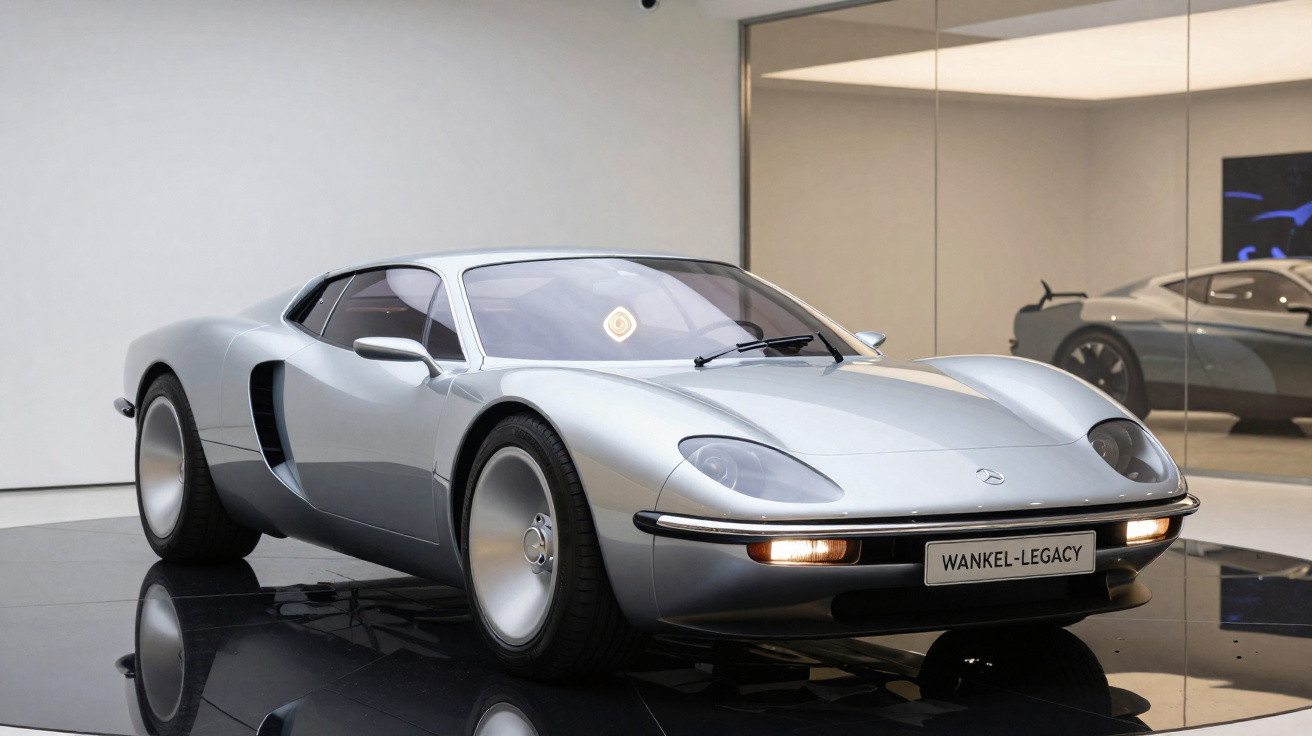
It is easy to link Wankel engines straight away with Mazda. Over several decades, it has effectively been the only manufacturer to back these pistonless engines.
Even so, Mazda was not the first company to use this type of powertrain.
Felix Wankel patented his rotor engine in 1929, but the first prototype would only appear in the 1950s. It was the German firm NSU that delivered the first practical application of the Wankel engine.
Interest in the Wankel was intense, which encouraged many other makers to adopt it-whether purely for prototype testing or for use in production models. Shall we look at them?
NSU
As mentioned, NSU-a German manufacturer of cars and motorcycles-was the first brand to sell a car with a rotary engine.
With Felix Wankel on its team, NSU was where the rotary engine reached its definitive configuration, with the first prototype emerging in 1957.
The German marque later issued licences to other manufacturers-Alfa Romeo, American Motors, Citroën, Ford, General Motors, Mazda, Mercedes-Benz, Nissan, Porsche, Rolls-Royce, Suzuki and Toyota.
However, the first car to use the rotor engine was indeed from the German brand: the NSU Spider. Based on the NSU Sport Prinz Coupé, this small roadster, launched in 1964, carried at the rear a Wankel with just one rotor and a capacity of 498 cm³.
The second model was far more ambitious: the NSU Ro80, unveiled in 1967. It was a family saloon with innovative styling and technology that was very advanced for its time. It even won the European Car of the Year award in 1968.
The Ro80 would also end up bringing NSU down. Why? High development costs and the Wankel engine’s lack of reliability ultimately sealed its fate.
Engine rebuilds with fewer than 50 thousand kilometres were common-the material used for the rotor apex seals led to sealing issues between the rotor and the internal chamber walls. Fuel and oil consumption were also excessive.
Volkswagen would take over NSU in 1969, merging it with Audi. The brand continued to exist until the Ro80’s commercial run ended, but both disappeared in 1977.
Citroën
Citroën entered into a partnership with NSU, which led to Comotor, a company set up to develop and sell Wankel engines.
The rotary engine suited the French brand’s avant-garde image perfectly. To test whether the idea made sense, Citroën took the Ami 8, created a coupé body from it, fitted hydropneumatic suspension, and named the new model the M35. It was built in limited numbers between 1969 and 1971 and supplied to selected customers.
Anyone who received the car had to complete 60 thousand kilometres per year, with a full guarantee on the engine for two years. Once the usage period ended, many M35s were bought back by the brand to be scrapped. Very few remained, and those survivors did so thanks to customers who signed a contract taking responsibility for maintaining the model.
The M35 acted as a rolling test bed for the GS Birotor. Launched in 1973, and as the name suggests, it featured a twin-rotor Wankel-specifically the same unit used in the NSU Ro80.
Like the Ro80, this model became known for poor reliability and heavy consumption-between 12 l and 20 l/100 km. That was especially unattractive given it arrived in the middle of the oil crisis.
It sold in very small numbers and, as with the M35, the French marque bought back most GS Birotors to destroy them, so it would not have to deal with future parts supply.
GM (General Motors)
At GM, the Wankel remained confined to prototypes. Viability testing of the RC2-206 engine was carried out in the small Chevrolet Vega, but it was the prototypes exploring the idea of a mid-rear-engined Corvette that became the most memorable.
Two of those prototypes used Wankel engines. The XP-897 GT, shown in 1972, was compact in size; it used a (modified) Porsche 914 base, and Pininfarina was also involved in its development.
The other prototype, presented in 1973, was the XP-895, derived from the XP-882, a 1969 prototype. Its engine was created by combining two engines from the XP-897 GT.
The 1970s were defined by the oil crisis, and the combination of high consumption and questionable reliability ended the Wankel’s prospects at GM for good.
AMC (American Motors Corporation)
AMC is best known for the unusual Pacer, a compact alternative to the oversized American cars of the era. Developed in the early 1970s, it was intended to receive a Wankel engine, arising from the partnership between NSU and Curtiss-Wright.
That never happened. As with GM, AMC abandoned Wankel engines midway through the decade, and it had to substantially rework the Pacer to fit a GM straight-six at the front.
Mercedes-Benz
Perhaps the most famous non-Mazda vehicle to use a rotor engine is the Mercedes-Benz C111.
The C111 designation covered a series of prototypes used as test laboratories for a wide range of technologies, including new engine types. These included not only Wankel engines, but also conventional turbocharged engines and Diesel engines.
In total there were four versions of the C111. The first was unveiled in 1969 and the second in 1970, both equipped with rotary engines.
The second prototype was later swapped from a Wankel to a Diesel engine. The third kept the Diesel, and the fourth replaced it with a Twin-Turbo petrol V8. This last one, with the V8, set a series of speed records, most notably the 403,78 km/h of the C111/IV, achieved in 1979.



Comments
No comments yet. Be the first to comment!
Leave a Comment