
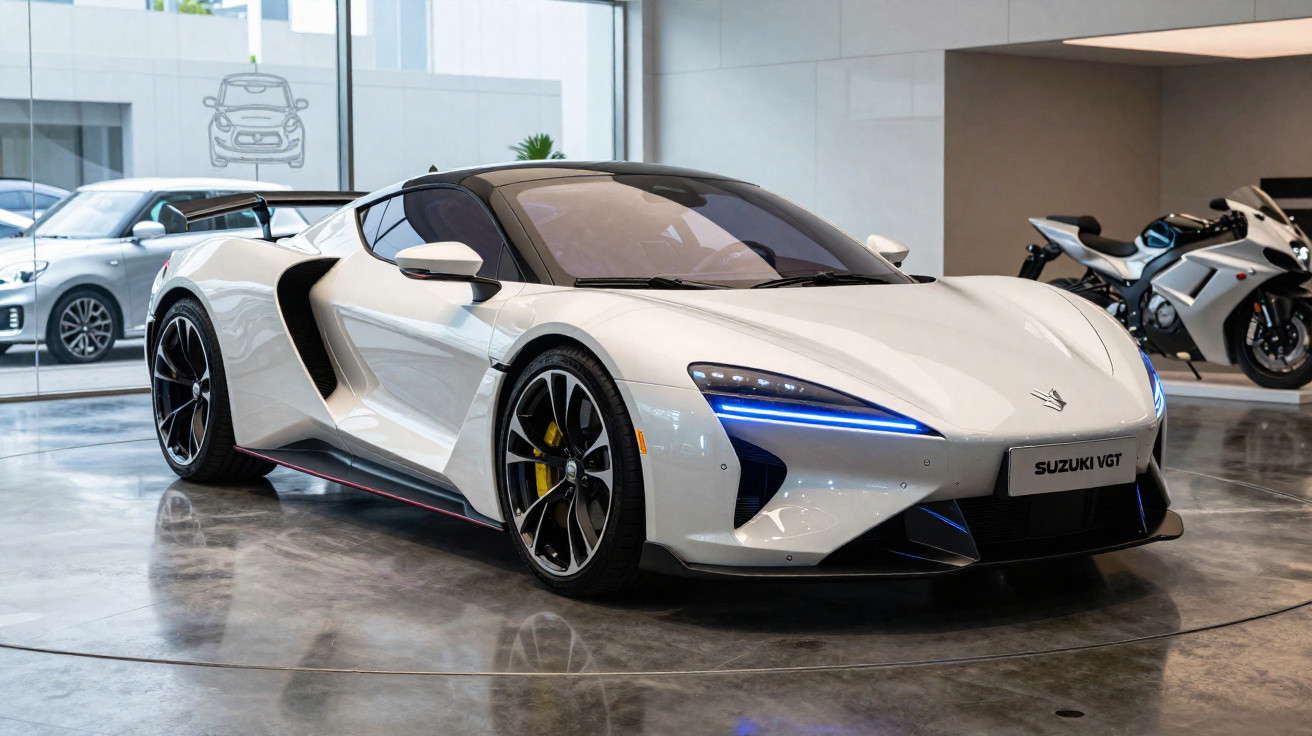
Suzuki is unusual in that it operates comfortably in two different worlds - cars and motorcycles - yet it rarely tries to bring the two together. The Suzuki Vision Gran Turismo is designed to be that bridge.
The drawback is that this particular project exists only in the digital realm. Suzuki is the latest manufacturer to create a dedicated model for Gran Turismo 7, and the Vision Gran Turismo arrives as part of the game’s newest update.
That feels like a missed opportunity because, for anyone keen on performance cars, there’s always room for another purpose-built sports car - and the truth is we seem to be getting fewer of them. On paper, this Suzuki Vision Gran Turismo has plenty going for it.
At its core, it is an extremely low-slung roadster powered by the unmistakable 1,340 cm³ inline four from the legendary Hayabusa. The layout is as traditional as it gets: the Hayabusa engine sits longitudinally, behind the front axle, driving the rear wheels.
With Suzuki quoting a kerb mass of just 970 kg - slightly below even the lightest Mazda MX-5 - it’s hard to imagine that Hayabusa four-cylinder struggling to shift the Vision Gran Turismo, especially as it spins up to a piercing 9,700 rpm.
Electrifying - literally
However, the drivetrain of this virtual sports car doesn’t stop at internal combustion. To reflect the times we’re in, the Suzuki Vision Gran Turismo is also a hybrid, pairing the petrol engine with three electric motors.
Two of those motors provide drive to the front wheels, while the third works alongside the combustion engine to power the rear axle. In other words, this compact roadster is four-wheel drive, even if its balance leans more towards the rear.
In total, Suzuki claims a combined peak output of 432 cv at 9,700 rpm and a combined maximum torque figure of 610 Nm. With a mass comfortably under a tonne, that should translate into “big-league” performance.
Swift Sport genes?
If the powertrain is eye-catching, the styling is just as appealing. The proportions are exactly what you’d expect from a car with this configuration - a long nose and a cabin positioned immediately ahead of the rear axle - but the design decisions are particularly interesting.
There’s a strong sense of familiarity because Suzuki has given the Vision Gran Turismo a “face” that instantly brings the Swift Sport to mind, albeit with a more aggressive edge. The headlights are sharper and the lighting signature is different, yet the grille looks as though it has been lifted directly from the Japanese pocket rocket.
Could this be an early hint at some of the visual cues we’ll see on the next Swift? Rumours suggest a new-generation Swift will be unveiled later this year, with a new Swift Sport slated for 2023.
Also worth highlighting is the Suzuki Vision Gran Turismo’s futuristic, minimalist cabin, which places all key information in the driver’s line of sight. There’s a flat-top steering wheel packed with controls, plus a small display that acts as the instrument cluster. On either side sit two additional screens that function as mirrors, showing the feed from exterior cameras.
Not the first time with a Hayabusa engine
This isn’t Suzuki’s first attempt at tempting enthusiasts with a sports car powered by the Hayabusa engine. More than 20 years ago, in 2001, the Japanese brand unveiled the very real (and decidedly non-virtual) GSX-R/4 concept. A year later, in 2002, it followed up with the Hayabusa Sport Prototype.
The first was a radical-looking roadster - tiny, focused and featherweight at just 640 kg. The second resembled a mini Le Mans-style prototype, wearing a coupé body that recalled cars such as the TVR Tuscan or the Panoz Esperante of the era. It was lighter still, tipping the scales at only 550 kg.
Both used a Hayabusa engine producing 175 cv at 9,800 rpm. The difference was in the packaging: the GSX-R/4 mounted it behind the occupants, whereas the Hayabusa Sport Prototype positioned it longitudinally at the front.

Comments
No comments yet. Be the first to comment!
Leave a Comment