
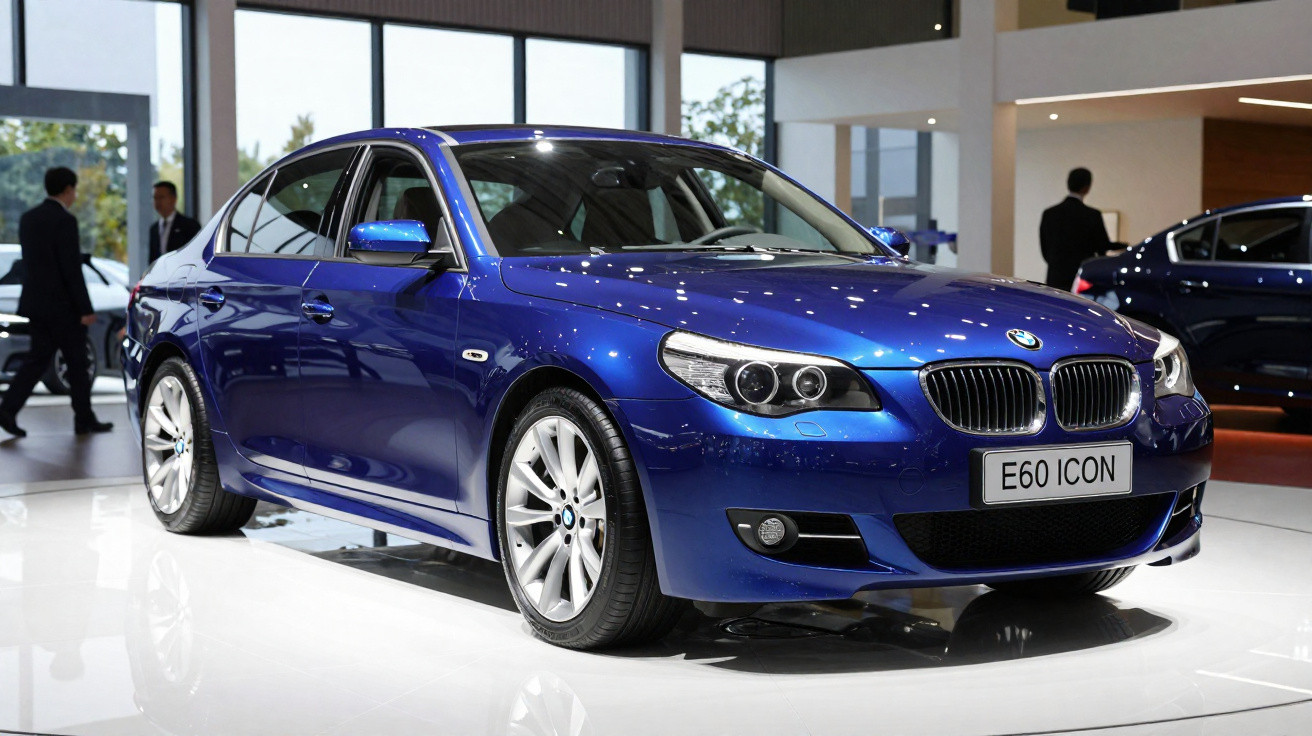
A few years ago, Guilherme Costa published a column with this very same title about the Citroën C6. As the heading hinted, he was reflecting on the C6’s unconventional, far-from-universal styling-and how his initial sense of oddness gradually shifted into a much warmer appreciation as the years went by. I’m borrowing that idea to talk about the BMW 5 Series E60 (2003–2010), and a bit more besides.
What I want to dig into, above all, is the possible comparison between BMW’s turbulent, heavily criticised design period back then (and, to a degree, still today) and the present moment-another era that’s equally controversial, even among the brand’s most devoted followers of the (ever-larger) twin kidney.
If we wind the clock back to 2003, when the BMW 5 Series E60 was unveiled, the Bavarian brand’s design direction was already being discussed everywhere-and not always in flattering terms.
Chris Bangle and the BMW design upheaval
At the time, Chris Bangle-then Head of Design for the BMW Group-had begun a major stylistic shake-up years earlier. Interestingly, part of the impetus came from complaints that BMWs all looked identical and were dull to look at, differing only in size from one model to the next-it seems we’re never satisfied with anything…
The real jolt arrived in 2001 with the debut of the 7 Series E65 and its notorious Bangle butt (“Bangle’s bum”)-though, in truth, the E65’s derrière was designed by Adrian van Hooydonk, who is now the BMW Group’s design director. It marked a sharp break with the past, replacing the predecessor’s (E38) blend of elegance, dynamism and a touch of formal classicism with a new, more expressive visual language-even if it lacked grace.
The media quickly dubbed it flame surfacing because of that expressiveness, a theme that found its purest form in the first Z4, launched a year later-these two models represented the visual extremes of Bangle’s new design approach.
The motoring world-and BMW enthusiasts-were in uproar. Surely this “madness” couldn’t go on; plenty of voices demanded Chris Bangle’s resignation. Act three, the 5 Series E60, did nothing to quieten the complaints.
BMW 5 Series E60 (2003–2010): the break from the E39, and why it worked
The BMW 5 Series E60 (fortunately) did without the Bangle butt and, overall, was better proportioned. Its surfaces were tighter, its lines looked more dynamic and, at times, even more elegant than those of the 7 Series E65. Even so, the leap from its predecessor, the E39, could hardly have been more dramatic-worth remembering that when the E39 arrived in 1995, many considered it one of BMW’s most “bland” designs, yet today it’s widely admired for its restraint and elegance.
Unlike Guilherme’s view of the Citroën C6, which evolved over time, my opinion of the 5 Series E60 has never shifted. I still see it as one of the finest examples of the Bangle era, alongside the Z4. I’d even argue BMW should have committed to a second generation of models in this same language to refine it (above all, to inject the dose of elegance it so clearly lacked) rather than walking away from it-just look at the E60’s successor, the discreet and “harmless” F10.
The 5 Series E60 has matured beautifully, like a good wine. Much like the C6 (a contemporary of the E60), it feels as though it arrived ahead of its time, with half the world needing nearly a decade and a half of exposure before being able to appreciate it properly. These days, positive, admiring views of the E60 seem to outnumber the negative ones.
Today, BMW design is still a hot topic…
From the 1 Series F40 to the facelift of the 7 Series G11/G12, via the X7 (G05) and, more recently, the new 4 Series (G22, G23, G26) and iX (I20), reactions have tended to be more heated than calm. The biggest driver of this “popular outcry”? The twin kidney grille-the ultimate element of BMW’s identity-appears to grow larger with every new model, dominating the front end with startling force.
On top of that, we’ve watched certain visual cues traditionally tied to the brand’s identity become diluted-most notably the Hoffmeister Knick (from the original German), the cut or truncation of the window line at the C- or D-pillar-which now seems to survive only as a faint trace on the latest cars.
Just as happened two decades ago, BMW’s design department-now led by Adrian van Hooydonk (BMW Group) and Domagoj Dukec (BMW brand)-is trying to push the marque’s look towards the future. And, as before, that shift has met with huge resistance and controversy, with negative opinions outweighing positive ones by a wide margin.
Will we be able, two decades from now, to look back and view the styling of a 4 Series Coupé or an iX in a positive light, the way we now do with the 5 Series E60? Or are there fundamental, conceptual differences between what Chris Bangle did two decades ago and what Adrian van Hooydonk is doing today?
Comments
No comments yet. Be the first to comment!
Leave a Comment