
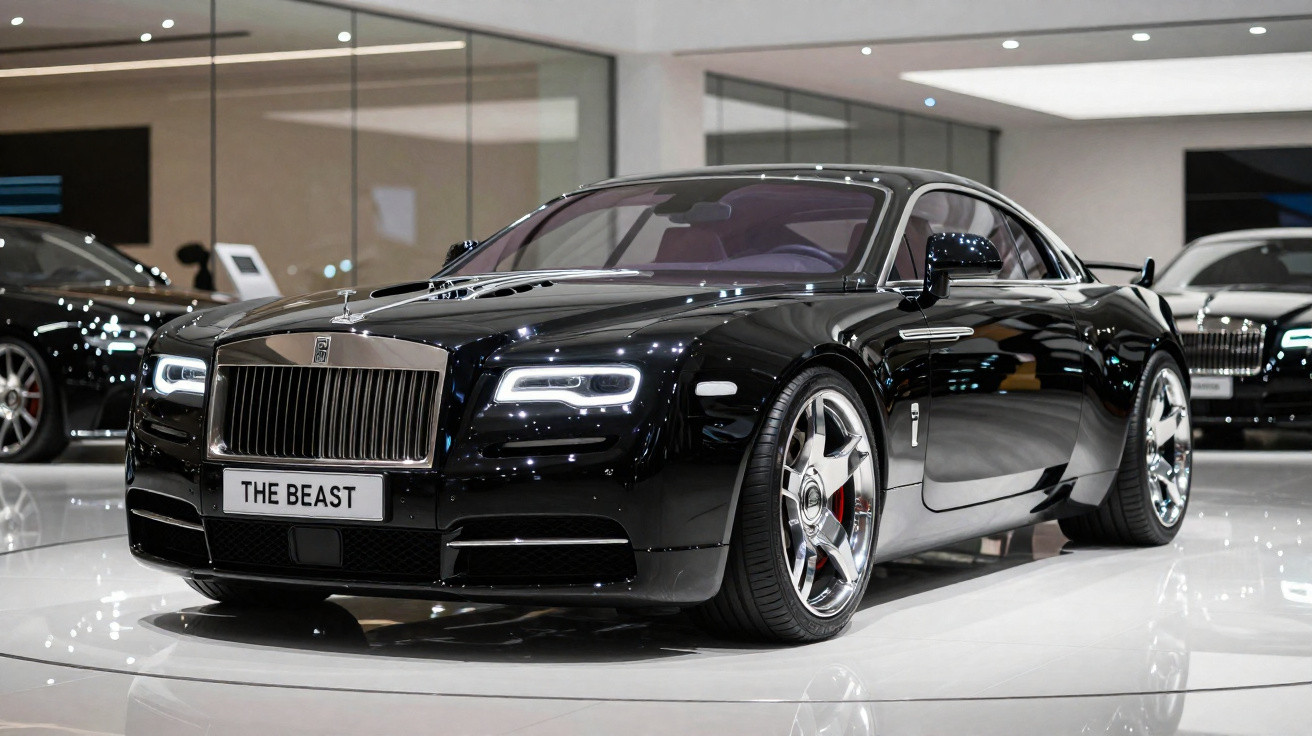
Half car, half aeroplane. Born out of the wild 1970s, “The Beast” is a one-off concept and a product of British creative spirit.
Right now it is up for auction on Car & Classic with no guide price shown, and the backstory of “The Beast” could almost fill a book.
It all began in 1966 as a chassis that Paul Jameson fitted with the engine from a Second World War tank, although John Dodd would later become the person most closely associated with what it ultimately became.
Dodd was initially brought in to design a transmission capable of coping with the engine’s enormous figures, but in 1972 he bought the project outright and turned it into the machine we recognise today.
A kind of Rolls-Royce
The first major change Dodd made to “The Beast” was to remove the tank engine; in its place went something even more remarkable: the 27 l V12 - 27,000 cc - used in the legendary Spitfire aircraft, the Rolls-Royce Merlin.
With the chassis and engine decided, the next job was to clothe it all in bodywork, and for that Dodd approached the company Fibre Glass Repairs.
Best known for building bodies for dragsters, Fibre Glass Repairs shaped this monster into its final form.
The end result was a strangely proportioned car with an extraordinarily long bonnet, and it did not do without the familiar Rolls-Royce grille - after all, its engine had been created by the renowned British company.
Inside, the dashboard may not match the finish you would expect from a Rolls-Royce, but it is certainly more distinctive than anything the marque ever produced, with its many switches evoking an aircraft cockpit.
“The Beast”, the most powerful car in the world
Unsurprisingly, “The Beast” quickly became a talking point. It appeared in magazines and newspapers, and even featured on Top Gear.
In 1973 it was tested by the RAC (Royal Automobile Club) and rapidly proved what it could do: 295 km/h at a time when most family cars were already struggling to get past 120 km/h.
Then, in 1977, it entered the Guinness Book of Records as the most powerful car in the world - even though it had never been run on a dynamometer.
In Spitfires, the 27 l V12 produced around 1520 hp. However, because “The Beast” did without the supercharger fitted to the aircraft, its output would have been lower.
Estimates put it at roughly 760 hp, but John Dodd told EVO Magazine that “The Beast” made about 960 hp and 1030 Nm.
Legal troubles
For all the attention “The Beast” attracted, Rolls-Royce was never pleased about the use of its grille and ultimately took John Dodd to court.
The British courts found in the company’s favour, leaving Dodd to hide “The Beast” and… flee to Spain. He later reunited with his creation, but gave up the Rolls-Royce grille.
Most curiously of all, despite Rolls-Royce winning the legal battle, “The Beast” is registered as a model of the British marque, creating a kind of stalemate between the luxury brand and John Dodd.
Now “The Beast” is looking for a new owner - ideally someone keen to use it almost every day, just as John Dodd did for several years.
Comments
No comments yet. Be the first to comment!
Leave a Comment