
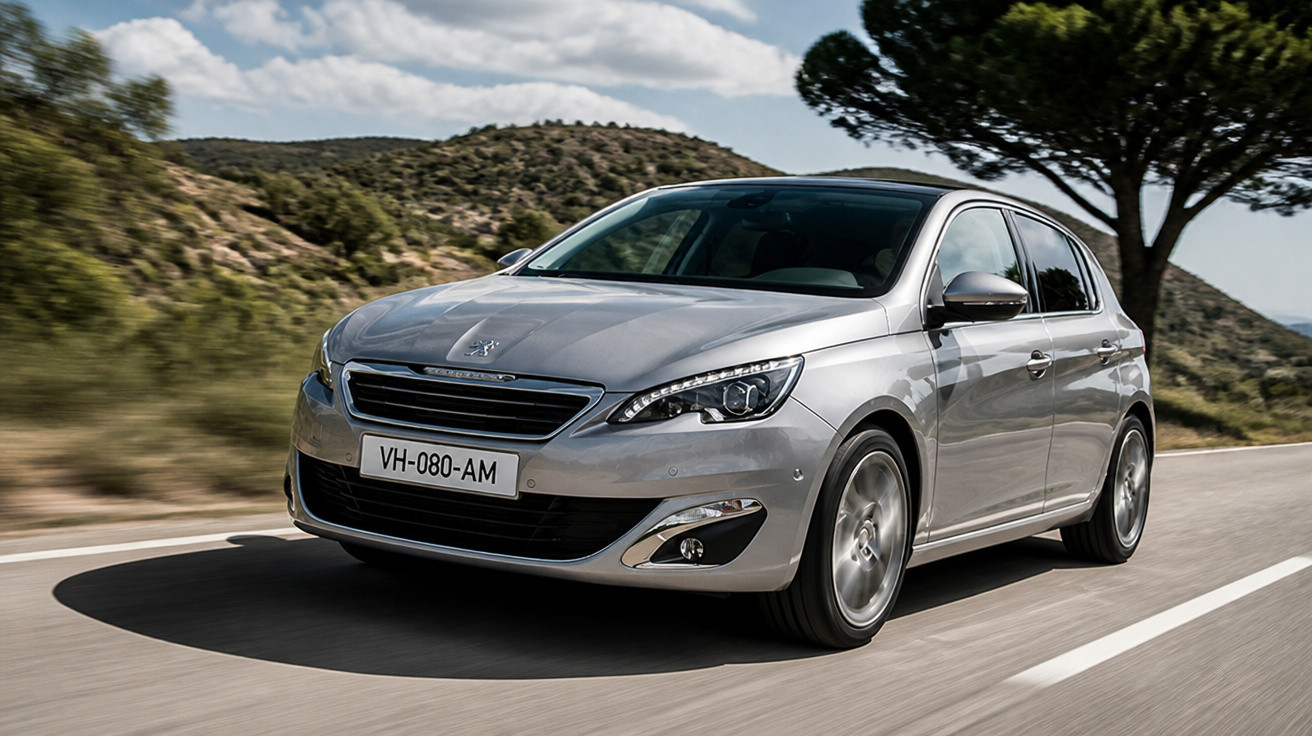
That looks… familiar.
After many millions of euros in investment, 116 patents lodged during development, and more than two million miles (about 3.2 million km) of road testing, are you seriously saying it looks like any other hatchback?
Yes.
Fair enough: there is a touch of the generic about it. Even so, we’d argue the new 308 wears it pretty well. It’s a good-looking, tidy piece of design, and a sizeable improvement on the old, bug-eyed 308.
Why it’s still called the 308
Hang on, why is this new one called the 308 too? Surely it should be called the…
309, yes. Except Peugeot already used 309 back in 1985 (and shifted 222,783 in the UK). More importantly, Peugeot now insists that all models must end in ‘08’ (with ‘01’ reserved for emerging markets). The idea is to build recognition around a fixed model number, so in future we’ll just keep getting ‘new’ 308s. Much like the Golf: Volkswagen doesn’t rename the next one the Golf-ier, does it?
Platform and weight: Peugeot 308 on EMP2
So it’s really all-new?
It is. The 308 is built on a completely fresh platform, previously seen only under the new Citroën C4 Picasso. Peugeot calls it ‘EMP2’ (efficient modular platform), and it helps trim 140kg from the old car’s weight. The new 308 is also lower and wider, with a longer wheelbase; combined with shorter overhangs, that gives it a squatter stance. The dieting even reaches the tailgate, which is plastic.
Engines and performance options
What about engines?
The range includes a 1.6-litre diesel with 92bhp or 115bhp, and a 1.6-litre petrol with 125bhp or 155bhp. Next year, a line-up of 1.2-litre three-cylinder turbo petrols arrives, and they’re meant to suit the lighter body particularly well.
To put the weight into context, this new 308 in 92bhp 1.6-litre diesel form tips the scales at 1,090kg-only a few bags of sugar more than a VW Polo from the class below.
On the road: ride, handling and steering feel
So how does it drive?
Competently. The suspension is excellent-very well judged and impressively settled-and overall refinement is right up there. The difficulty is coaxing much more than that from it.
Point it at sweeping A-road bends and tight hairpins and the 308 tends to give a distinctly Gallic shrug before getting on with it. There’s clear body roll in corners, and the steering isn’t as chatty as you might hope. It can feel slightly vague, and you don’t get early enough warning that understeer is building. That takes the edge off any temptation to press on. Ease back, though, and it makes a pleasant long-legged cruiser-just not a Focus. Or a Golf.
The 1.6-litre 155bhp petrol feels lively and responsive, while the 125bhp version can seem a little strained. The least powerful diesel also feels somewhat flat. The 115bhp diesel is impressively smooth, but still needs a gentle thrashing before it gathers pace with any real urgency. The three-cylinder engines due next year should be interesting to try…
Interior, touchscreen controls and practicality
And on the inside?
The cabin has taken a step up from the previous 308. Most notably, the central dashboard is now essentially button-free: everything has been moved into a 9.7in (about 24.6 cm) touchscreen that controls the lot-air conditioning, sat nav, media and so on.
Initially, it feels fiddly and distracting (not ideal while driving), but once you’ve built some familiarity your inputs become much quicker. The materials and finish around this part of the dashboard are excellent, with soft-touch plastics and a convincingly classy ambience. Directly below that, however, the plastics turn scratchy and hard, which knocks the premium impression Peugeot is chasing.
Rear legroom also isn’t especially generous, but the boot is enormous, and taken as a whole it’s a strong all-round package.
Pricing and competition in the C-Segment
So, should I buy one?
Here’s the thing: with the Golf, Focus and Astra in the mix, the C-Segment is brutally competitive. Make one small mistake and you’re instantly shark food. The sheer breadth of competence those cars offer means the 308 has a tough job on its hands.
It’s enjoyable enough, but it’s likely best suited to buyers who value refinement and ride comfort over sharp driving dynamics. Prices are expected to start from £14,500, while our 1.6-litre 155bhp petrol test car came in at approximately £20,000.
Comments
No comments yet. Be the first to comment!
Leave a Comment