
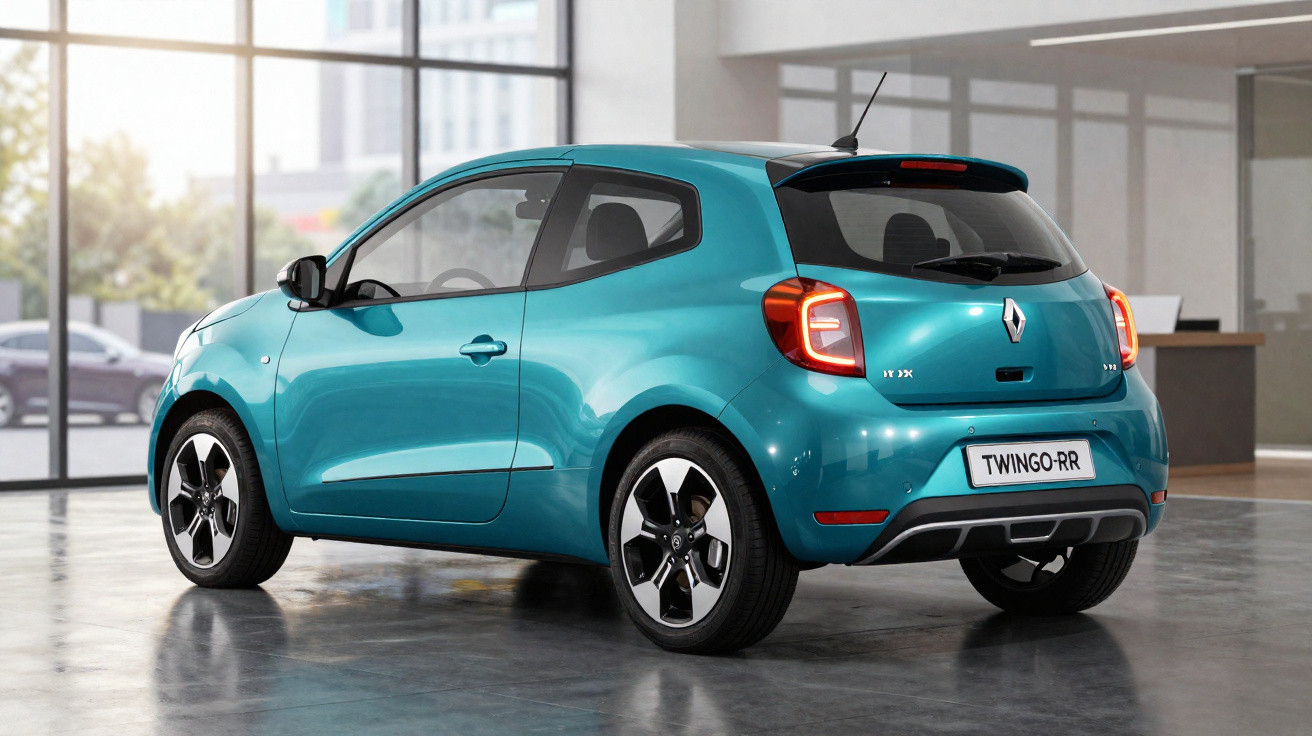
Well, that’s a sharp-looking little thing…
It is, isn’t it. Small city cars normally chase one of two looks: either a miniaturised version of a bigger car, or an enlarged, cute toy-like shape. Most don’t quite pull it off. This one avoids both clichés and looks confident being itself.
Renault Twingo design and packaging
And under the skin?
That’s where it starts to get genuinely intriguing. It isn’t laid out like a shrunken conventional hatchback at all, because the engine sits at the rear. With that arrangement, the front can be shorter while still providing enough crush space, which in turn frees up more room for occupants. Even though it’s shorter than the previous Twingo, its wheelbase is 12cm longer.
But the engine has to go somewhere. If it’s shoved in the back, won’t that steal the boot and make rear crash protection worse?
Reasonable concerns. Renault’s solution is to mount the engine almost flat, so it tucks beneath the boot floor. In an impact it’s designed to move downwards and forwards, rather than being driven into the backs of rear passengers.
So the whole arrangement is basically Smart-like, then.
Exactly. In fact, the latest Twingo is closely related to the latest Smart models. The Twingo, plus the new Smart Fortwo and Forfour, were engineered together by Renault and Daimler teams at Renault’s technical centre in Paris.
Beneath the bodywork, all of them share major components: engines, gearboxes, suspension, electronics, the underlying platform and even the seat frames. Renault staff say a rear-engined Twingo had long been the goal, but the cost of developing a bespoke platform was too high. Once Renault-Nissan began collaborating with Mercedes across several programmes, this became an obvious co-operation project.
Driving: steering, ride and stability
But Smarts have often been pretty grim to drive. Is the Twingo about lousy performance, hyperactive steering, a bouncy ride and a snatchy gearbox?
No. To begin with, it uses a manual gearbox, and it’s a pleasantly precise one to shift. The Twingo’s longer wheelbase and broader track help it feel planted and stable on the road. The downside is that the entry-level version has a slow steering rack, so tight mini-roundabouts can mean a fair bit of arm-twirling. With the 90bhp turbo engines you get a rack that speeds up near full lock, which largely fixes that issue. Ride comfort isn’t quite as calm as an Up, but it’s far from uncomfortable.
Any handling benefits from that rear engine? What about massive drifting potential?
Don’t expect oversteer. The ESP can’t be switched off, and it behaves like an over-enthusiastic H&S officer in a hi-vis. Still, the layout brings real upsides. With so little weight over the nose, it feels brilliantly agile on a twisty road. Because the steering isn’t being asked to handle drive torque, it stays clean and honest. And with the engine and exhaust further away, you hear less of their noise.
It also suits urban work perfectly, thanks to an exceptionally tight turning circle. You can pull cheeky u-turns and double-backs like a London cabbie. Threading into - and climbing back out of - tight parking spaces is almost laughably simple.
Engines, price and value
So is it only a city car, or is it alright on faster roads too?
That hinges on your engine choice. The base unit is a three-cylinder 70bhp naturally aspirated engine, and it’s pretty feeble when you need to overtake or climb hills. The one to have is the turbocharged three-cylinder, producing 90bhp and a strong helping of torques. With the turbo and the Twingo’s low weight, it’s the quickest of the sub-minis, and at this money it’s about the most fun you can have in a tiny car.
Which is?
Prices start at £9495 for the basic 70bhp version. It skips air-con (that’s bundled in a £500 pack) but you do get LEDs, DAB, USB, Bluetooth, plus a smartphone mount and a free sat-nav app. If you want the turbo, you have to go for the top specification, which is £11,695.
And is it worth it?
Yes. It’s a properly fresh take on design and engineering, and the benefits are real rather than novelty for novelty’s sake. Above all, it delivers far more fun than a base-model supermini for the same money.

Comments
No comments yet. Be the first to comment!
Leave a Comment