
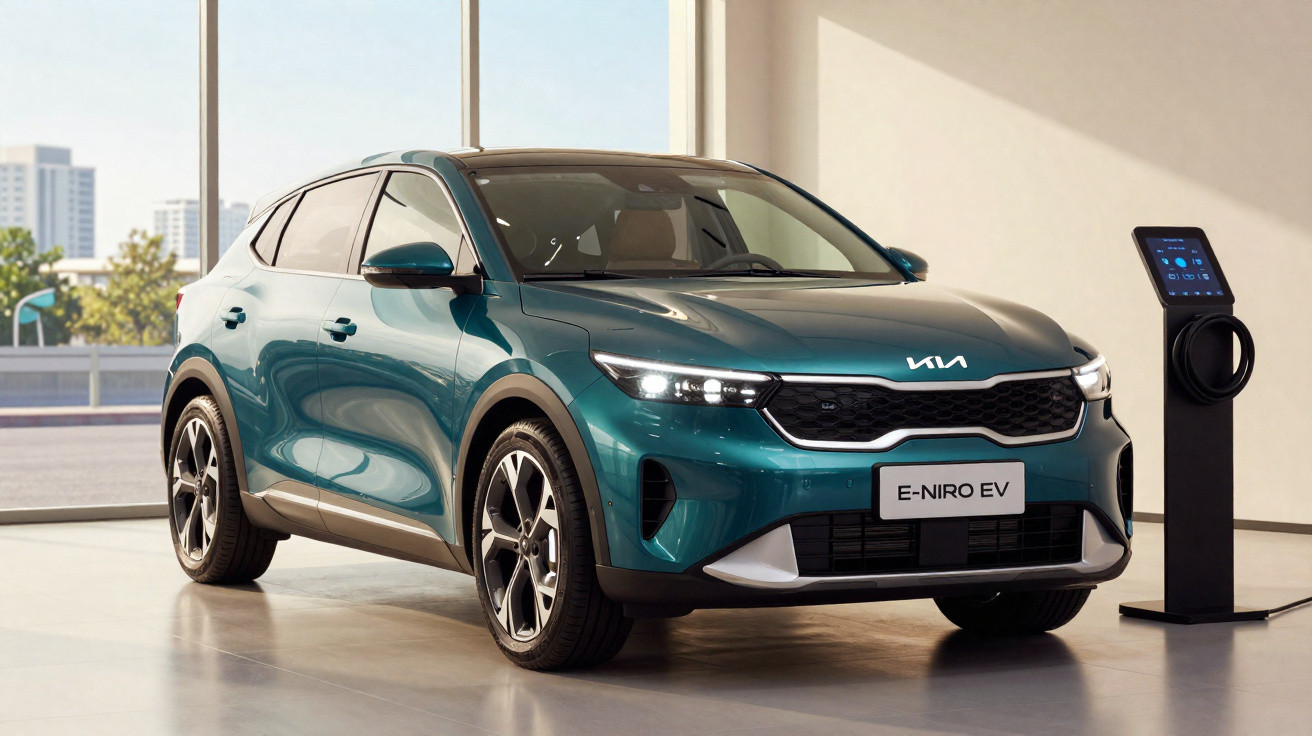
Almost a year after we tested the refreshed Niro as a hybrid (HEV), it is time to take a hard look at the Kia e-Niro, the fully electric version. There is no need to wait for the final verdict to say it is the most compelling Niro to date - even if it is also the least affordable of the range.
It earns that status for several reasons, but chiefly because it is the most powerful and quickest of the three - HEV (hybrid), PHEV (plug-in hybrid) and… e-Niro (electric). Interestingly, it is also the Niro with the largest boot of the trio, finally delivering a capacity that better matches this crossover’s family-friendly ambitions.
Benchmark efficiency
What impressed most about the e-Niro, however, was just how efficient its electric drivetrain proved to be. The official figure of 15.9 kWh/100 km is strong - very strong - particularly when you realise it matches, and in some cases betters, the published numbers for several electric cars that are smaller, less powerful and lighter than this e-Niro.
At first I considered that figure rather optimistic - after all, this is an electric crossover weighing close to 1800 kg with 204 cv and 395 Nm. But based on other EVs I have tested, and those that have been through Razão Automóvel’s garage, I have to admit it surprised me in real use: not only is it easy to hit the official 15.9 kWh/100 km, it is equally straightforward to do even better, with results typically sitting in the high 14s to low 15s.
Even on the motorway, the Kia e-Niro proved highly competitive. Despite having a larger frontal area than more compact EVs (taller body, wider stance and greater ground clearance), consumption hovered around 20–22 kWh/100 km - entirely in step with smaller electric models.
If your driving is mainly urban and suburban, and you do not “overindulge” too often in the tempting 204 cv/395 Nm on tap, achieving more than 400 km per charge is realistic without much effort - range anxiety? Not even a moment of “heart-in-mouth” worry… Unless you are covering around 100 km per day, the Kia e-Niro will most likely need only one recharge per week.
Longer journeys? No problem
That efficiency, combined with generous cabin space and the performance available, makes the Kia e-Niro a credible companion for (dare we say it) longer distances - such as a weekend escape (or at least, as soon as that becomes possible).
Its long-distance strengths are reinforced by the high levels of comfort and refinement on board. Some of that comes from the seats - they could do with more support, apart from the lumbar area which has electric adjustment - some from the very good sound insulation, and some from the soft-leaning suspension tune.
The Kia e-Niro feels more at home on open, wider roads - where its stability stands out - than on narrower, twistier routes. The compliant suspension set-up and Michelin Primacy tyres are not the ideal partners if you plan to exploit the full “fury” of 204 cv and, above all, the instant 395 Nm.
Treat the accelerator like an on–off switch and the sudden torque delivery can quickly overwhelm the softer front tyres, which will make their displeasure clearly known. That said, the e-Niro remains capable and predictable in its responses, even if it is not the most thrilling - personally, I would “trade” a little of that softness for a more focused chassis tune and tyres better suited to the performance on offer.
Use the throttle more smoothly, avoid winding up the front tyres, and you will not want to swap the 204 cv and instant 395 Nm for anything. Press a bit harder and the Kia e-Niro surges forward with real intent: overtaking becomes effortless, and almost every incline is dealt with as if it were flat, thanks to how easily it builds and/or maintains speed.
Paddle shifters: the interaction you can have
Unlike some electric cars, the e-Niro does not include a B mode on the transmission selector - in other words, a setting that locks in maximum energy recuperation. Instead, there are paddles behind the steering wheel, positioned where you would normally find gear-change paddles in a car with an automatic gearbox, used here to adjust regenerative braking strength on the overrun.
The system runs from level 0 (no regeneration) to level 3 (maximum regeneration), and it does not take long for the paddles to become a natural part of the driving experience, adding a layer of interaction that is not always present in this type of vehicle.
For instance, on descents, if you want to mimic the effect of engine braking, one or two taps on the left paddle increases regeneration so you can hold a steady speed. Keep that same paddle pulled and the regeneration becomes strong enough to bring the e-Niro to a complete stop.
Hold the right paddle and you activate Auto regeneration mode, where the e-Niro automatically chooses the regeneration level based on traffic ahead, detected by its radar.
Is it the right car for me?
As with many other electric cars, the Kia e-Niro - with an asking price of almost €50,000 (excluding promotional offers) - makes more sense for companies than for private buyers. It is telling that it was the model chosen as “Company Electric Car” in the Fleet Magazine Awards 2020.
Even with a very long and comprehensive standard equipment list - the only real option is metallic paint - the Kia e-Niro’s price reflects the cost of electric technology, which remains expensive, more than it reflects the car itself.
It is easiest to see this by comparing it with the other, electrified Niro versions. The e-Niro costs €10,000 more than the PHEV (plug-in hybrid) and €20,000 more than the HEV (hybrid). Fortunately, it counters that with a level of performance its “siblings” can only dream of, and that makes a meaningful difference to the overall appeal of the model.
Right now, there are not many alternatives to the Kia e-Niro that can deliver the same space/efficiency/performance trio. The closest option is its “cousin”, the Hyundai Kauai Electric, from the segment below, which uses the same drivetrain and is a few thousand euros cheaper - but its more compact dimensions show up in the cabin, where space is more limited.
This year we will see more electric crossover/SUV models arrive, such as the Skoda Enyaq, which should be, for all intents and purposes, the closest rival to the Kia e-Niro - in both price and powertrain specification - even though it is significantly larger overall.
Comments
No comments yet. Be the first to comment!
Leave a Comment