
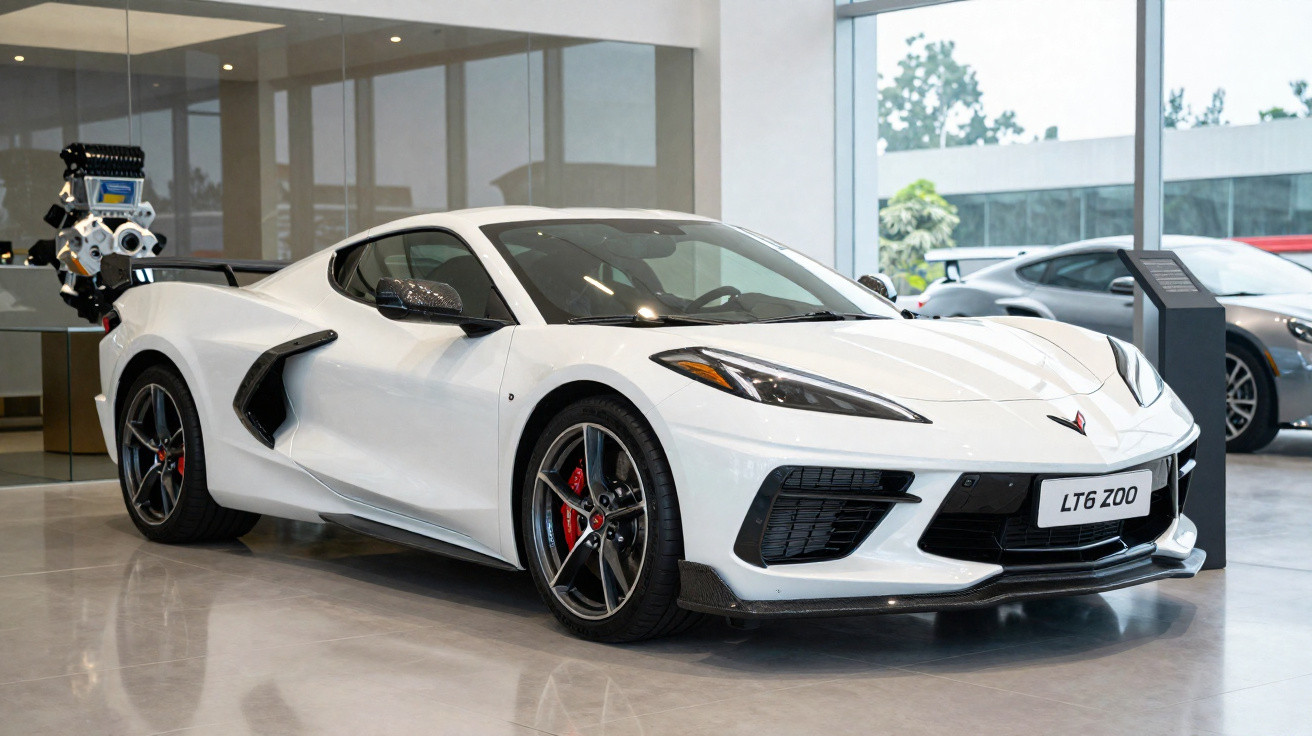
LT6 is the unassuming label for the new Chevrolet Corvette Z06’s loud 5.5-litre naturally aspirated V8, which delivers peak power at 8,400 rpm and "cuts" at 8,600 rpm, making it the highest-revving V8 currently on sale.
At a time when European supercars have almost all shifted to turbocharging (and, more recently, electrification), Chevrolet looked to the C8.R racing Corvette and lifted its naturally aspirated beating heart for the new Z06, positioned above the Corvette Stingray (C8) we already knew.
Even the Corvette Stingray was never exactly restrained. As the first Corvette with a rear mid-mounted engine, it uses a 6.2-litre naturally aspirated V8 (LT2) producing 502 cv at a more civilised 6,450 rpm - but to earn the Z06 badge, it needed something more piercing than thunderous. That is where the new LT6 comes in: despite a smaller 5.5-litre displacement, it shouts far louder.
It uses a flat-plane crankshaft (as seen in Ferrari engines), a shorter stroke (to enable much higher revs), and the camshaft sits in the cylinder head (the modern approach) rather than in the block as on the LT2 (an older solution known as pushrod, which still retains certain advantages).
The engine block is aluminium, the pistons are forged aluminium, and the connecting rods are forged titanium. At the rear, there are also four new centrally mounted exhaust outlets.
All of this (and more) results in 680 cv at 8,400 rpm and 623 Nm at 6,300 rpm.
Putting those figures to the rear axle is the same eight-speed dual-clutch gearbox as the Stingray, while the Corvette Z06 also comes as standard with a limited-slip rear differential and a shorter final drive ratio (inherited from the Stingray’s optional Z51 package).
More than an engine
The engine may be the headline act in the new Corvette Z06, but this more track-focused version of the supercar has been engineered in detail throughout. It is now 30 mm wider at the front and 40 mm wider at the rear, primarily to make room for larger wheels.
Up front, the wheels measure 508 mm in diameter and 254 mm in width, while at the rear they are 533 mm and 330 mm, respectively. They are wrapped in Michelin Pilot Sport 4S ZP tyres, sized 275/30 ZR20 at the front and a huge 345/25 ZR21 at the back.
The larger wheels also make space for an uprated Brembo braking system, with 370 mm discs at the front and 380 mm at the rear, clamped by six-piston and four-piston callipers, respectively.
That extra "firepower" and the increased width are backed up by larger air intakes, with the standout being the central front opening that conceals a heat exchanger.
Aerodynamics have also been revisited. The most obvious change is the rear wing, paired with a new front splitter. The aim is to "stick" the new Corvette Z06 to the tarmac, with Chevrolet claiming 165 kg more downforce (negative lift) at 300 km/h than the Corvette Stingray.
Z07 package: raising the bar
If the new Corvette Z06 already represents a major leap over the Corvette Stingray in performance, handling and aerodynamics, that threshold can be pushed even higher by choosing the Z07 package.
With it, you get carbon-ceramic brakes (398 mm at the front and 391 mm at the rear) and stickier Michelin Sport Cup 2 R ZP tyres, carbon-fibre wheels (cutting unsprung mass by 18.6 kg), a more aggressive aero package featuring carbon-fibre items, and a dedicated calibration for the Magnetic Ride Control 4.0 suspension.
On the suspension tuning, Chevrolet says the Corvette’s structure is so rigid that, despite the Z06’s stronger focus on performance, it has been able to keep the same calibration for both the coupé and the convertible (with a metal roof).
When does it arrive?
Pricing has not yet been announced, with production of the new Corvette Z06 due to begin in the second quarter of 2022.
Chevrolet also says it intends to export its new supercar to markets beyond North America, fitting it with particulate filters so that it complies with local emissions regulations.

Comments
No comments yet. Be the first to comment!
Leave a Comment