
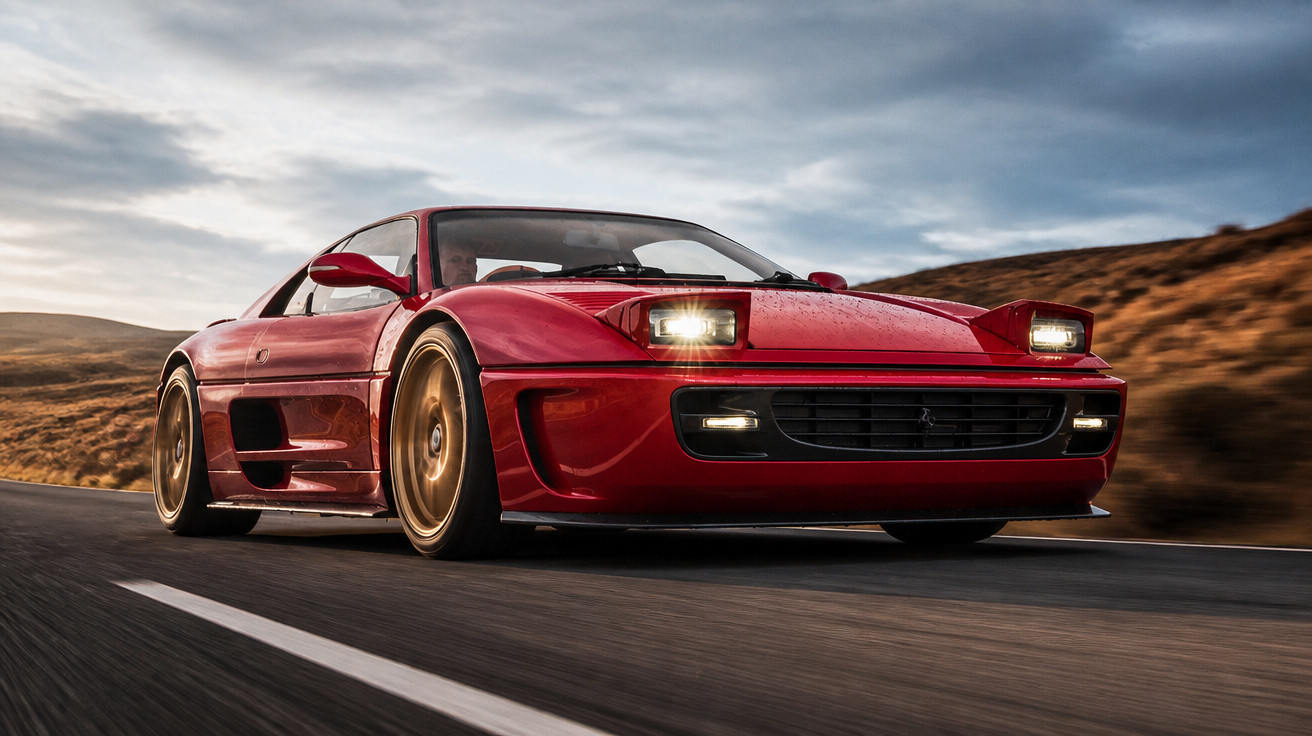
Is that… a new Ferrari F355?
It is, yes - and it always felt inevitable that what’s arguably the most important mid-engined V8 Ferrari ever to come out of Maranello would eventually be taken apart and reimagined. Plenty of restomods stop at a light refresh, but the Evoluto take on the 355 has gone far beyond that, and the result is spectacular. Think of it as a Ferrari F355 restomod making 414bhp (or 473bhp if you’re in a hurry - we’ll get to that), comprehensively re-styled and re-engineered with the aim of making every element better.
Which raises the awkward question: can a ’90s supercar that many consider close to perfect actually be improved? And, more importantly, should it be, given the original is still gorgeous, still delivers those high-rev theatrics and still has real presence? The real-world decision is this: do you spend £100k on a used F355 (and then spend a similar amount again if you want it brought back to as-new standards), or do you stump up £595k plus VAT plus a donor car plus options for the Evoluto - and they’re only making 55 of them. Yes, you’ve added it up correctly: that’s the unnerving side of £800k.
Yikes, these upgrades had better be good…
Start, as you should with any Ferrari, with the engine. The standard car used a flat-plane crank 3.5-litre V8 producing 375bhp - a big leap over the 348’s 312bhp, and, at the time, the best horsepower-per-litre figure of any naturally aspirated production car you could buy, even including the McLaren F1. Back then, the grumbles were limited: it could do with a bit more torque, and it only really turned properly operatic once you’d cleared 5,000rpm.
In the Evoluto you’ll still find a 3.5-litre V8 that spins to 8,500rpm, but output climbs to 414bhp and torque rises by 22 to 295lb ft (about 30Nm, to roughly 400Nm). That extra shove and sharpness comes via bespoke camshafts, ported cylinder heads (200 components are replaced overall) and a new equal-length stainless-steel exhaust manifold and system. The payoff is more immediacy, and an exhaust note that’s richer at lower revs before swelling into a deeper, more muscular howl beyond 4,000rpm.
If you want to go further, there’s a 3.7-litre engine option: 473bhp at 9,000rpm and 332lb ft of torque (around 450Nm), delivered through the extra capacity, high-lift cam profiles, revised fuelling, titanium conrods, carbon intake plenums and a full titanium exhaust. Add throttle-by-wire (the 3.5 sticks with a dependable cable) plus a single-mass flywheel, and it ought to feel keener and more urgent more of the time. Traditionally, red cam covers mark the 3.7 and black denotes the 3.5 - although this 3.5 final-stage prototype pays absolutely no attention to that.
Looks like the styling’s been messed with, too?
This is the bit most likely to split opinion, partly because the original is almost impossibly pretty, and partly because a few people in the TG office reckon the Evoluto looks a touch too ‘tuner’. That’s not an unreasonable take: the slats behind the headlamps and on the rear quarters add a hint of fuss, the carbon sills and front splitter aren’t essential to my eye, and the gold wheels make a loud statement. They’re 19-inch (483mm) now rather than 18s (457mm), and these particular optional magnesium alloy rims cut 4kg per corner. For me, silver would be the pick.
This is probably the most controversial bit, mostly because the original is untouchably stunning… some in the TG office think it looks too ‘tuner’
Still, the key stuff is nailed: the proportions and stance look right. Ride height drops by 25mm, while the front and rear tracks grow by 77mm and 66mm respectively - achieved properly rather than by bolting on spacers - which visually squares it up and properly fills the front arches. The bodywork is entirely carbon-fibre, and every panel is new. That includes deeper, wider side intakes to feed the engine and rear brakes, a change that forces the door handle to become a push button and requires a complete rethink of the internal door mechanism.
What about the interior?
Alongside restored analogue instruments, everything you touch is new: leather, carbon and metal surfaces throughout, and it’s a major step up. Entry is via a key inserted into a barrel, and from the first moment the lineage is clear - you sit low and reclined, the pedals are offset to the left, and while the steering column still adjusts for rake rather than reach, the deep-dish wheel is outstanding. The rim is delicately thin, and it feels like it comes to meet your hands.
There are no screens - just a phone cradle and Bluetooth - and Ferrari badges are banned unless they’re on components carried over directly. That’s why the Cavallino appears only on the front grille, on the shifter gate and on the window glass.
And under the skin?
Evoluto has also reworked the car in a way that changes the ownership experience: there’s a completely new rear subframe designed to unplug and drop out, turning what used to be major engine-out servicing into something far faster and less painful. Carbon reinforcement within the chassis (on top of the carbon body) increases stiffness by 23 per cent, while the suspension is comprehensively redesigned with new upper and lower arms, uprights, wheel bearings, anti-roll bar drop links and R23 three-way adjustable dampers.
In practice, that means wider Michelin Pilot Sport 4S tyres spend more of their time properly connected to the tarmac, and the steering feels cleaner and less interfered with. With all that carbon, dry weight lands at 1,250kg - 100kg lighter than the original.
Was all that work worth it?
Within a minute, it’s obvious this is one of the best-sounding, most visceral engines I’ve ever come across - up there with the gargling Shelby GT350R and the rasping Alfaholics GTA-R in my own personal hall of fame. Keep your foot in and there’s a pause just before 40000rpm, as though it’s bracing itself for what follows, then it rips hard towards the 8,500rpm limiter. ‘Spine tingling’ is a rotten cliché, but it’s also the most accurate, literal phrase I can use here.
And it’s not only the metallic purity of the note as it climbs in pitch and volume. In something like an 800bhp+ Ferrari V12 you can still get that sparkling top end, but by the time you’re there you’re travelling so quickly you’ve either been arrested or flattened a sheep. Here, the consequences are lower: you can enjoy letting it run to the red line, and you’re not already deep into three-figure speeds when you grab the next ratio.
Assume the open-gate manual gearbox is pure joy?
The gearing matches the original (Evoluto swaps out first and second because those are the ratios that tend to suffer in its previous life) and, yes, it’s as wonderful as you’d expect - provided you’re purposeful with it. You need to guide it firmly into the correct plane with a bit of effort. It doesn’t have the oily slickness of, for example, an Audi R8 manual, but getting the clutch timing, the blip and the shift to align is just as rewarding.
Any other standout sensations?
The steering ratio is dramatically quicker: where the standard F355 needed 3.25 turns lock-to-lock, this takes two turns, matching a contemporary 296 GTB. The difference is that it doesn’t come across as overly light or frantic in the way a 296 can; there’s more weight and more feedback, yet it remains sharp and immediate.
Ride quality is another highlight - something that impressed when driving a stock F355 - and it’s been maintained, only now with top-tier parts and tidied-up geometry. The car feels generally more rigid and tied down, but because the suspension has a sturdier base to work from, it can stay compliant while still keeping body control beautifully in check.
Straight away you click into a flow on the road, surfing the crests, hollows and cambers… it’s about interaction, analogue thrills and a bit of theatre
Almost instantly you find a rhythm, flowing with the crests, dips and cambers rather than battling them. You can amble along, short-shifting and settling into a calm cadence, and then, when the moment arrives, open it up. It hasn’t been created for track days, hot laps, 0-60mph times or downforce bragging rights; it’s built around interaction, analogue excitement and a little drama. It’s essentially a modern supercar interpreted through a ’90s filter.
Sounds like a slam dunk?
More or less… it drives exactly how I always imagined an F355 should, the way I’d mythologised it in my head. And that makes it, by extension, the supercar I’ve always wanted - a potent mix of sound, tactility, compact dimensions and performance that feels spot on. Is the 3.7-litre upgrade necessary? If your budget really is limitless (and you are shopping for a near million-pound F355, so it probably is), then an extra 60bhp is hardly a hardship - but I’m unconvinced you need it. Sometimes the sweeter thing is the slightly lesser option.
I also know there’ll be people who object on principle, who’ll call it a bastardisation of the 355 and mourn the loss of purity. It also costs an extraordinary amount. But on the road it’s more entertaining than hypercars with four times the power, it sounds better (at speeds you can actually use) than any current supercar, and as a love letter to analogue driving it’s about as close to perfect as it gets.
It’s the car Ferrari would love to build, but can’t, because it’s being herded towards turbos, hybrids and EVs. For the poster on my bedroom wall, the original 355 is still the one that matters - it always was - but the Evoluto is the one I’ll be driving in my head.
- Photography: John Wycherley
25 minutes 42 seconds
Comments
No comments yet. Be the first to comment!
Leave a Comment