
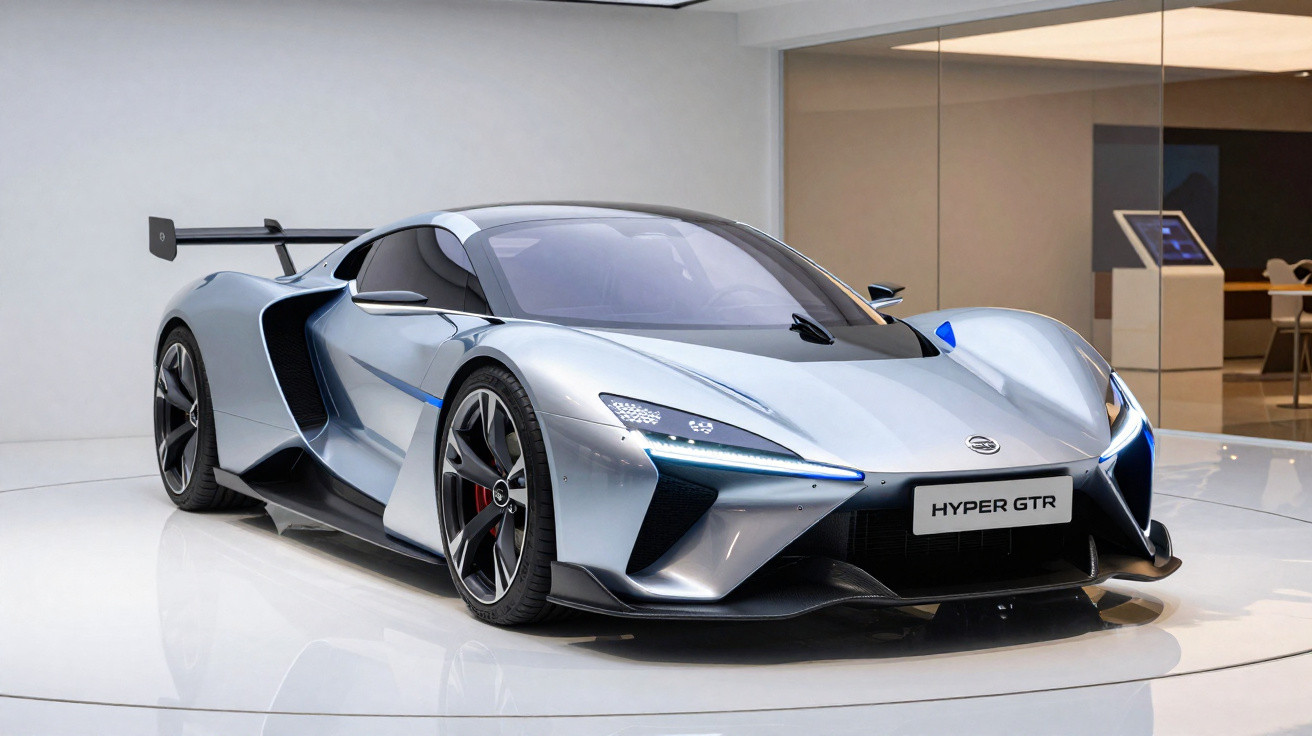
Anyone wondering what comes next for the Nissan GT-R has just been given an answer: the Hyper Force. And what an answer it is…
Behind a name that feels deliberately abstract-almost like something from an animated series-sit the first clear outlines of what looks set to become the next GT-R. It is bold to the point of being startling.
Nissan Hyper Force styling clues point to the next Nissan GT-R
The signs that the Hyper Force “hides” the future Nissan GT-R are hard to miss. From the overall silhouette to the twin, circular rear light clusters, it is all there. Even the nod to the “GT-R” badge at the front appears, reimagined through illuminated coloured pixels.
Yet that familiarity does little to soften the sheer aggression of its shapes. The bodywork is all sharp volumes and tightly drawn surfaces, with carbon fibre defining the forms with clinical precision.
The Nissan Hyper Force looks as if it has been dropped into a dystopian backdrop, where visual menace is the main theme. A large part of that comes from its aerodynamic armoury-developed in collaboration with Nismo-which amplifies the car’s already intense presence.
Electric, of course
The Hyper Force arrives with a “bang” as the final member of Nissan’s recently revealed Hyper concept line-up: Urban, Adventure, Tourer and Punk. Together, these prototypes are intended to preview Nissan’s future, not only in design but also in its shift towards becoming a 100% electric brand-and the Hyper Force follows that direction completely.
So, forget the VR38DETT, the excellent twin-turbo V6 found in the GT-R R35. The Hyper Force is announced with 1000 kW of power, the same as 1360 cv, delivered by multiple electric motors-we do not know exactly how many-with torque distributed to all four wheels via the e-4ORCE system.
Solid-state batteries and Nissan’s timeline
Powering those electric motors are solid-state batteries, and this is not presented as mere “fantasy”. Nissan is set to open a pilot plant for solid-state battery production in 2024, with mass production planned for 2028-right on schedule for a new GT-R to emerge.
For now, Nissan has not shared further details about the battery itself, the expected driving range, or the performance figures that 1360 cv might enable.
An interior as radical as the exterior
If the exterior is meant to shock, the Nissan Hyper Force cabin is equally uncompromising. The lighting stands out in particular, changing to match the car’s two driving modes: R for Racing and GT for Grand Touring. In the first mode, designed for circuit driving, red dominates; in the second, intended for the road, the theme switches to blue.
There is room for two occupants, seated in carbon-fibre sports seats with four-point harnesses, while the driver is presented with a compact rectangular steering wheel.
This is paired with four satellite screens. In R mode, they display circuit-relevant data, from tyre condition to brake temperature. Switch to GT mode and the screens move back and merge into a simpler interface, showing different information such as climate control, audio, and the chosen damper setting.
Although the Nissan Hyper Force is clearly performance-led, the Japanese manufacturer has also added multiple sensors and even a LiDAR unit, building in an extra layer of safety through driver-assistance systems-both on the road and on track.
To blur the line between the real and the virtual, it is also possible to use virtual-reality goggles for “races in the ether”, along with augmented-reality displays that can, for example, let you follow a “ghost car” around a circuit… as if you were playing Gran Turismo.
Comments
No comments yet. Be the first to comment!
Leave a Comment