
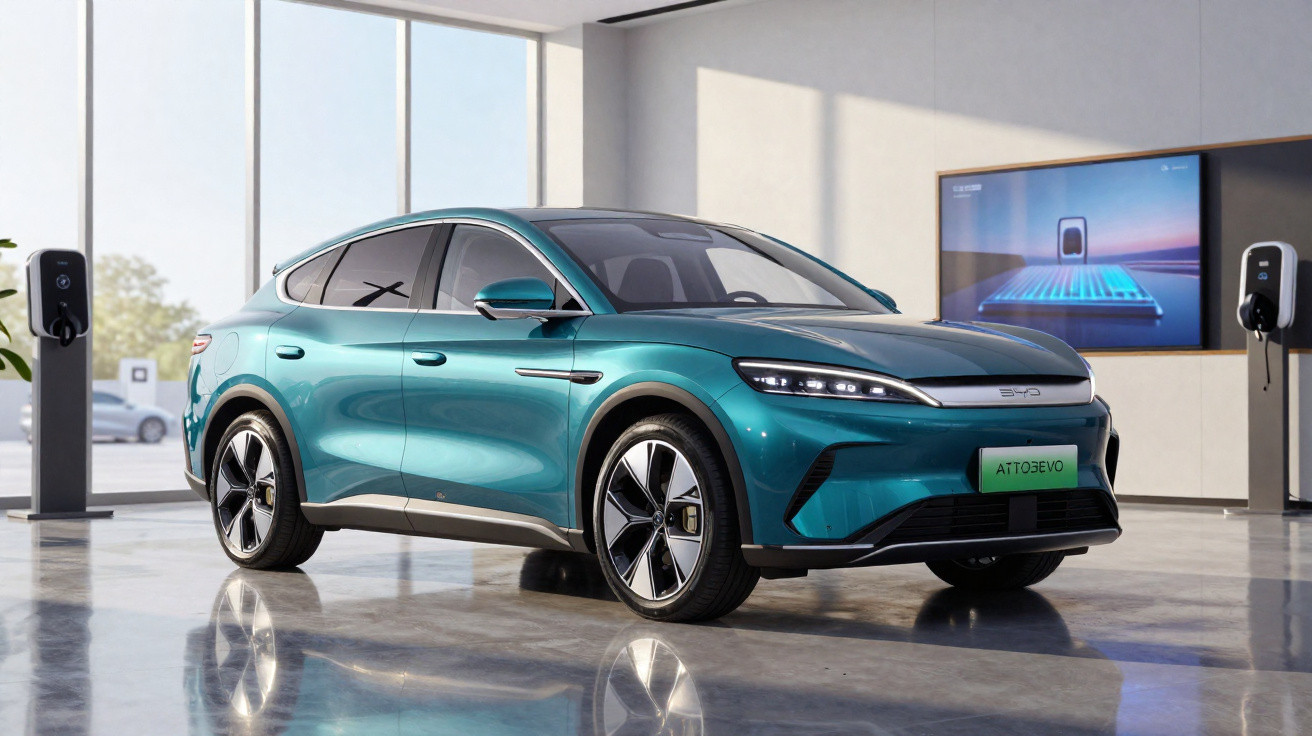
The body shape might not give much away, but the new BYD ATTO 3 EVO has been changed far more than it first appears. According to the manufacturer, this is a major step on from the first SUV the Chinese brand launched in Europe.
This goes well beyond refreshed bumpers, new alloy wheels or a few cabin touches. The underpinnings have been substantially reworked: the battery is larger, the electrical system moves to 800 V, the motor swaps axles, the drivetrain becomes rear-wheel drive, and the suspension has been revised too.
Even with the familiar ATTO 3 silhouette, the specification sheet tells a very different story.
The biggest difference is the battery
The headline change is the battery. The ATTO 3 EVO still uses BYD’s Blade Battery LFP technology, one of the brand’s best-known solutions, but capacity increases to 74.8 kWh (previously 60.5 kWh).
On the figures published by BYD, range now rises to 510 km on the combined WLTP cycle and 710 km in the urban cycle. For a family electric SUV, that is a meaningful jump, offering more headroom for everyday use, longer trips, and fewer mid-journey charging stops.
Charging performance also takes a clear step forward. With the move to an 800 V electrical architecture, the ATTO 3 EVO supports DC rapid charging of up to 220 kW. BYD says this enables a 10–80% charge in around 25 minutes. Compared with the previous ATTO 3, which was limited to 110 kW DC, peak charging power is effectively doubled.
For home or workplace charging, the ATTO 3 EVO continues to support AC charging up to 11 kW. In other words, it remains well suited to day-to-day charging routines, while being notably better equipped for longer journeys where rapid chargers are needed.
The platform has been revised
The battery upgrade is not a standalone change. The ATTO 3 EVO is still built on BYD’s e-Platform 3.0, but in a thoroughly updated form. The brand says integrating the battery into the vehicle structure via Cell-to-Body technology helps increase rigidity and frees up cabin space.
This is where the EVO separates itself most clearly from the earlier ATTO 3. Although the exterior dimensions change only slightly, it introduces a new electrical architecture, a higher-capacity battery, faster charging, and a technical foundation aligned with BYD’s latest generation of models.
For that reason, calling it merely a facelift would undersell what has been done. The name and overall shape remain, but the engineering underneath is different.
More powerful
The new architecture also brings a major change to the powertrain layout. The electric motor moves from the front axle to the rear axle. The previous ATTO 3 was front-wheel drive; the new ATTO 3 EVO becomes rear-wheel drive.
According to the brand, this layout improves packaging, weight distribution and the SUV’s dynamic responses. It also gives each axle a clearer role: the front end is no longer responsible for putting power down, while the rear axle takes over traction duties.
Power output increases as well. The electric motor now produces 230 kW, equivalent to 313 hp, along with 380 Nm of torque. That is 109 hp more than the earlier ATTO 3. The impact is evident in acceleration: 0–100 km/h is now completed in 5.5 seconds. Not long ago, that would have been the territory of sporty models; here, the aim is different-stronger response for overtakes and motorway slip roads in a family SUV.
More dynamic
Suspension has been updated as part of the platform work. Based on BYD’s technical information, the previous rear four-link multi-link arrangement is replaced by a five-link solution.
BYD’s stated goal is better body control, greater precision through corners, and improved composure over poor road surfaces. That last point is particularly relevant in a country like Portugal, where worn tarmac is easy to find.
With rear-wheel drive, the new suspension layout and the battery integrated into the structure, the ATTO 3 EVO now sits on a substantially different technical base from the one we knew.
More space where it matters
The updated hardware also brings practical benefits. Boot capacity rises to 490 litres-50 litres more than before-and can expand to 1360 litres, making the model more competitive among family-sized electric SUVs.
In addition, there is now a front storage compartment, or frunk, offering 95 litres. It is a simple but genuinely useful addition, giving you somewhere to stash charging cables or smaller items without eating into the main boot.
Versatility has been improved in another area too, with towing capacity increasing to 1500 kg, according to the figures released by the manufacturer.
New interior and Google built in
If the exterior changes are subtle, the cabin updates are far easier to spot. The interior has been redesigned, the centre console rearranged, and the gear selector has been relocated to the steering column, opening up more room between the front seats.
The 15.6-inch central display remains a standout feature, but it now incorporates Google services, including Google Maps, the Google Play Store and voice assistant. Meanwhile, the 8.8-inch digital instrument cluster adopts a more contemporary interface consistent with BYD’s newest models.
Safety and driver-assistance equipment is also fitted as standard. The package includes adaptive cruise control, lane-keeping assistance, autonomous emergency braking, blind-spot detection, 360-degree cameras, cross-traffic alerts, traffic-sign recognition and driver monitoring.
The BYD ATTO 3 EVO, then, keeps its name and overall profile, but it operates on a higher tier of hardware: a larger battery, higher charging speeds, rear-wheel drive, revised suspension, a new cabin and a different position within BYD’s line-up.
Starting price?
In Portugal, the new BYD ATTO 3 EVO is available only in Design trim, starting at 43 990 euros. Compared with the previous ATTO 3 Design, the EVO is around 500 euros cheaper despite the upgrades. BYD provides an 8-year or 250,000-kilometre warranty for the high-voltage battery.
For businesses able to deduct VAT in full, the net figure is 35 770 euros. That is a significant gap in a market like ours, where buying an EV is often influenced as much by tax treatment as by the technology itself.

Comments
No comments yet. Be the first to comment!
Leave a Comment