
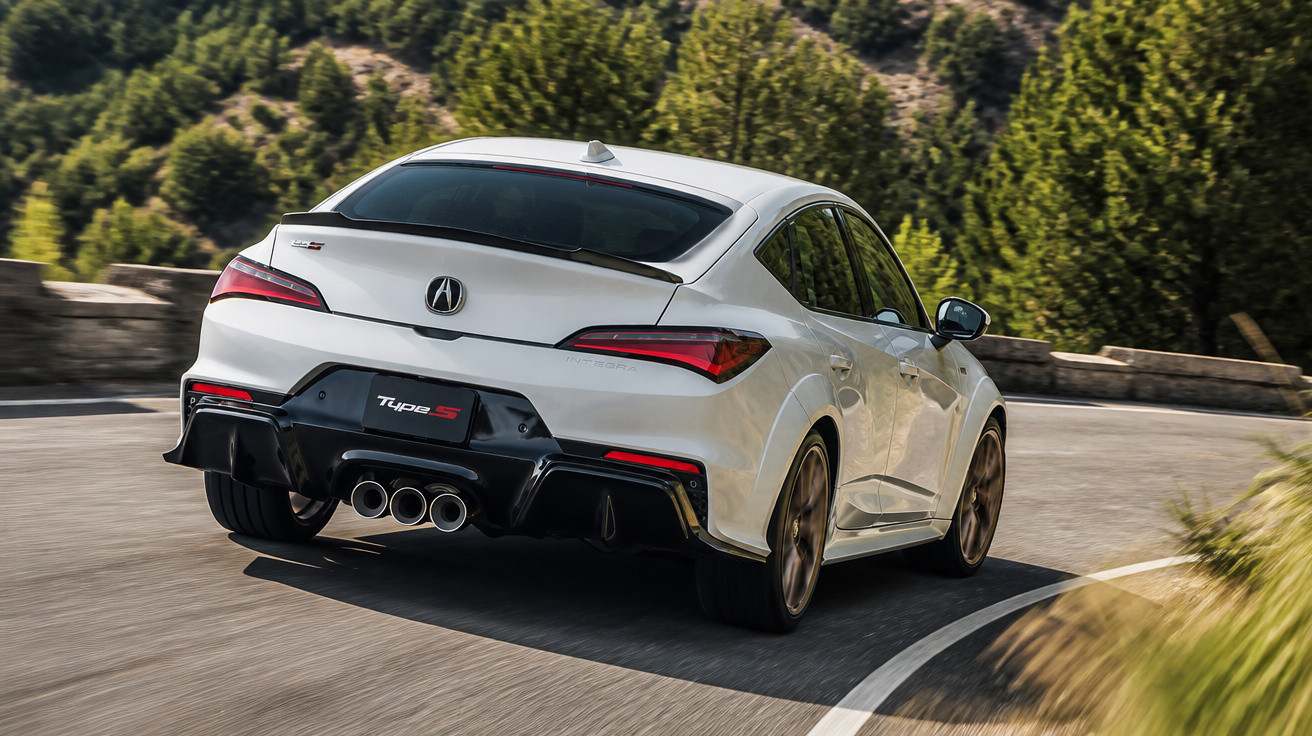
Hold on - Type S? Surely you mean Type R?
Not this time, although you’re thinking along the right lines. The Integra Type S is Acura’s interpretation of the seriously quick Honda Civic Type R, and it arrives with a longer list of creature comforts - and a correspondingly steeper price.
Even so, it isn’t merely a leather-trimmed facsimile of Honda’s hero hot hatch. If anything, the Integra Type S brings its own character. It’s a touch more forgiving and a touch more relaxed, yet still thoroughly engaging. It’s the sort of sporty compact you can live with every day, and, honestly, that counts for a lot.
More forgiving and more relaxed? Isn’t this meant to be a hot hatch?
To be clear, Acura hasn’t taken a perfectly good Civic Type R and turned it into a floaty luxury cruiser. The Integra Type S is genuinely great fun - it’s simply a bit less punishing.
Look at the chassis. Like the Civic, the Integra runs adaptive dampers, but the calibration is slightly more supple. Acura reckons the Integra’s Sport mode lines up with the Civic’s Comfort setting; in the same way, Sport+ in the Type S mirrors Sport in the Type R.
Because the differences between modes aren’t night-and-day, the Integra doesn’t lose its ability to attack tight hairpins or remain composed when you’re pressing on along a twisty B-road. The Type S feels alert from the outset. Its bespoke tuning mostly shows up when you switch into Comfort for, say, an hour of motorway miles - the Integra simply fidgets less than the Civic. Ultra-stiff performance cars are only pleasant for so long.
Fair enough. But it’s still a proper riot, right?
Absolutely. The Integra’s limited-slip differential does a brilliant job of apportioning power across the front wheels, without policing things so strictly that it wipes out every hint of playful torque steer when you squeeze the throttle on corner exit. Honda’s steering set-up is famously strong - and Acura benefits by association - and the quick rack helps the Integra feel eager, light, and easy to place.
Michelin Pilot Sport 4S summer tyres sit on 19-inch (483 mm) wheels (and yes, you can - and should - choose bronze), delivering more than enough grip for spirited runs or anything short of proper circuit work. Before long you’ll realise the Integra can carry more speed through bends than you might expect, and the sizeable 13.8-inch (351 mm) front Brembo brakes stand up to repeated heavy stops. The harder you drive the Integra, the more it seems to egg you on. It may not be quite as uncompromising as the Civic Type R, but after a couple of hours at the wheel, you really won’t mind.
And the engine stacks up, yeah?
Very much so. The Integra Type S shares the same 2.0-litre turbocharged inline-four as the Civic Type R, but the Acura edges it on power: 320hp versus the Honda’s 315. Both produce 310lb ft (420 Nm) of torque, and it arrives with real force once the rev counter sweeps past 2,600 rpm.
Drive the Type R and Type S back-to-back and the difference in powertrain calibration becomes obvious. The Civic feels more punchy and immediate when you demand power, while the Integra feeds torque in a more linear fashion, particularly at mid-throttle. The upside is that you don’t have to automatically drop a gear while braking into a corner, and you can simply lean on the accelerator to pass slower traffic in sixth on the motorway.
Hang on - does the Type S do the Type R’s auto rev-matching trick?
It does, and I’m all for it. Traditionalists often complain that this sort of system dilutes the old-school art of heel-and-toe downshifts. But having to heel-and-toe in rush-hour traffic just to keep gearchanges smooth is properly miserable - and if you want to do it yourself on a fun weekend drive, you can switch the rev-matching off. Easily.
Soapbox aside, the Integra’s manual gearbox is excellent: short, precise throws and a clutch that bites with reassuring consistency. Acura’s compact gear lever is wrapped in leather around its circumference, though the exposed metal top is still there, ready to imprint the shift pattern into your palm on a scorching summer day.
Sounds clutch (pun intended). But what about the noise from that 2.0-litre…
You’re not wrong - the turbo four-cylinder isn’t exactly a sonic masterpiece - but the trio of large tailpipes delivers a rich exhaust note. Better still, an active exhaust valve opens in Sport+ so you get the cheeky snap-crackle-pop soundtrack that makes hot hatches so likeable.
At the same time, the Integra stays fairly hushed in the cabin - certainly quieter than a Civic Type R. Honda removed some sound-deadening in the Type R to save weight; Acura left it in place for the Type S, which cuts wind and tyre roar at higher speeds. The weight hit is modest, too: at 3,219 pounds (1,461 kg), the Integra Type S is only 31 pounds (14 kg) heavier than a Civic Type R. That’s a respectable trade.
Right - but there must be some downsides
Yes, a couple, though they’re largely minor and a bit picky. My main complaint is that the Integra doesn’t get a rear wiper, which is irritating on wet mornings. Acura argues the car is aerodynamic enough to shift water off the rear glass as you drive, but I’ve never found that to be true. And the Civic has a rear wiper. Really.
I’d also say Acura (and Honda) feels slightly behind the curve with infotainment. The 9in (229 mm) centre display is a good size, but the software is basic and the menus can be fiddly. On the plus side, Apple CarPlay and Android Auto work wirelessly, and every Integra Type S comes with Acura’s excellent 16-speaker ELS audio system plus a full set of driver-assistance features. It even includes adaptive cruise control - yes, paired with a manual gearbox.
What’s the cabin like otherwise?
It’s a pleasant place to be, and noticeably more upmarket than the Civic Type R. The leather front sports seats are electrically adjustable, with three-stage heating, and they’re supportive enough to keep you firmly planted when you’re driving quickly. The driving position is spot on as well, giving you a clear view over the bonnet even with the seat at its lowest setting.
Adults will fit in the rear, although taller passengers will feel a bit squeezed thanks to the sloping roofline. With the back seats up, there’s a decent 24.3 cubic feet (688 litres) in the boot area (Acura doesn’t quote a seats-folded figure), but the relatively high bumper makes lifting heavy items in a little awkward. Bring a mate.
So, “decision time.” Integra Type S or Civic Type R?
They’re both excellent, and it really depends on what matters most to you. The Civic is the more single-minded tool: slightly sharper on the road and clearly better suited to track use. The trade-off is that it feels more rough-and-ready, and the large rear wing broadcasts its intent - even if the current Type R’s styling is calmer than earlier versions.
The Acura, by contrast, is the kind of hot hatch you could plausibly drive to a serious grown-up office job every day and still look the part. It’s more comfortable than the Civic and packs in more amenities, yet it doesn’t short-change you on excitement. Naturally, that comfort costs: at $51,995 to start, including a $1,195 destination fee, the Acura is $7,105 more expensive than a Civic, and that’s not pocket change.
Mate, I said “decision time.” Stop sitting on the fence.
Alright then - I’ll have the Integra. I think it’s the better-looking of the two, and - grimace - I’m in my late 30s and I want the cosseting luxury of heated seats while I’m hurrying along mountain roads. The Integra’s biggest strength is how little of the Type R’s brilliant performance it gives up, while still meeting my desire for a daily driver with some proper nice-to-haves. The Civic Type R is a cracker, but the Integra Type S is the stronger all-rounder, without question.
Comments
No comments yet. Be the first to comment!
Leave a Comment