
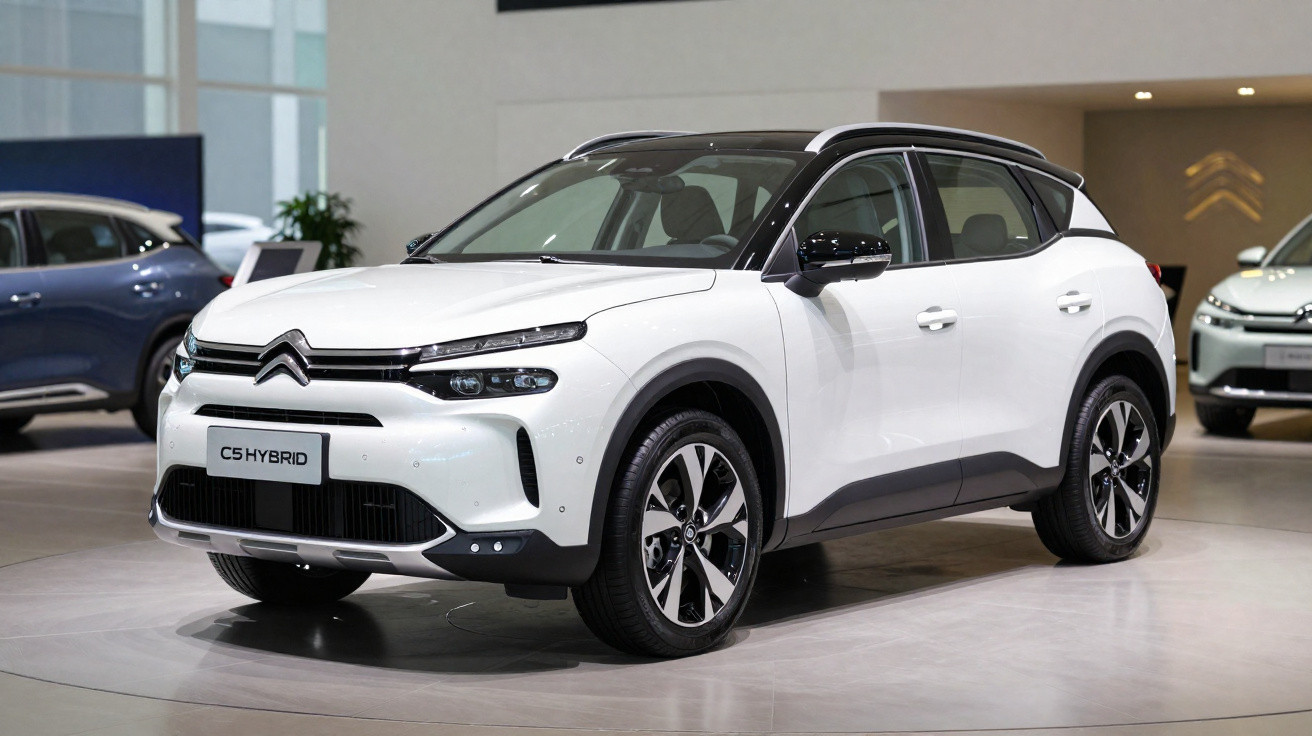
With all the recent controversy surrounding plug-in hybrids - from claims that they are an “environmental disaster” to the contentious PAN proposal for the 2021 State Budget to strip them of tax benefits - aboard the Citroën C5 Aircross Hybrid, everything feels calm, as if none of it applies.
“Calm” is, in fact, the best word not only for Citroën’s first plug-in hybrid, but for the C5 Aircross overall. That’s something we have confirmed on several occasions: when we first met it in Morocco in 2018; earlier this year on home soil at the wheel of the 1.5 BlueHDi; and, more recently, during the dynamic launch (on video) in Spain of this new Hybrid.
After spending several days in Portugal driving the C5 Aircross Hybrid, we had time to understand its strengths and weaknesses - and also to clear up questions around the much-debated issue of consumption/emissions figures for plug-in hybrids.
1.4 l/100 km - is it possible?
If you have read and/or watched our tests of other plug-in hybrids, you will have noticed a pattern: the consumption figures we achieve are always higher than the official combined values - two, three, or even four times higher - and it’s not hard to see why. In WLTP certification tests for plug-in hybrid consumption and emissions, the battery is at maximum charge, so naturally the electric motor alone is used for a substantial portion of the test.
It’s no surprise, then, that most plug-in hybrids advertise combined consumption below 2.0 l/100 km and CO2 emissions under 50 g/km. The C5 Aircross Hybrid claims just 1.4 l/100 km and 32 g/km, along with an electric range of 55 km. In the real world - more chaotic and far removed from the controlled lab environment, where it isn’t always possible to recharge the (small) battery as often as it demands - the combustion engine has to step in much more frequently.
The same holds true for the C5 Aircross Hybrid we tested here. Yes, it is possible to match the official 1.4 l/100 km figure - and even do better - if your daily driving is made up of short trips and you have a charger close at hand. But once the battery is out of “juice” - with relaxed driving, I managed roughly 45 km of zero-emissions range - consumption in the 6–6.5 l/100 km region is easy to reach.
Is that a lot more? Absolutely. Does that make it an “environmental disaster”? Clearly not. These numbers need context.
We are talking about consumption figures that sit a little above what we recorded with the C5 Aircross 1.5 BlueHDi. The difference is that, in the Hybrid, the 1.6 PureTech delivers 180 hp, rising to 225 hp when the electric motor is added, while the Diesel remains at 130 hp. The electrified C5 Aircross is much quicker - not only on paper but in the way it feels - thanks to the electric motor’s instant torque, even though it is several hundred kilograms heavier.
As we have said for every other plug-in hybrid we have tested, this C5 Aircross Hybrid isn’t for everyone, and it only truly makes sense when it is charged frequently.
Smooth - perhaps too smooth
Choose the Citroën C5 Aircross Hybrid and you will find a very comfortable, refined family SUV. The C5 Aircross is comfortable in any version, but this hybrid variant adds an extra layer of refinement - in other words, better sound insulation.
That is slightly ironic, because the Hybrid is also the most powerful and among the quickest C5 Aircross versions. The electric motor’s immediate torque contributes significantly to the lively performance that is genuinely satisfying, and the SUV can really shift when asked. The coordination between the two power units is impressively polished - the combustion engine doesn’t cut in abruptly and noise levels are well contained - while the ë-EAT8 (eight-speed automatic) does a very good job of managing the whole system.
Even so, the driving experience can feel a little contradictory. On one hand, you have performance that encourages you to explore it; on the other, everything else about the C5 Aircross Hybrid urges a more measured pace.
That can be down to the assistance of its controls, which is consistently high even when it shouldn’t be - the steering, for instance, lacks weight on the motorway; or the very soft suspension damping, which shows some limitations in controlling body movements when you raise the tempo; or even the ë-EAT8 itself, which can hesitate when you press the accelerator more decisively (a trait that remains in manual mode).
Take a deep breath, ease off the pace, and soften your inputs on the steering and pedals, and the harmony between the mechanical and dynamic set-up returns. After all, this is a family SUV, not a hot hatch, and if there is one theme that defines the C5 Aircross, it is comfort. Even so, a little extra weight and a stronger sense of connection between driver and machine would be welcome. Which makes us wonder why there is a Sport mode at all…
That said, the handling is safe and benign. There are no odd reactions, and everything remains progressive.
SUV or MPV? Why not both?
Beyond that, it is the C5 Aircross we already know: as well as being comfortable, it is also notably versatile, in a way that recalls MPVs. It is still the only model in the segment to offer three identical, individual rear seats, all sliding over 150 mm, with backrests that recline and fold. Space in the second row is perfectly reasonable (particularly good for width), but rivals from the Volkswagen Group - the Skoda Karoq, Volkswagen Tiguan, and SEAT Ateca - offer more legroom and a greater perceived sense of space.
The Citroën C5 Aircross Hybrid does, however, have a drawback compared with its other range siblings. The batteries fitted at the rear steal boot capacity, dropping it from a quoted 580–720 l (depending on the rear seat position) to a more modest, though still meaningful, 460–600 l.
Is it the right car for me?
It’s a difficult question to answer, because this version is so specific. The C5 Aircross Hybrid does its job effectively as a family vehicle - its MPV-like genes play a big part in that - but the plug-in hybrid powertrain will not suit everyone, because it only truly makes sense if you regularly recharge the battery (which even nudges you towards more urban use).
What’s more, it carries the burden of combining two powertrains (combustion and electric), which pushes the price to figures above €46,000 - over €48,000 in the case of our test car once the cost of options is added. It is likely to make more sense for a company, in order to benefit from the tax advantages that (still) exist for this type of vehicle.
For private buyers, there are cheaper choices within the C5 Aircross range, although the only one that offers performance of a similar level is the petrol-only 1.6 PureTech with 180 hp and the EAT8 gearbox. Even though it is around €7,000 more affordable (give or take), it will always use far more fuel.

Comments
No comments yet. Be the first to comment!
Leave a Comment