
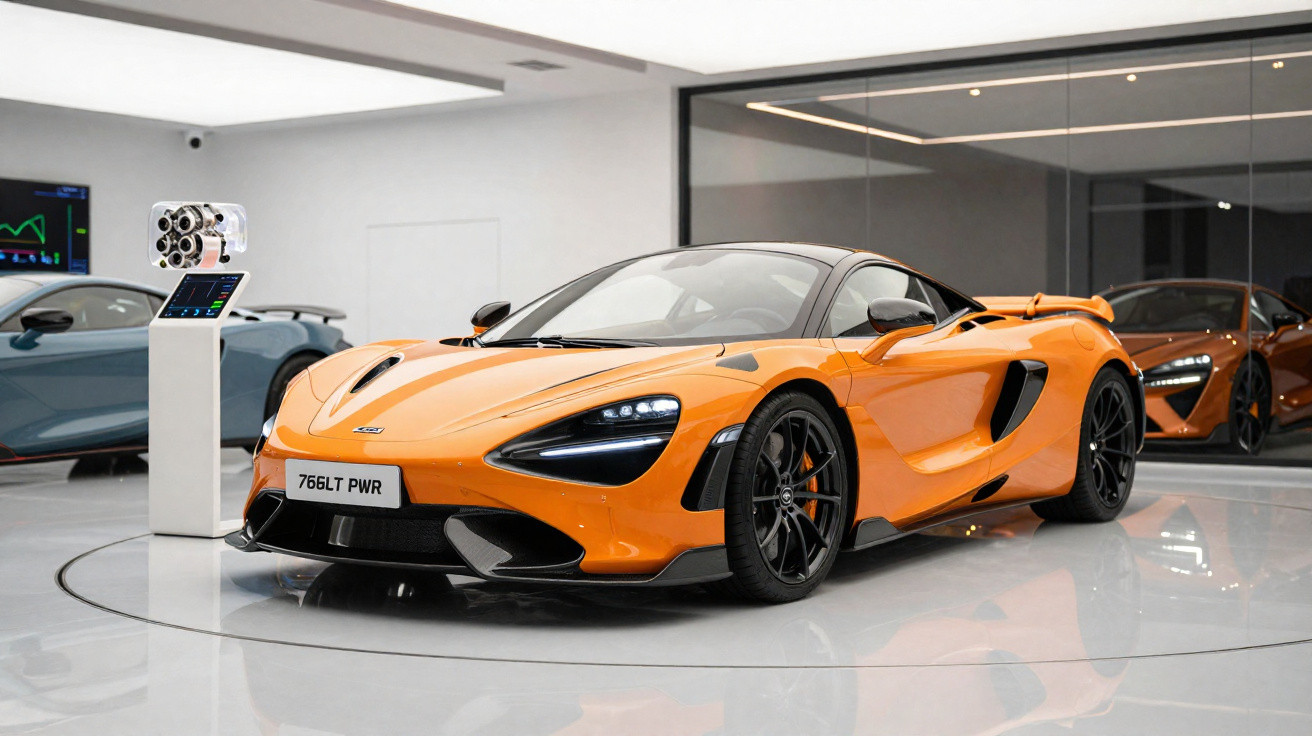
As one of McLaren’s last purely combustion-powered models, the McLaren 765LT arrives with an impressive calling card: a 4.0 l twin-turbo V8-a layout that already makes you miss an era that is clearly nearing its end-officially rated at 765 cv and 800 Nm.
Even with figures like these, and given the real-world pace already proven by the British supercar, the official output almost feels a touch conservative.
There is only one way to find out whether it is hiding extra power: strap the 765LT to a rolling road. That is exactly what the DragTimes YouTube channel and Hennessey Performance decided to do.
The moment of truth
Rolling-road results can always attract some scepticism (after all, dynos can be miscalibrated). This time, however, the findings are better supported: two different 765LTs were tested on two different dynamometers.
DragTimes carried out three runs. The first two were completed in fifth gear, and on the very first attempt the wheel horsepower was recorded at 776 cv, with 808 Nm of torque.
On the second run, wheel power climbed to 780 cv (torque stayed at 808 Nm). Finally, a third pull in sixth gear produced 768 cv, while torque edged up to 822 Nm.
Hennessey Performance also tested in fifth gear and measured 791 cv at the wheels-once again, a figure comfortably above the official claim.
There is, however, an important caveat: neither set of numbers was achieved using “regular” pump petrol. In both cases, the British supercar was run on race fuel-higher-octane petrol-which, unsurprisingly, influenced the readings.
So where does that leave us?
By now you may be thinking, “look, with some fancy fuel even my car has more power”. That is not always the case, and it is worth keeping the wider context in mind.
To settle the question, Hennessey Performance also performed a dyno run on the 765LT using “normal” fuel-meaning the grade recommended for this model, the North American equivalent of our 98 (93 in the US).
So what happened on regular fuel? The McLaren 765LT showed 758 cv at the wheels, which strongly suggests that at the crankshaft it is very likely making more than the quoted 765 cv.
Why? It is straightforward: crankshaft output is always higher than wheel output because drivetrain losses occur between the crank and the tyres. Power has to travel through the gearbox, driveshafts, differential and more-some is always lost along the way.
With a traditional automatic transmission, drivetrain loss through the driveline is often estimated at 25%. The 765LT, however, uses a modern dual-clutch automatic gearbox and a rear mid-engine layout (which avoids the need for a long propshaft). For that reason, DragTimes suggests a loss of only 13%, based on other similarly configured cars they have tested.
Running the numbers, if 13% is the appropriate loss figure on standard fuel, then the 765LT’s twin-turbo V8 should be producing roughly 857 cv at the crank-90 cv more than the official figure. On higher-octane race fuel, that estimate would sit somewhere between 866 cv and 890 cv. Impressive.
Comparison with the 720S
Another takeaway from these tests is that, judging by the measured outputs, the power gap between the McLaren 765LT and the 720S appears far larger than McLaren officially states.
Here is the reference point: on another occasion, the same YouTube channel tested a 720S on a rolling road and recorded 669 cv and 734 Nm at the wheels. If you do the maths, that implies the difference between the two cars is closer to 100 cv, rather than the official 45 cv.
That may help explain just how much quicker the McLaren 765LT can be than the already ballistic 720S-something Hennessey Performance illustrates in a drag race.

Comments
No comments yet. Be the first to comment!
Leave a Comment