
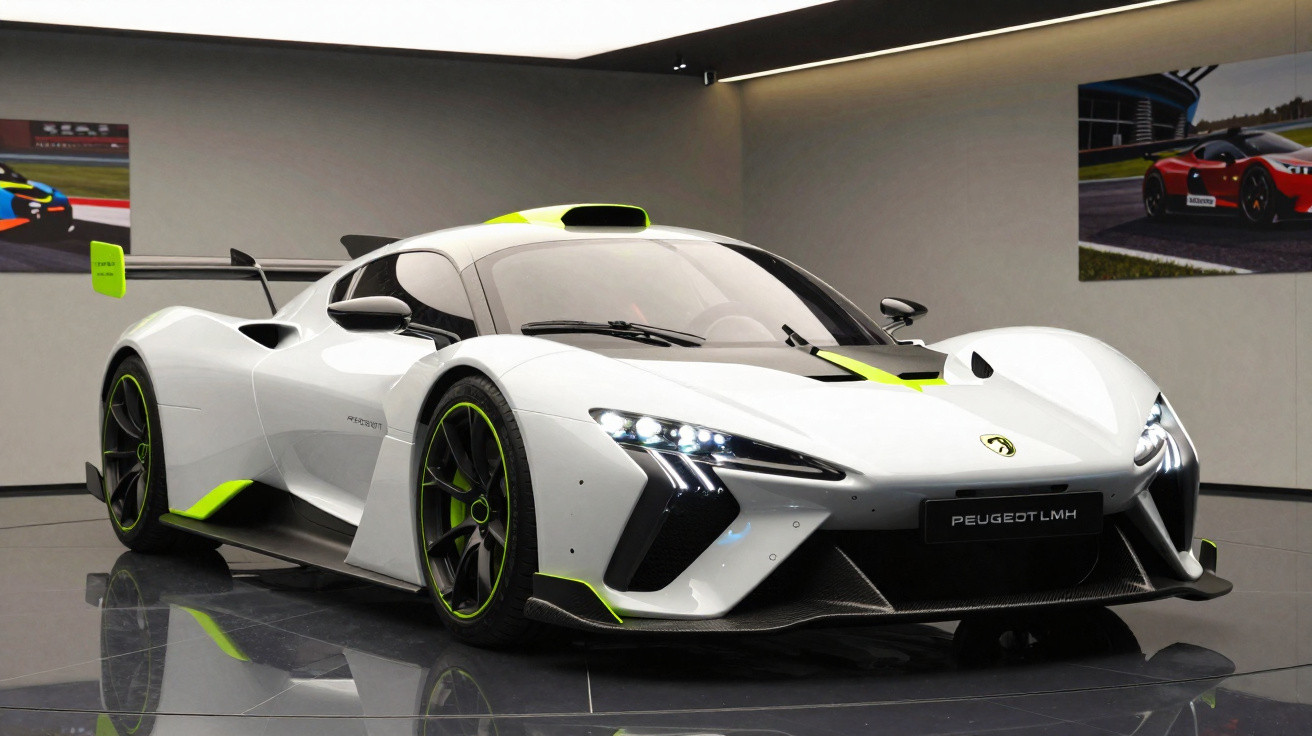
The first announcement came in September 2020: Peugeot, via Peugeot Sport-its motorsport division-would return to endurance racing (the WEC, or FIA World Endurance Championship) and to the 24 Hours of Le Mans in 2022, entering the new Hypercar class.
Given Peugeot’s history at Le Mans-winning with the 905 (1992 and 1993) and later with the 908 HDi FAP (2009)-it is hardly surprising that the news created such high expectations. From the French brand, anything less than victory is what many will be looking for.
Peugeot Sport’s Hypercar has not yet been unveiled. Even so, Olivier Jansonnie, Peugeot Sport’s technical director, has already indicated the design is 95% finished-and we also now know what will power it.
It will be a pure prototype. Unfortunately, we recently learned it will not have a road-going counterpart, despite that having once been set out in the class regulations. It will also be a hybrid.
The car has not been named yet, but its headline technical layout is already known: a 2.6 l (90º) twin-turbo V6 mounted in a rear mid-engine position, capable of producing up to 680 cv and driving only the rear axle; plus an MGU (motor-generator unit) rated at 272 cv to drive the front axle. Even so, the combined output of both power sources is not allowed to exceed 680 cv (500 kW). That means the 2.6 V6 must be capped at 408 cv (300 kW) whenever the electric motor is operating. Here is what we know so far about the new machine:
The drivers
Naturally, the car is only half of the story-we also need the drivers. Peugeot Sport has now announced the line-up that will form the backbone of its WEC and 24 Hours of Le Mans campaign from 2022.
According to Peugeot Sport, the driver selection process began some time ago. An initial group of 40-50 drivers was narrowed down after analysing each candidate’s statistics across the WEC, IMSA and LMS, producing a final shortlist of 12-before the team ultimately chose the seven drivers who will make up the programme.
Perhaps the standout name is Kevin Magnussen, the Danish Formula 1 driver who raced for Haas in 2020. Even coming from the top tier of motorsport, his limited background in endurance racing is clear. Magnussen aims to address that this year by driving a Chip Ganassi Racing Cadillac prototype in the IMSA championship (the equivalent of the WEC). You can see the remaining drivers in the gallery below:
Although the seven drivers have only just been announced, their work will begin shortly-well before the car is ready to run. Not only will they be actively involved in the development of the Peugeot Sport Hypercar, but simulator work has already started.
LMH or LMDh?
The new Hypercar category, also known as LMH (Le Mans Hypercar), in which Peugeot Sport will compete, has undergone changes by its creators-the FIA and the ACO-to better align and balance the cars against another new class: LMDh (Le Mans Daytona Hybrid). The move proved controversial and, for example, led Aston Martin to pause development of the Valkyrie LMH.
LMDh cars benefit from lower costs versus LMH because they use a range of standardised or shared components across all entrants. For instance, while participating manufacturers can use their own engine and bodywork, the chassis must come from ORECA, Ligier, Dallara or Multimatic; and the hybrid system is the same for everyone.
To bring on-track performance between the two categories closer together, the minimum weight and the maximum combined power are now also identical: 1030 kg and 680 cv (500 kW), respectively.
Even so, Peugeot Sport has opted to stay in the Hypercar class. Although development is more expensive, the regulations allow greater freedom-something Jean-Marc Finot, programme director, highlighted during the Q&A after the driver reveal: “the Le Mans Hypercar category offers more freedom in the design regulations (Editor’s note: aerodynamics and styling) and allows us to develop new technologies ‘in-house’.”
That advantage could translate more directly into future electrified Peugeot road models. It also fits with Peugeot Sport’s choice of Total as the Hypercar development partner-a collaboration that will also lead to battery manufacturing in Europe from 2023.
When will we see the Peugeot Sport Hypercar?
According to Olivier Jansonnie, Peugeot Sport’s technical director, it will still be months before the finished car is revealed. Bench testing of the Hypercar’s V6 is only due to begin at the end of April, and mating it with the MGU in the new chassis is expected to take place in November.
If everything stays on schedule, the Peugeot Sport Hypercar should begin its first dynamic tests towards the end of this year.
Comments
No comments yet. Be the first to comment!
Leave a Comment