
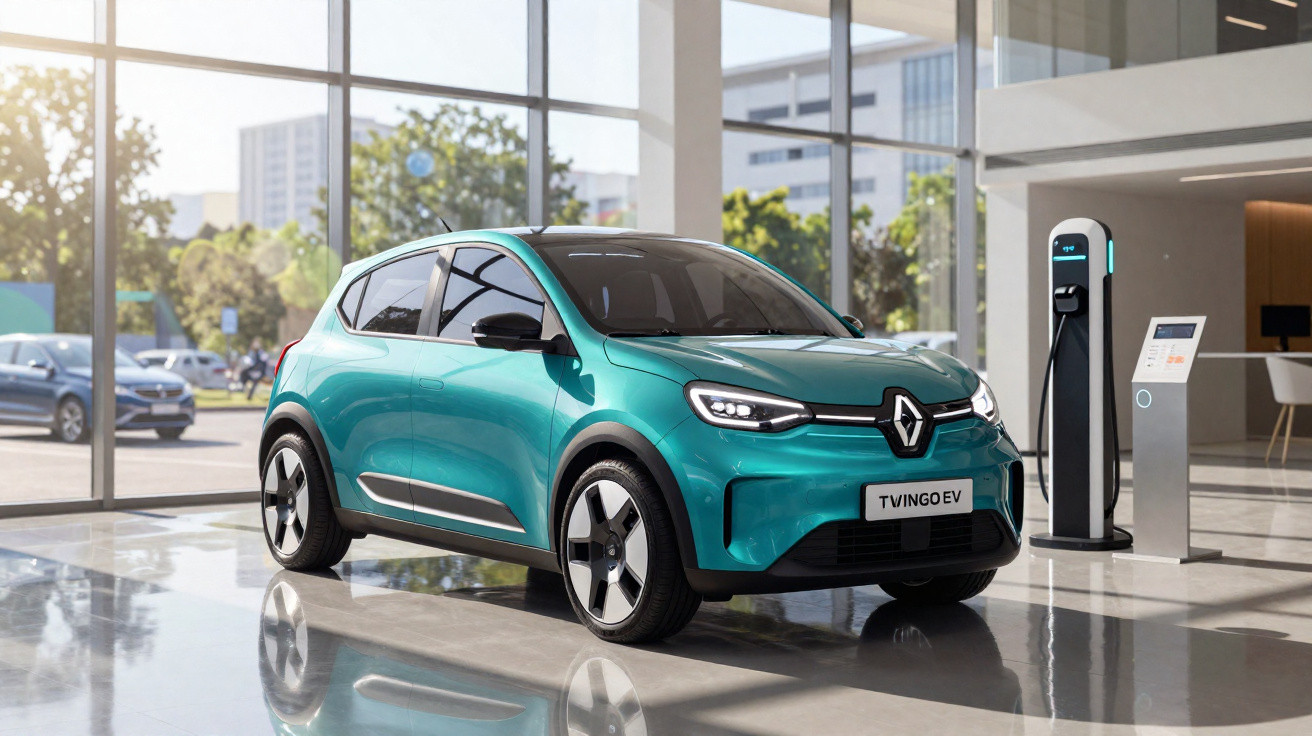
It may be a case of better late than never. Still, it is hard not to wonder why Renault took so long to bring out the Twingo Electric, its 100% electric version. Not only has its Smart “cousin” been available as an EV since 2018, but the French brand has also led the compact electric-car market in Europe in recent years with the Zoe - the best-selling electric car on our continent in 2020.
The delay is also surprising given the depth of technical know-how inside the Renault–Nissan–Mitsubishi Alliance. The Twingo Electric is Renault’s seventh fully electric model, and it arrives with technology that continues to move on - in this case, a more compact liquid-cooling system for the battery pack, whereas every previous Renault EV relied on air cooling.
Renault’s explanation is that the Zoe’s range was initially lower than it is today, and that would not have allowed the brand to create enough separation between the two models.
In terms of looks, there is little to distinguish it from the petrol car. You get a specific blue-accent “grille”, the same blue theme can appear on the wheels and, on some versions, in a painted line running around the bodywork, plus Z.E. badging (for Zero Emissions, even though the model’s official name is Twingo Electric) on the side and the rear.
The charging port sits exactly where the fuel filler is on the petrol Twingo. Inside, the differences are just as subtle: there are a few EV-specific customisation options offered through different packs, or simply alternative colours used for the trim rings around the air vents, the steering wheel and the transmission selector.
As you would expect in this class, all the plastics are hard to the touch. The dashboard carries an instrument cluster with an analogue speedometer and an integrated monochrome display that looks rather dated, plus a 7” screen used to control and show the infotainment system. Apple and Android smartphone users can connect to the Twingo Electric without fuss, and the usual apps are available to manage charging and plan journeys according to available range and route.
Spacious cabin, small boot
You are sitting in a narrow car (designed for four people), but it is tall: occupants up to 1.90 m will not brush the headlining. The driving position is high because the batteries sit directly under the front-seat area, which has required the platform to be raised.
Rear-legroom for the two passengers in the second row is more generous than in the Volkswagen e-Up, Skoda Citigo and SEAT Mii electric rivals (people measuring 1.80 m fit without undue discomfort), helped by the French car’s wheelbase being 7 cm longer.
Overall length is only 3 cm to 5 cm greater than these competitors (and, in reality, the three Volkswagen Group cars are the same vehicle), which means the Renault’s body overhangs are shorter. Even so, the Twingo’s boot is smaller - 188-219 l versus 250 l in the Volkswagen Group rival.
The fact that the platform was engineered from the outset with future 100% electric versions in mind explains why the Twingo Electric’s boot capacity matches that of the combustion-engined versions. The engine is always mounted over the rear axle, and the smaller size of the electric motor also helps make that packaging possible.
Agility is entertaining, but comfort on rough roads disappoints
It is once you start moving that the Twingo Electric really stands apart. It is much quieter than the three-cylinder versions and, naturally, it launches far more promptly the moment the accelerator pedal “catches the scent” of the driver’s shoe sole. The 0 to 50 km/h time of 4,2s delivers excellent urban zip, while 0 to 100 km/h (less relevant in a car that is essentially city-focused) takes virtually the same 13 seconds as the 95 cv petrol version (now discontinued, leaving only the 65 cv version).
Set against the Volkswagen e-up, the Twingo is clearly slower - its 12,9 seconds mean it needs an extra second for the same sprint. That is not so much down to peak output (82 cv for Renault, 83 cv for Volkswagen), but rather the lower torque (160 Nm versus 210 Nm) and a less favourable drag coefficient. Top speed is 135 km/h, which means that on occasional motorway runs the Twingo Electric can hold its own among the “sharks”.
That said, it feels far more like a “fish in water” around town. Its manoeuvrability is notable not only for its nimble responses but also for the tiny space it needs to turn around, because the front wheels can steer further without an engine in the way: 9,1 m for a full 360º turn between walls, or 8,6 m between kerbs - half a metre less than its rivals. The first few times you try it, it is hard not to grin, as it feels as if one wheel stays put while the other three swing around it.
Rear-wheel drive also keeps certain vibrations and torque effects out of the steering, making the car genuinely relaxing to drive. In terms of feedback, though, the steering is very light and you do a lot of turns lock-to-lock (3,9), precisely because the wheels steer more than usual (45º).
Given how tall and narrow it is, you might expect more body roll, but the extra weight, the lower centre of gravity and a notably “firm” suspension set-up keep it stable - even if ride comfort on poor surfaces is the price you pay.
The single-speed selector lever sets drive, reverse or stop, and it also lets you choose one of three energy recuperation levels via regenerative braking. In truth, the difference between B1, B2 and B3 is too slight - probably the smallest separation I have experienced in any electric car.
Alongside those three settings, there are also Normal and Eco driving modes, selected via a button on the lower dashboard. In Eco, top speed and maximum power are restricted (if you press the accelerator fully, that limitation disappears for situations where you urgently need the extra power).
Charging: highs and lows
This brings us to two points that could either justify choosing a Twingo Electric over its rivals… or do exactly the opposite. On the plus side, its highly adaptable onboard charger means AC charging can be handled across a wide range, from 2 to 22 kW.
In fact, along with the smart forfour, it is the only one that can accept such a high AC charging rate - the Volkswagen e-Up tops out at 7.4 kW AC. The impact on charging times is significant: 1,5 hours for a full battery (or half an hour to add enough for 80 km), while the Volkswagen Group rivals can take up to 5 hours.
On the downside, the Renault does not support rapid charging - DC, or direct current - unlike the Volkswagen, SEAT and Skoda triplets which, at 40 kWh (the maximum power they accept), can take the battery to 80% in just one hour. As public DC chargers become more widespread, this is an important consideration.
Range limited by a small battery
The battery is also smaller, with just 21,4 kWh of usable capacity - 11 kWh less than the quoted competition - which results in an official WLTP mixed-cycle range of 190 km, compared with 260 km for the German group car.
In practice, it can vary from 110 km in especially unfavourable conditions (very low ambient temperature - batteries do not like the cold - plus the radio and air conditioning running, and so on) to 215 km in Eco mode, and it can reach 250 km in purely urban driving.
It is true that the average European urban driver covers no more than 30 km per day in an A-segment city car (so you can almost get through the working week without “plugging in”), but it is still a mark against the Renault. Its lighter weight could have helped (at 1135 kg, it is 50 kg lighter than the rivals mentioned), yet it does not translate into better performance (which is worse) nor into the quoted consumption figure which, at 16 kWh, is the highest (the trio of “Teutonic enemies” sits between 13,5 and 14,5 kWh).
Interestingly, during this test I beat the official average without doing anything out of the ordinary, and without any attempt to enter the Guinness record for the most frugal electric car. The route covered 81 km, leaving Loures, a short stretch of motorway into Lisbon, then through central Lisbon (avenues, Baixa, Santa Apolónia) and back to Loures via central Alverca - in other words, a mix of fast roads, intermediate routes and urban streets.
The average was 13,6 kWh/100 km, and I finished with 52% battery remaining, still showing enough for another 95 km on a cold, rainy day. In other words, 81 km driven plus 95 km remaining gives 175 km in total, close to the 190 km promised by the French brand.
Technical Specifications
| Renault Twingo Electric | |
|---|---|
| Electric motor | |
| Position | Rear transverse |
| Type | Synchronous |
| Power | 82 cv (60 kW) between 3590-11450 rpm |
| Torque | 160 Nm between 500-3950 rpm |
| Battery | |
| Type | Lithium-ion |
| Capacity | 21,4 kWh |
| Voltage | 400 V |
| No. of modules/cells | 8/96 |
| Weight | 165 kg |
| Warranty | 8 years or 160 000 km |
| Transmission | |
| Drive | Rear-wheel drive |
| Gearbox | Single-speed reduction gear with reverse |
| Chassis | |
| Suspension | FR: Independent, MacPherson; TR: Rigid De Dion type |
| Brakes | FR: Ventilated discs; TR: Drums |
| Steering | Electric assistance |
| Turning circle diameter | 8,6 m |
| Dimensions and capacities | |
| Length x Width x Height | 3615 mm x 1646 mm x 1557 mm |
| Wheelbase | 2492 mm |
| Boot capacity | 188-219-980 l |
| Wheels | FR: 165/65 R15; TR: 185/60 R15 |
| Weight | 1135 kg (EU) |
| Performance and consumption | |
| Top speed | 135 km/h (electronically limited) |
| 0-50 km/h | 4,2s |
| 0-100 km/h | 12,9s |
| Combined consumption | 16 kWh/100 km |
| CO₂ emissions | 0 g/km |
| Combined range | 190 km |
| Charging | |
| Charger | Adaptable charger, single-phase or three-phase (2 kW to 22 kW) |
| Full charge times | 2,3 kW: 15 hours; 3,7 kW: 8 hours (Wallbox); 7,4 kW: 4 hours (Wallbox); 11 kW: 3h15min (charging point, three-phase); 22 kW: 1h30min (charging point, three-phase) |
Comments
No comments yet. Be the first to comment!
Leave a Comment