
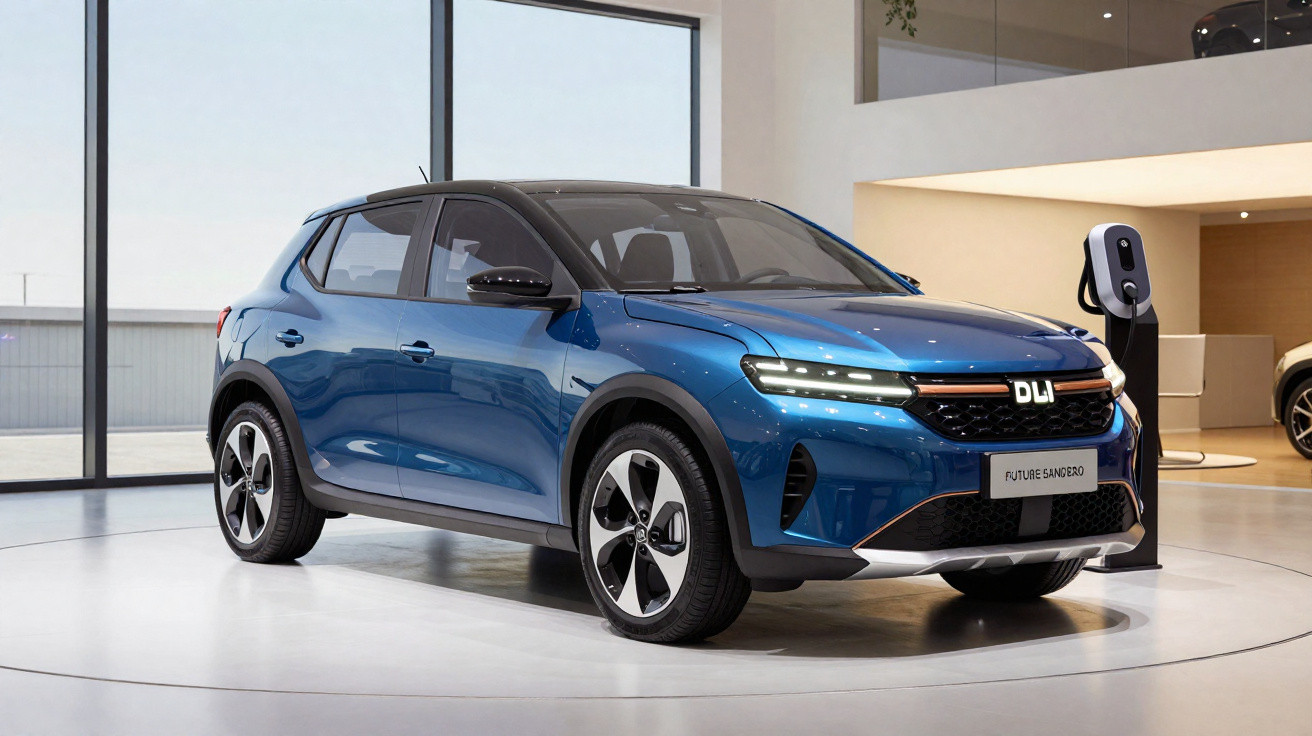
Romania’s evergreen hit is approaching a crossroads: Dacia’s best-selling Sandero has to reinvent itself for the electric era.
For years, the Dacia Sandero has been something of an under-the-radar star in Europe’s registration charts. While brands such as Volkswagen, Renault or Stellantis pour money into costly electric programmes, Dacia has been shifting its low-priced supermini in five-figure volumes almost as a side act. But Renault’s group reshuffle and its refreshed long-term roadmap are starting to test the once-straightforward promise of “lots of car for little money”.
Renault plan FutuREady: Dacia has to become more electric
Renault, as the parent company, has laid down firm expectations with its “FutuREady” strategy package. Dacia-until now mainly defined by value and toughness-is meant to move much further towards electrification. At present, the line-up includes only one fully electric vehicle, the small city EV Spring.
Dacia will introduce three additional electric models by 2030, significantly expanding its battery-electric offering.
At the same time, the company does not intend to erase everything associated with combustion overnight. Dacia is deliberately pursuing a transitional step, aimed particularly at budget-focused customers who still find a pure electric car a difficult switch.
Multi-energy instead of an electric-only mandate
Dacia is planning a modular approach to powertrains. The intention is to offer a blend of:
- Petrol engines for traditional buyers who want to keep costs as low as possible
- Eco-G versions running on autogas (LPG), promising lower running costs and reduced CO₂ emissions
- Hybrid systems combining a combustion engine with an electric motor
- Additional fully electric cars in the lower price brackets
This multi-energy strategy is already working well for models such as the Jogger and Duster. The new Striker crossover-around 4.62 metres long and positioned between an estate car and an SUV-is intended to push the idea further while also filling the gap between the traditional compact class and crossovers.
What happens to the Dacia Sandero?
The question many readers care about most is simple: will the Sandero stay in the range at all? The answer, internally, is more straightforward than you might expect.
There is no internal talk of discontinuing the Sandero-on the contrary, the model is seen as an indispensable pillar of the brand.
Across Europe, the supermini is Dacia’s best-selling model. In France, for example, the brand put more than 6,500 units on the road in the first two months of the year-more than Renault managed with the Clio or the R5 E-Tech over the same period. You do not quietly park a sales workhorse like that.
The current generation will remain for a few more years
There is also a practical reason: the existing model line has only recently received a facelift. The front end, cabin and infotainment have been refreshed, and driver-assistance systems have been refined. Manufacturers only invest in updates like these when they are planning several more years of production.
In its documentation, Dacia refers to a “next chapter” for the Sandero. The wording is intentionally broad, but the message is clear: the name stays, even if the engineering evolves. A full new generation is not imminent, but its outline is already beginning to appear.
What might the next Sandero generation look like?
One thing is clear: the next iteration of the Sandero is expected to be far more wide-ranging in terms of drivetrains. The company is signalling a “multi-energy” line-up-meaning more than a single extra engine choice.
The future Sandero generation is intended to bring petrol, Eco-G and very likely a hybrid powertrain together under one roof.
In the context of group targets, that approach is logical. Renault has stated that by 2030 Dacia aims to achieve roughly two thirds of its sales with electrified drivetrains. Without a high-demand, high-volume model such as the Sandero, that ambition is difficult to imagine. As a result, a Sandero featuring hybrid technology is widely seen as close to inevitable.
Combustion stays-but with electric assistance
Rather than jumping straight to a fully electric supermini, Dacia is likely to lean on hybrids, for three reasons:
- Price: In the supermini segment, battery-electric cars are still difficult to offer cheaply. A hybrid using an existing platform is more cost-effective to deliver.
- Target audience: Sandero buyers prioritise purchase price and running costs, not maximum range or the latest high-tech extras.
- Infrastructure: Not every market where the Sandero performs strongly has a dense rapid-charging network.
A hybrid Sandero could handle much of everyday urban driving with an electrified component, while still refuelling normally for longer trips. For commuters with limited budgets, that would be a tangible benefit.
New electric superminis are getting closer-will the Sandero face in-house competition?
Alongside the Sandero’s ongoing development, Dacia is pushing ahead with a new generation of small electric cars. The current mini EV, the Spring, is due to be replaced in a few years. At the same time, internal material also mentions another fully electric supermini model line that is meant to serve the very bottom of the price scale.
That inevitably raises the question of whether a future electric supermini could make the Sandero partly redundant. Within the group, the expectation is more of a division of labour: the battery city car would focus on urban use, while the Sandero-using hybrid or Eco-G power-would remain the choice for customers who regularly cover longer distances or lack access to home charging.
Positioning will be decisive
Whether the plan works will depend heavily on pricing. Dacia’s appeal rests on a clear promise: “cheap, robust, simple”. If a future electric city car gets too close to the Sandero on price, the brand risks an internal price clash.
Industry observers therefore expect the electric city runabout to be particularly compact and pared back, while the Sandero remains positioned as a more “traditional” supermini with a bit more space, comfort and usable range. That would allow both models to sit side by side without directly cannibalising each other.
What does all of this mean for buyers in Germany, Austria and Switzerland?
Anyone considering a Sandero today does not need to worry about buying an end-of-line model. The current generation is expected to receive support for several more years, including parts availability and updates. The recent facelift reinforces that point.
Even so, it is worth watching what comes next. For high-mileage drivers or commuters in urban regions, an upcoming hybrid Sandero could be more appealing than today’s pure petrol and Eco-G versions. Lower fuel consumption, improved emissions figures and potentially tax advantages all favour electrified drivetrains.
It also matters that Dacia is likely to stick to its long-standing approach: using proven technology from Renault’s shelf. That keeps development costs down and reduces the risk of faults. Anyone looking for an affordable car without too many early teething problems benefits from exactly this.
A quick look at key terms
Autogas, offered by Dacia under the Eco-G label, is essentially liquefied petroleum gas (LPG). Its advantages are a lower fuel price and typically reduced CO₂ emissions. Many Sandero drivers value precisely this mix of cheap miles and respectable range.
Hybrids work differently: an electric motor assists the combustion engine when pulling away and accelerating. In city driving, many systems can travel short distances on electric power alone without plugging in-the battery is replenished mainly through braking energy and engine operation. That sort of solution suits a supermini that spends a lot of time in stop-start traffic.
From today’s perspective, there is plenty to suggest the Sandero name will not disappear from registration charts in the coming electric era-it is simply likely to change materially in both technology and strategy. Anyone keeping an eye on Dacia’s budget favourite should follow the brand’s next model announcements closely.
Comments
No comments yet. Be the first to comment!
Leave a Comment