
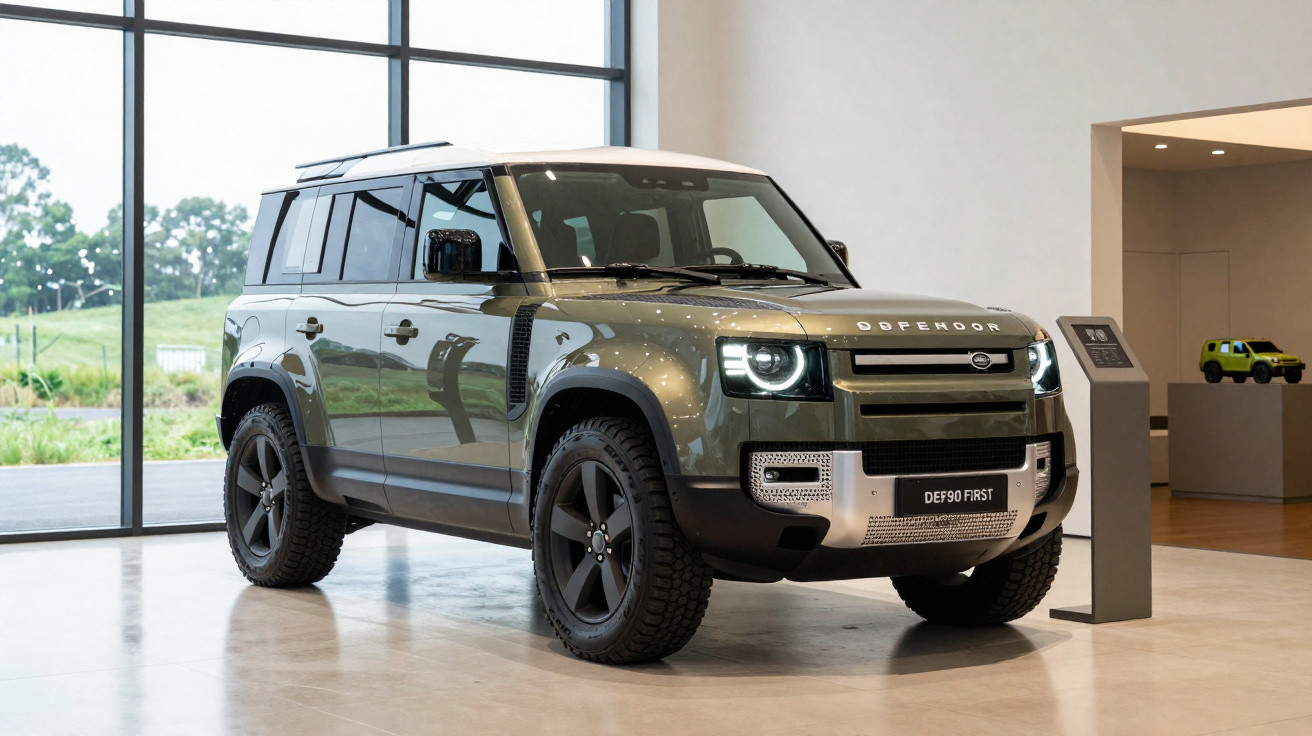
Nine months after the 110, the three-door Land Rover Defender 90 arrives with an average price around €6,500 lower and an overall length cut to 4.58 m (including the external spare wheel) - 44 cm shorter than the five-door version. It is offered in five- or six-seat form (3+3).
Even with its modernised exterior, it is immediately clear this is the Defender for the third millennium. Anyone - even those less familiar with the classic angular bodywork - will spot the embossed name on the bonnet, repeated on both front wings, at the rear and along the door-sill trims.
The upright front and rear sections remain (despite the aerodynamic penalty, unlike the flat underbody that helps airflow), and you can still bolt a long list of accessories to the body to further enhance its go-anywhere credentials. At the same time, it retains the ability to tow 3.5 tonnes (braked trailer, 750 kg unbraked) using the rear tow hitch.
More Discovery and “less” Defender
A completely new platform and an overall design philosophy now place it closer to the Discovery, with which it shares the monocoque and body structure (largely aluminium), as well as independent suspension and a comprehensive suite of driver-assistance systems.
The engines - all paired with an eight-speed automatic gearbox and four-wheel drive - are familiar too. The line-up starts with a 3.0-litre inline-six Diesel producing 200 cv, followed by 250 cv and 300 cv versions (all 48 V mild hybrids). There is also a 2.0-litre four-cylinder petrol with 300 cv (the only one not a mild hybrid) and a 3.0-litre inline-six petrol delivering 400 cv (48 V mild hybrid).
The flagship options require a little more patience: a plug-in hybrid is being finalised (P400e with 404 cv, already available on the 110), along with a sportier 525 cv variant, taking advantage of the space under this bonnet for the veteran supercharged 5.0 V8 (it remains to be seen whether both versions will be offered on the 90 as well as the 110).
Good visibility in town and out in the countryside
Using the huge grab handles at the door opening, it is easy to hoist yourself into this 4×4 with generous ground clearance and immediately enjoy the high driving position. Tall seats, a low waistline and large glass areas combine to deliver very strong outward visibility.
Even the spare wheel mounted “on its back”, plus large headrests or luggage stacked to the roof, does not ruin the rearward view, because the Defender offers an innovative and genuinely useful live image feed from a high-mounted, high-definition rear camera. At the press of a button, the frameless interior mirror stops acting as a conventional mirror and becomes a digital display instead - dramatically improving what you can see behind:
The rear pillars and spare wheel vanish from the field of view, which becomes 50° wider. The 1.7-megapixel camera delivers a crisp image in low light and features a hydrophobic coating to maintain performance when driving on wet, muddy surfaces.
Less room and a smaller boot than the 110…
In the second row, it does not quite feel like travelling in Business Class. Thanks to the “Easy Entry” seats, access is fairly straightforward, and even an adult 1.85 m tall can fit without major compromises.
Up front, headroom and shoulder room match the spacious 110 (as does the middle front seat in the six-occupant version, best suited to a smaller person or short trips), but the second row loses 4 cm in headroom and 7 cm in shoulder room. Both the cabin floor and the boot are lined in rubber to make cleaning easier.
With 397 l of luggage space (expandable to 1563 litres with the rear seatbacks folded), the boot is naturally smaller than the Defender 110’s (which grows from 231 l in seven-seat form to 916 l with five seats and 2233 l with only the front seats in use), but it is still big enough for a monthly supermarket shop.
… but more agility and stronger performance
The Land Rover Defender 90 comes with the same wide-ranging electronic aids designed to take it “to infinity and beyond”, including a wading-depth sensor that tells you whether the Defender will “touch bottom” before you drive into water. Even so, it is rated to cross water up to 900 mm deep (850 mm with coil springs rather than air suspension) - there is no point soaking everything if the depth exceeds that.
Its day-to-day fit with urban life has improved dramatically and, despite further strengthening its ability to tackle hostile terrain, one of the key steps forward is simply how well it now slots into normal routines when it does not need to play Indiana Jones.
In this short-wheelbase form - here with the 400 cv petrol engine - it feels equally at home on the motorway or on narrow, winding B-roads, encouraging you to enjoy the capable steering and a chassis that is more dynamic in the three-door, while still keeping a strong comfort buffer. The range-topping X uses adaptive dampers and air springs. Even so, unlike modern SUVs, there is still a more obvious tendency for the body to lean through bends and roundabouts (this is a tall, “old-school” square 4×4).
Its greater agility versus the 110 is helped by lower weight (116 kg lighter), a shorter body and a reduced wheelbase (turning circle down by 1.5 m). In outright pace, it feels ready to take on any hot hatch (the 550 Nm available under your right foot from 2000 to 5000 rpm plays its part), as shown by the 0–100 km/h sprint in just 6.0s and a 209 km/h top speed.
The ZF eight-speed automatic makes good use of the mild electric assistance in mid-range acceleration, while still responding in a way that supports (more) sporting driving when you move the selector into S. Its smoothness is also welcome when things get more delicate off-road.
The six-cylinder engine’s “song” comes through as a low-frequency soundtrack without becoming intrusive, and the cabin’s sound insulation is in a different league to its predecessor. The brakes take some getting used to because of the regenerative braking system - meaning the initial pedal travel delivers less response than you might expect - but they then deliver in terms of power and fade resistance.
For fuel use, it is more realistic to expect averages around 15 l/100 km (above the claimed 12.0), even without too much enthusiasm at the wheel.
Technical Specifications
| Land Rover Defender 90 P400 AWD Auto MHEV |
|---|
| Engine |
| Position |
| Configuration |
| Capacity |
| Valve gear |
| Induction |
| Compression ratio |
| Power |
| Torque |
| Transmission |
| Drive |
| Gearbox |
| Chassis |
| Suspension |
| Brakes |
| Steering |
| Turning circle |
| Dimensions and Capacities |
| Length x Width x Height |
| Wheelbase |
| Boot capacity |
| Fuel tank capacity |
| Tyres |
| Weight |
| Performance and consumption |
| Top speed |
| 0-100 km/h |
| Combined consumption |
| CO₂ emissions |
| 4×4 capability |
| Approach/Departure/Breakover angles |
| Wading depth |
| Ground clearance |
Authors: Joaquim Oliveira/Press-Inform
Comments
No comments yet. Be the first to comment!
Leave a Comment