
NEW MODELS 2021, part two… After getting to grips with the 50-plus new cars expected for 2021, we decided to zoom in on the ones that put performance front and centre - the cars we all really want to get our hands on…
And even with the automotive industry changing at pace, performance (thankfully) hasn’t been left behind - it’s simply taking on new shapes and new interpretations. Yes, more and more SUVs and crossovers are gaining high-performance derivatives, and electrons are increasingly part of the mix when it comes to boosting performance.
Without further delay, here are all the “high-performance” new arrivals for 2021.
Hot hatch, class of 2021
Let’s start with what should be the most attainable performance option of the lot: the Hyundai i20 N. This brand-new pocket rocket aims to live up to the foundations laid by the i30 N - also updated in 2021 - and it has one clear target in its sights: the Ford Fiesta ST. Expectations for this new South Korean weapon are high - very high.
Climbing a long way up the hot hatch pecking order, expect a new Audi RS 3. This year we met the S3 (2.0 turbo with 310 cv), but the four-ringed brand has no intention of letting the Mercedes-AMG A 45 (2.0 with up to 421 cv) rule unchallenged. Like its predecessor, the new RS 3 will continue to rely exclusively on the 2.5 l five-cylinder and, without doubt, output will sit north of 400 cv - will it top the rival’s 421 cv? Quite possibly…
Still among the German hot hatches, the already-unveiled Volkswagen Golf R will arrive: the most powerful Golf ever made, with the turbocharged 2.0 delivering a healthy 320 cv. As has long been the Golf R calling card, it will come with four-wheel drive and a dual-clutch gearbox.
Sports saloons
One of the headline performance stories for 2021 is the arrival of a new generation of the essential BMW M3 and its sister model, the BMW M4. Both have already been revealed, but both only reach customers next spring - and there’s plenty that’s new.
As we’ve seen with other BMW M models, the M3 and M4 will split into “regular” and Competition versions. The former retain rear-wheel drive and (for now) a manual gearbox; the latter add 30 cv - 510 cv in total - along with an automatic gearbox and… four-wheel drive, an absolute first. The biggest M3 news of all, however, won’t land until 2022 - make sure you find out everything about it.
The new M3 won’t have the stage to itself for long. Its arch-rival from Stuttgart - or rather, Affalterbach - is already lining up a counterpunch. Alongside the new Mercedes-Benz C-Class, AMG is also expected to unveil the new C 53 and C 63 in 2021, but the rumours that are increasingly looking like certainty leave us slightly uneasy.
It’s all but confirmed that the next C 53 will drop the six-cylinder (like the current C 43) and replace it with a four-cylinder supported by an electric motor. Even more unsettling is the prospect of the all-conquering C 63 following the same route, swapping the thunderous twin-turbo V8 for the same M 139 from the A 45 - in other words, a heavily boosted turbo four-cylinder, again aided by electrons. Will it really be that way?
As an antidote to that recipe, it’s hard to beat the approach Alfa Romeo took with the new Giulia GTA: lighter, more powerful, more… hardcore. Yes, it has already been presented, but sales only begin in 2021.
But, as they say, progress can’t be stopped… Peugeot has also chosen the path of hybridisation. The Peugeot 508 PSE is the first of a new generation that pairs an internal combustion engine with two electric motors. The outcome: 360 cv of maximum combined power and 520 Nm of maximum combined torque, sent to all four wheels via an eight-speed automatic gearbox.
Sports saloons, XL edition
Staying with sports saloons but stepping up one - or several - sizes from the models above, we find a group of genuine heavyweights, whether in performance or, quite literally, in kilograms.
To keep the theme consistent, we’re back with BMW M, which has already shown - “more or less” - the BMW M5 CS, the most “focused” M5 ever. How does it differ from the M5 Competition? In short: 10 cv more (635 cv), 70 kg less, and four individual seats. It promises extra pace and sharper responses, with its official reveal due right at the start of the year.
Next comes AMG, with two electrifying additions: the S 63e and the GT 73. The former is the high-performance take on the newly arrived S-Class W223 and will combine the 4.0 V8 biturbo with an electric motor, delivering - it is speculated - 700 cv.
The latter, the GT 73, is set to “crush” every rival, at least in terms of sheer horsepower: more than 800 cv is the promise! That’s what happens when you pair hydrocarbons burned by a biturbo V8 with electrons from an electric motor. What’s more, as a plug-in hybrid it should also manage a few dozen kilometres running purely on electric power. It’s speculated this powertrain could also make its way into the S-Class.
However, the third member of this trio - Audi Sport - also refused to be left behind, and unlike its rivals will embrace electricity in full. When the Audi RS e-tron GT arrives in 2021, it will be the most powerful production Audi ever. The Taycan’s “brother” (which also gains a new body style in 2021, the Cross Turismo) has already been in our hands, albeit as a prototype.
Where are the real sports cars?
If so far we’ve covered high-performance versions of hatchbacks and saloons, 2021 couldn’t pass without fresh news among coupés and roadsters - still the ideal foundations for true sports cars.
After meeting the second-generation Subaru BRZ - which won’t be sold in Europe - we’re now eagerly awaiting the reveal of its “brother”, the Toyota GR86, successor to the GT 86. It should stick to the same key ingredients we saw in the BRZ, keeping rear-wheel drive and a manual gearbox. What remains unclear is whether it will also use the 2.4 l naturally aspirated boxer engine fitted to the BRZ.
Type 131 is the codename for a new Lotus coupé - the first completely new model from the British brand in 12 years - and it matters because it is being billed as the last Lotus with an internal combustion engine. Every Lotus after Type 131 is expected to be 100% electric, like the Evija, the brand’s electric hypercar that will begin production in 2021.
Type 131 will debut a new aluminium platform, while keeping a mid-rear engine layout like the Exige and Evora. Where will the engine come from? Probably Sweden, given that Lotus is now part of Geely - the same group that owns Volvo.
Porsche is readying two heavyweight launches: the 911 GT3 - already teased in several videos - and the most hardcore 718 Cayman, the GT4 RS. Both are “old-school” models, with naturally aspirated six-cylinder boxer engines that love revs, and rear-wheel drive.
Without quite the same razor-sharp focus as Porsche’s GT cars, Maserati’s new GT - the GranTurismo - will finally gain a successor. The coupé will stay faithful to a 2+2 layout, but as a new twist, alongside combustion-engine versions it will also offer an unprecedented 100% electric variant.
Still at Maserati, the brand unveiled the MC20 this year - its first supercar since the more extreme MC12. It arrives in 2021, and we’ve already seen it “in the flesh”:
Hopping “just next door” to Modena, Ferrari has also presented two new models due in 2021: the Portofino M and the SF90 Spider. The first is essentially an update of the roadster revealed in 2017: it now uses the same V8 as the Roma, with 620 cv, and it brings a handful of styling changes along with technology upgrades.
The second is the long-awaited open-top version of the SF90, the brand’s first series-production hybrid - the LaFerrari was limited production - combining a twin-turbo V8 from the F8 Tributo with three electric motors to reach 1000 cv. It is the most powerful road-going Ferrari ever.
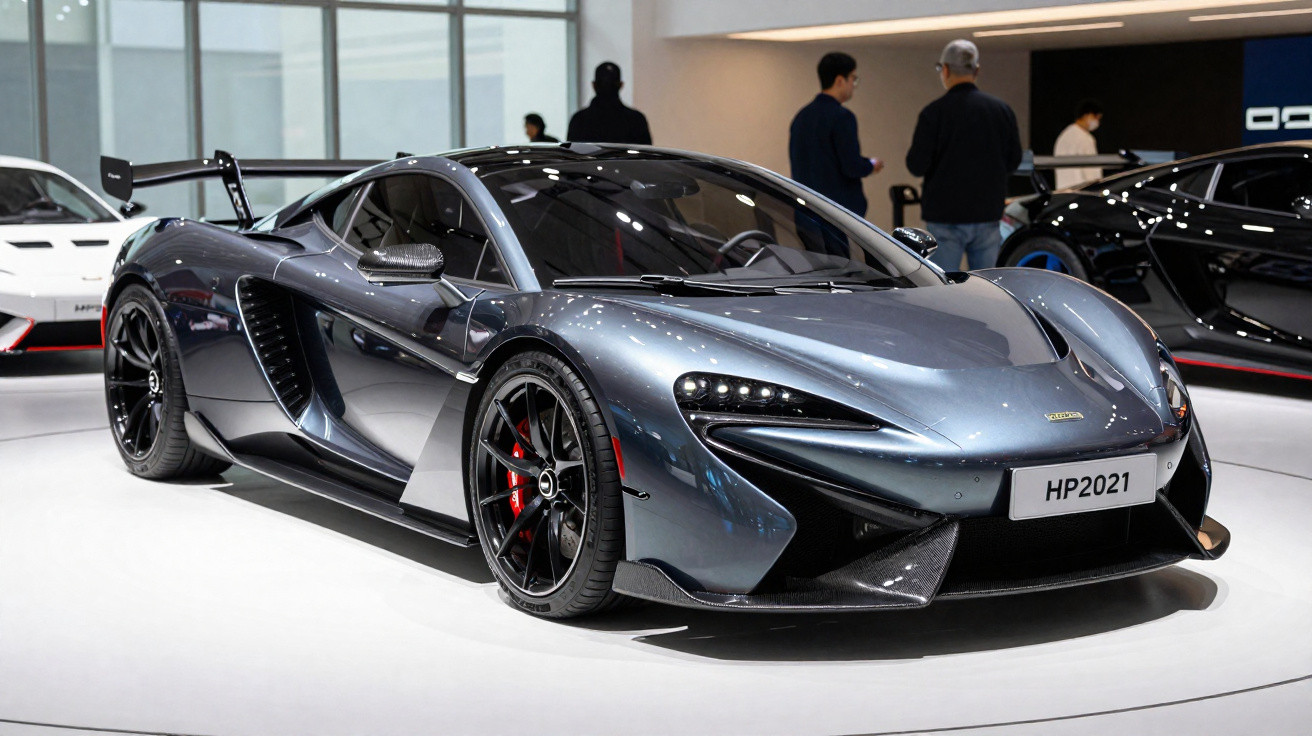
Ferrari’s rival, Britain’s McLaren, also looks set to enter a new electrified era with its first series-production hybrid supercar, already named Artura, which will take over from the 570S. Out goes the V8 we’ve come to associate with McLaren road cars in this century, replaced by a new hybrid V6.
Hyper… everything
We’ve already mentioned the Lotus Evija - the most powerful road car ever produced, with 2000 cv - but the hypercar universe, whether electric, combustion or a blend of both, has far more to offer than that.
In the all-electric hypercar camp, at least two more are set to begin production in 2021: the Rimac C-Two and the Pininfarina Battista. The two are closely related, as their powertrain is essentially the same, developed by Rimac. Like the Evija, both promise an excess of horsepower, with each sitting above 1900 cv.
One badge you might not expect to see in this category is Toyota - yet here it is. After the TS050 Hybrid ended its WEC career with three Le Mans victories, the Japanese brand wants to return to the French circuit under the new Hypercar category. To do it, much of the TS050 will be repurposed into a new hybrid hypercar, the GR Super Sport, set to be revealed in January. Official figures are still unknown, but 1000 cv had been promised.
Still mixing electrons with hydrocarbons, there are two more very different propositions. The first is the long-promised AMG One, which will use the same 1.6 V6 as the German team’s 2016 Formula 1 car, the Mercedes-AMG W07 (2016). AMG’s hypercar was supposed to arrive in 2020, but development ran into hurdles that proved difficult to overcome - emissions compliance among them - pushing the launch to 2021. At least 1000 cv is promised.
The second is the Aston Martin Valkyrie, born from the mind of the brilliant Adrian Newey. This project has also faced its share of complications, and in 2020 we learned that development of the competition version had been cancelled. The road car, however, is due in 2021, bringing with it a spectacular 6.5 V12 naturally aspirated engine that delivers 1014 cv at… 10 500 rpm. Final output will be higher - approximately 1200 cv - because, like the AMG One, it will be a hybrid.
Staying with naturally aspirated V12s, we also have to mention the phenomenal GMA T.50, effectively the true successor to the McLaren F1. Its 4,0 l naturally aspirated V12 “screams” even louder than the Valkyrie’s, producing “just” 663 cv - but at an unbelievable 11 500 rpm. Pair that with only 986 kg - as light as an MX-5 1.5 - plus a manual gearbox and rear-wheel drive… and, of course, the unusual and fascinating central driving position, as well as an intriguing 40 cm diameter fan at the rear. Development is still ongoing, but production begins in 2021.
500 km/h is the new frontier for anyone chasing the title of world’s fastest car. In 2021, two more contenders will join the race, following the controversial SSC Tuatara attempt in 2020 - they have since made a second attempt, also unsuccessfully. The Hennessey Venom F5 was revealed in final form in December, and next year we should also see the final version of the Koenigsegg Jesko Absolut, which wants to inherit the crown from its predecessor, the Agera RS.
Both use V8 engines with massive turbochargers to reach 1842 cv and 1600 cv - the outputs of the Venom F5 and Jesko Absolut, respectively. Will they manage it? The Tuatara shows just how difficult and complex that challenge can be.
Are there even more new models for 2021?
Yes - we still need to talk about… SUVs. SUVs and crossovers have been taking sales from every other body style with convincing success, so it’s no surprise to see an “attack” on the high-performance niche. We’ve watched this play out in recent years in the upper segments, but last year we started to see more attainable offerings arrive - a trend set to continue in 2021.
The spotlight here falls squarely on Hyundai, which will bring two new models: the Kauai N and the Tucson N. We recently saw the Kauai refreshed, but the N version won’t appear until 2021. The rumour is that it will inherit the i30 N’s engine - meaning a B-SUV with 280 cv. It was recently teased through a series of Christmas-themed previews:
The Hyundai Tucson has also moved to a new generation, and all signs suggest that in 2021 we’ll meet the Tucson N, ready to take on rivals such as the Volkswagen Tiguan R or the CUPRA Ateca. For now, we only know the N Line variants, with a sportier look:
Speaking of the Volkswagen Group, beyond the updated Audi SQ2 (300 cv), the big news at this level will be… electric. The Skoda Enyaq RS is expected to offer more than 300 cv of “zero-emissions” punch, becoming the most powerful model the Czech brand has ever made. It will be joined by its similarly potent “cousin”, the ID.4 GTX, which introduces a new Volkswagen badge for high-performance versions of its electric cars.
Moving up several levels - and to close this NEW MODELS 2021 special - we come to the unprecedented BMW X8 M. Set to sit at the top of BMW’s X family, the X8 M is expected to appear in two versions. The first, purely combustion-powered, should inherit the 4.4 V8 we already know from other BMW M models, with 625 cv. The second will be electrified (hybrid) - the first time that has happened in BMW M history - and, according to rumours, will lift output beyond 700 cv.

Comments
No comments yet. Be the first to comment!
Leave a Comment