
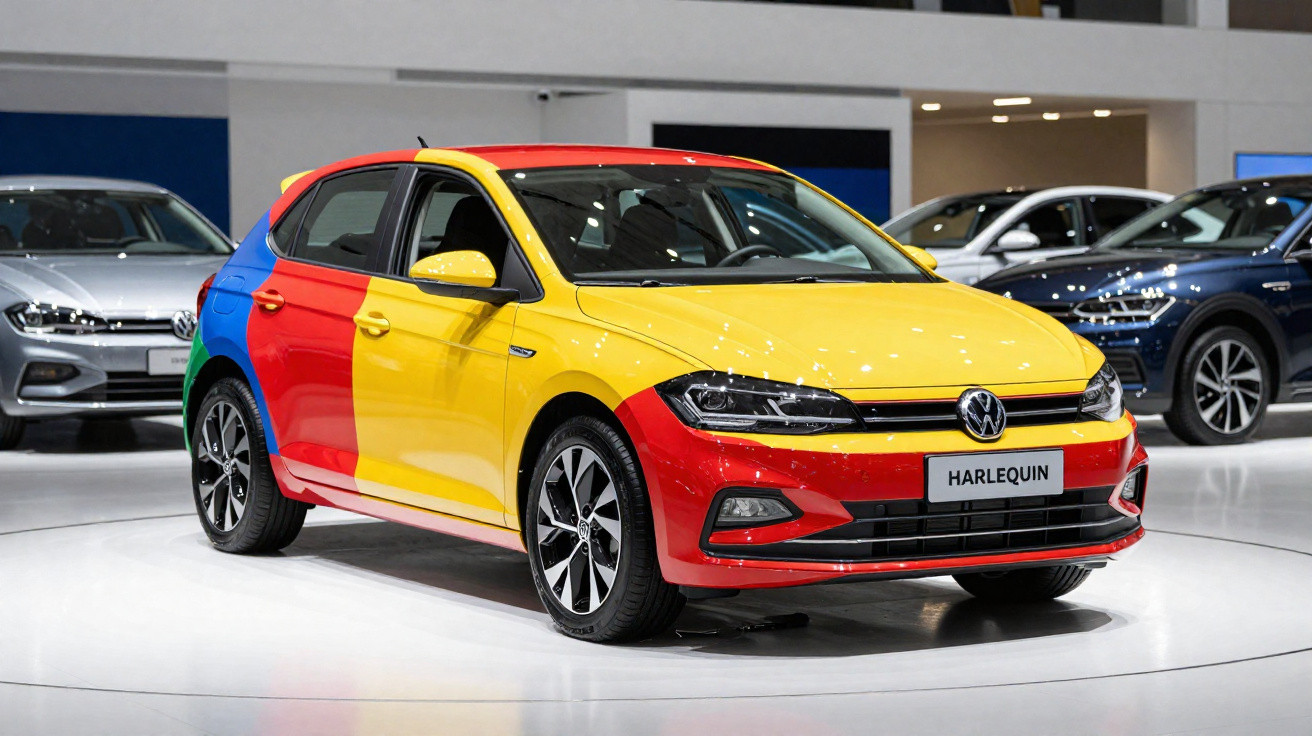
Traditionally a restrained, sensible-looking car, the Polo’s most striking-and least conservative-interpretation across its entire lineage is the Volkswagen Polo Harlequin.
A bit of a 1990s landmark (much like its “cousin”, the Skoda Felicia Fun), the Polo Harlequin is one of those cars that, on paper, was never really meant to exist.
And yet this brightly coloured Polo did make it into production-and into customers’ hands. Around 3800 were sold, and it went on to build a kind of “legion of fans” that still exists today.
How did the Volkswagen Polo Harlequin come about?
Introduced in 1994, the third-generation Volkswagen Polo represented a turning point for the model. It decisively moved away from the Polo’s roots in the 1970s-and from its ties to the Audi 50.
Built on an all-new platform, the car was designed around modular “units”-mechanicals, equipment, paint colour and options-intended to make life easier when buyers came to configure their Polo.
To simplify the process even further, Volkswagen assigned a colour code to each of those modular “units”. Blue stood for the engine and chassis (mechanicals); red identified optional extras; green referred to colour-related choices; and yellow represented equipment.
To communicate that colour coding, Volkswagen put together 20 Polo units finished in a mash-up of those shades, using them for dealer events.
What the German brand hadn’t anticipated was that some people would actually want to buy a Polo… in multiple colours. Once Volkswagen realised there was genuine demand, the decision was made quickly: in 1995, 1000 Volkswagen Polo models would be built with that same colour scheme.
Built like a puzzle
Named the Polo Harlequin-a nod to the Commedia dell’arte characters, where the harlequin’s job was to entertain the audience during intervals-this was not a straightforward car to manufacture.
In practice, Volkswagen had to assemble four Polo examples painted in red, blue, yellow and mint green. After that, various body panels were swapped between the four cars, effectively “mixing and matching” parts to create the multicoloured Volkswagen Polo units.
Inside, the Volkswagen Polo Harlequin featured seats with a dedicated pattern, plus a steering wheel and gear lever trimmed in blue leather and, as was typical for the era, a Blaupunkt radio.
Because buyers couldn’t specify the dominant colour of their Polo Harlequin, they had to wait until delivery to find out which one they’d ended up with. On top of that, the first 1000 examples came with a certificate and a numbered keyring.
In 1996, the Harlequin “fever” spread to the Golf as well. Aimed at the North American market, a total of 246 Golf Harlequin units were built, finished in “Pistachio Green”, “Ginster Yellow”, “Tornado Red” and “Chagall Blue”.
A comeback in sight?
Created by Volkswagen’s importer in the Netherlands, the latest Volkswagen Polo Harlequin is, for now, a one-off. The point of the project is to pay tribute to the model which, ironically, was never officially sold there.
With a colour layout that mirrors the original car, it’s unclear whether the same production approach was used. That leaves just one question: would you like to see the Polo Harlequin return?

Comments
No comments yet. Be the first to comment!
Leave a Comment