
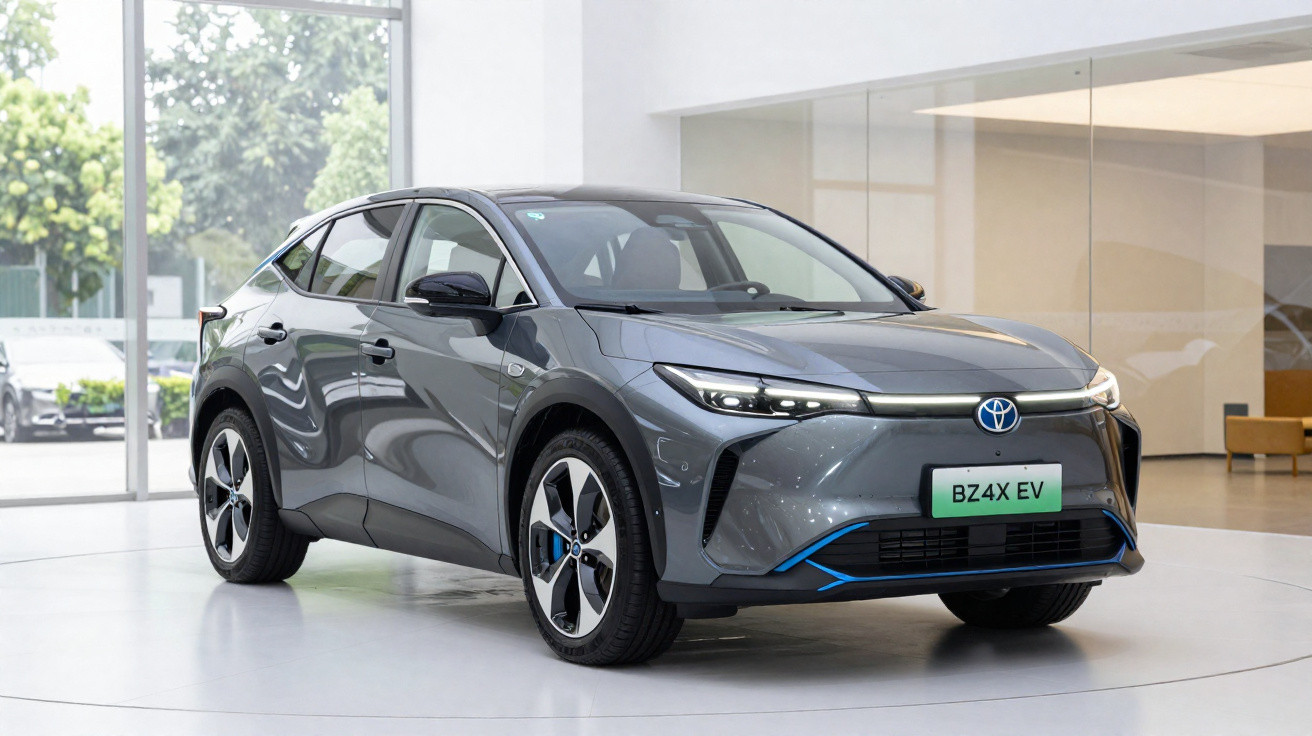
Toyota may look as though it arrived late to the electric "party", but the bZ4X marks the opening move of its offensive
You do not need a perfect memory to recall just how committed Toyota has been to electrified cars-especially hybrids-for more than 25 years.
Ever since the Prius launched in 1997, that focus has been central to the brand’s strategy. Even so, the leap to fully electric models only happened very recently. I can still remember how long it took for the Prius to gain a plug-in hybrid version.
With all that in mind, the arrival of a new 100% electric model family called "Beyond Zero"-and the debut of the bZ4X as its first member-left me wondering: was this a decision driven by "we also need to be here", or more of a "let’s do this" moment?
After all, Toyota still carries the status of the world’s largest car manufacturer. And the Japanese giant does not usually launch new products just to tick a box. When it moves, it tends to do so with the aim of taking a leading position.
Design and styling for a new family
My first visual encounter with the Toyota bZ4X did not win me over, I have to admit. It is also larger than I expected: almost 4.7 m long, even though the height stays under 1.6 m-lower than a RAV4, for instance, despite sitting in the same segment.
Back to the styling-always a subjective topic where taste is personal-you can clearly spot links to Toyota’s most recent models.
The unpainted plastic cladding did not appeal to me, and I also found it odd to see several smaller plastic pieces seemingly "scattered" around the bodywork. Examples include the trim above the front light units, or the plastic section on the charging-port flap.
Even so, the longer I spent with the Toyota bZ4X, the more it began to grow on me.
Sharper lines, but the cabin lacks colour
Inside, the layout feels unlike Toyota’s usual approach. It is almost as if the bZ4X project came with permission to simply experiment.
The instrument panel, for example, is very compact, shows only the essential information, and sits further away from the driver.
Further across, the central console design leads into a large, rectangular touchscreen with good resolution. It offers wireless smartphone connectivity via Apple CarPlay or Android Auto. It also includes dedicated pages for the electric system, with a usage history covering consumption.
Still on the centre console, the climate controls retain separate, independent operation rather than being buried in a "tangle" of confusing menus. Some functions use touch controls instead of traditional buttons, but they remain right there in your line of sight.
The gear selector is a rotary controller, the same type as on the Lexus RZ 450e I have previously tested, although here it sits in a central position.
It is one of the elements that helps (to a small extent) with a good driving position, aided by adjustments with enough range to suit different heights. On the other hand, it is not always easy to place the steering wheel at an "ideal" height that still allows clear visibility of the instruments.
Generous room on board
Since we are getting into tape-measure territory, this is also the right moment to say that space is not an issue inside the Toyota bZ4X-particularly in the rear seats.
Legroom is genuinely generous, even if front occupants need to slide back for extra space, and headroom is also reassuring.
For storing small items, the bZ4X offers plenty of places, not least because Toyota has not fitted a glovebox in this model. Instead, there is a huge "cavity" beneath the centre console, enclosed storage between the front seats, and sizeable door pockets.
Less positive is something that, unfortunately, remains common across many manufacturers-not only Japanese ones. Inside the Toyota bZ4X, there is almost no colour beyond shades of grey.
Build quality feels solid, and every control gives the impression it will outlast us. However, the cabin tones do not match the boldness of some shapes and materials, such as the fabric trim used across the dashboard.
Smoothness on the move
On the road, the Toyota bZ4X stands out for its refinement, acting like a "protective cocoon" that shields passengers from much of what is happening outside, including noise.
That strong cabin insulation pairs well with suspension that rides properly, even when the road surface is less than ideal. With 18" wheels and relatively deep-profile tyres, many imperfections simply fail to make their way into the cabin.
This softer, comfort-led set-up has to manage a kerb weight of more than two tonnes, which inevitably dulls the more emotional side of driving.
In fairness, though, the Toyota bZ4X was not designed as a corner-hungry machine, but rather as an efficient family car. It even seems happier in town, where it can regenerate more energy and deliver more restrained consumption figures.
Even so, the battery placement helps lower the centre of gravity, which can lend a hand when you are in more of a hurry.
Energy use and range of the bZ4X
For this Premium version of the bZ4X with a single 150 kW motor (or 204 bhp), Toyota quotes an average consumption figure of 16.9 kWh/100 km. With the 71.4 kWh battery fitted, the claimed range sits between 444 km and 512 km.
During this test, covering a mix of driving that included city use and motorway miles-and with the air conditioning always on-the final result was a very acceptable 18.1 kWh/100 km. Even so, on the open road at a steady speed, I did manage figures closer to 17 kWh/100 km.
Because I ended up above the official consumption, I was never going to reach the 442 km of range the trip computer showed at the start of the test. In real-world use, I finished closer to 400 km.
Toyota has, however, been working to improve these results. Evidence came in one of the latest software updates, which added a battery charge-percentage display to the instrument cluster, along with broader optimisation of how the whole system operates.
Mid-range version of the line-up
The Premium equipment grade, like the test car, sits on the middle rung of the three available levels, with a base price of €56,190. To match the car shown in the images, you only need to add the metallic paint (€950), bringing the total to €57,140.
If you want more equipment, there is nothing to add from an options list. You would have to choose the Lounge version, which is far better equipped than this Premium trim-but its base price already jumps to €62,240.
Finally, but importantly, it is worth noting that the bZ4X battery comes with a warranty of 10 years or one million kilometres. That is a serious selling point among electric cars.

Comments
No comments yet. Be the first to comment!
Leave a Comment