
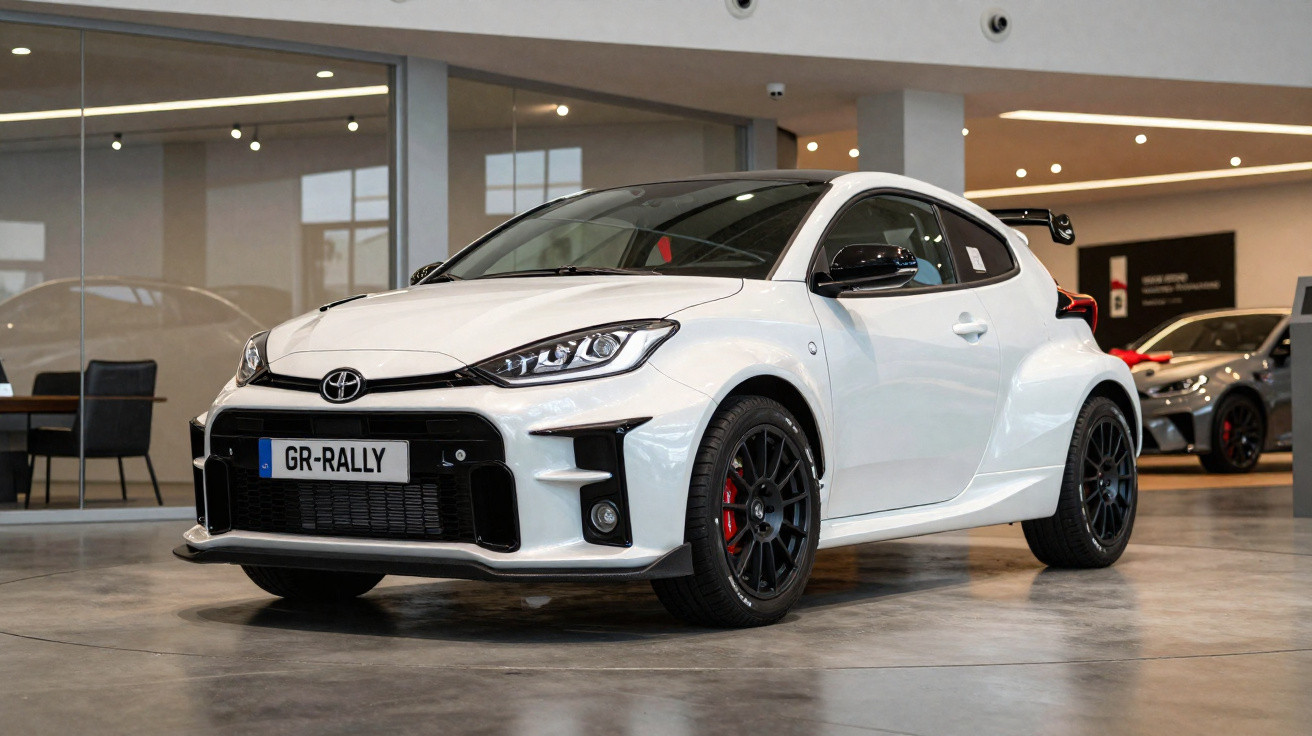
Toyota and the Yaris range already have well-established credentials for low fuel consumption and reliability, but this is no ordinary Yaris. The Toyota GR Yaris was created as the “road-going” foundation for the brand’s new rally car (Toyota returned to the World Rally Championship six years ago): a true homologation special, with first-year production of (at least) 25 000 cars (in Japan). Largely because of the pandemic, we will not see it compete in 2021, with Toyota instead relying on an evolution of its 2020 car.
This is the second model in the GR family (the first was the Supra, which shares its technical base with the BMW Z4), yet it is genuinely the first one developed from the ground up by the Japanese brand-an important moment, reflected in the car’s unique specification.
At a glance, the GR Yaris makes its intentions clear: swollen bumpers, larger air intakes, a three-door body, frameless door glass, twin exhaust outlets, and a rear end far broader than any other Yaris. In fact, it differs markedly from the regular car-even at a structural level.
A very different kind of hybrid
The GR Yaris is also a “hybrid”, though not in Toyota’s usual sense (electric motor + petrol engine). Here, “hybrid” refers to its architecture: the front section uses the same GA-B platform as the standard Yaris, while the rear comes from the Corolla/Prius GA-C.
That choice brings an independent rear suspension with double wishbones, replacing the simpler (and less effective) torsion-beam layout fitted to other Yaris versions. Despite having two fewer doors, the GR Yaris is 5,5 cm longer and 6 cm wider (the rear track is 4,4 cm wider to accommodate the independent rear suspension). It is also 4,5 cm lower overall (almost 10 cm if measured at the rear). Even the body construction is notably different.
The side doors and tailgate are aluminium (10% of the body structure, saving 24 kg), while the roof is moulded in carbon fibre (C-SMC), cutting a further 3,5 kg and lowering the car’s centre of gravity-solutions that are unusual for a performance car in this market segment.
Beyond the use of aluminium (stiffer and lighter), the Yaris family’s enfant terrible also focuses on higher structural rigidity (to cope with the exponential jump in dynamic performance), adding 260 extra weld points and 15 m of structural adhesives.
Unsurprisingly, braking hardware has been substantially upgraded, with ventilated, drilled discs on all four wheels and fixed four-piston calipers visible behind the 10-spoke, forged-alloy BBS wheels (lighter).
On the test car, these are wrapped in Michelin Pilot 4S 225/45 R18 tyres as part of the Circuit Pack (standard fit is Dunlop SP Sport 225/40 R18). The pack also brings stiffer springs and anti-roll bars, revised dampers, a different calibration for the electric power steering, plus front and rear Torsen limited-slip differentials and red brake calipers. In Portugal, this version is called Extreme Rally and costs 3900 euros more than the “base” GR Yaris.
The world’s most powerful three-cylinder
And there is more. The engine-mounted 2 cm further back to improve front-to-rear weight distribution-matches the same high standard, claiming the title of the most powerful three-cylinder engine in the world. At the same time, it is the smallest and lightest 1.6 fitted to any road car.
This unit has been treated to extensive strengthening and an array of lightweight, rigid components, along with larger exhaust valves, specially light pistons, multi-point oil-jet cooling for the piston crowns, accelerated combustion in the cylinders, dual injection (direct and indirect), and an installation designed to minimise both noise and vibration. This is how racing engines are built.
Those choices underpin output of 261 cv, delivering an impressive specific power figure of 160 cv/l (helped by the turbo’s 1.6 bar maximum boost with ball bearings), plus 360 Nm. Combine that with a vehicle weight of 1280 kg (DIN)-a Mini JCW is smaller, lacks 4×4 traction, and is only 55 kg lighter-and you get a 4,9 kg/cv power-to-weight ratio. It helps explain near-ballistic figures for this class: 5,5 s from 0 to 100 km/h (rivals need at least another second), 230 km/h top speed, and 80 to 120 km/h in under three seconds.
Sophisticated 4×4
Toyota has not developed a brand-new 4×4 system like this-fitted to the GR Yaris-for more than two decades. There is no centre differential; instead, a multi-plate clutch enables variable torque distribution (Japanese engineers say that, in extremis, it can reach 100%-0 and 0-100%). Its behaviour is programmed around three modes selected via a switch beside the gear lever.
The choices are: a 50:50 split in Track mode, suited to fast driving on any surface from dry tarmac to snow; 30:70 in Sport mode, which prioritises rear-axle drive; and 60:40 in Normal mode (the default at start-up), intended for everyday use. Switch off traction and stability control and the display indicates Extreme (Sport or Track), as shown in the instrument cluster.
Inside, there are clear references to the world of competition, from the Alcantara-style trim on the door panels to specific read-outs (such as turbo boost) in the largely analogue instrumentation (with a small central digital display). It makes sense for it to be analogue, although it could look less “downbeat” with, for example, a white background, red needles, or something similar.
The steering wheel has a thick rim, there is red stitching on the seats and the gear lever gaiter, perforated metal pedals, and a WRC-FIA World Rally plate to complete the sporting ambience.
The front seats provide strong lateral support, albeit with relatively soft padding. The rear seats… yes, they exist, but do not expect generous legroom or headroom (anyone over 1,75 m is better off in the front). Worse still is the boot: at 174 litres, it is closer to an oversized glovebox than a proper luggage compartment.
Child of the WRC
Press the start button and the engine fires with a telling growl-another item on the list of upgrades Toyota has made to turn its rally car into something usable day to day, naturally with input from rally drivers Kris Meeke and Jari-Matti Latvala, who helped get the set-up “just right”. The result is that even an average driver can become “king of the sideways moments” (in properly controlled environments, of course).
From the first few kilometres, it is obvious this is one of the most sporting road-going Toyotas ever, with near-instant engine response helped by low inertia (thanks, in part, to having one fewer cylinder than you might expect), and a soundtrack rich in low frequencies.
Those acoustic notes also sound fairly “natural”, despite assistance from the audio system’s speakers, and they do a convincing job of disguising any hint that there are only three cylinders under the bonnet (it becomes overly theatrical only above 6500 rpm, right before the fuel cut at 7000).
The six-speed manual gear lever sits closer to the steering wheel so revs do not drop more than strictly necessary when the driver removes their right hand from the wheel to change gear. Some performance-driving purists would still prefer a lower driving position. In return, the shift is fast and accurate, with a short throw.
The king of drift
Even in Normal mode, the accuracy with which you place the car into a bend-and how easily it fires out again-can be genuinely disconcerting. Credit goes to steering with Toyota GT86 genes (outstanding for feedback and speed) and a chassis set-up which, while decidedly firm, still manages to take the edge off some road imperfections without punishing occupants’ bones too harshly.
Even if you get impatient on the throttle before the corner has fully opened, the four-wheel-drive system ensures the GR Yaris can put its power down. Here, the limited-slip differentials add extra help, pulling the car towards the inside of the curve when physics would otherwise start pushing it wide.
Select Sport mode and it adopts a rear-driven attitude (with more than 2/3 of the 360 Nm torque sent to the rear axle). On track, you can hurl the Yaris into a corner, flick the wheel to “set it up”, then go flat out and drift as if there is no tomorrow (while the driver, temporarily dressed as a racing hero, wears a broad smile to forget a few of life’s frustrations).
That is, of course, provided stability and traction control are switched off-done via the button near the handbrake, just behind the i-MT switch. Once activated, i-MT performs the “heel-and-toe” function: for example, when the clutch is pressed before a downshift from 4th to 3rd, it raises engine revs to match transmission speed, smoothing the manoeuvre and helping avoid unsettling the car mid-corner.
In the GR Yaris Extreme Rally, everything is in place for even a relatively calm driver to feel tempted to put on a racing suit, thanks to how detailed (and timely) the information is about how the tyres are interacting with the road.
Matching the chassis talent, the braking system has been properly “beefed up” to cope with tougher demands-for instance, at 356 mm in diameter, the front discs even exceed the 348 mm items on the larger, heavier GR Supra.
And so that nothing is missing for the lucky person gripping the thick, grippy steering wheel, pulling the (manual, of course) handbrake lever disconnects the front axle from the rear so the rear wheels can lock, making it easier to rotate the car around its own axis (for that purpose, a small drum brake sits inside the rear discs). The rally driver within us is grateful.
Technical specifications
| Toyota GR Yaris Extreme Rally | |
|---|---|
| Engine | |
| Position | Front transverse |
| Architecture | Inline 3-cylinder |
| Capacity | 1618 cm³ |
| Valve gear | DOHC; 4 valves per cylinder (12 valves) |
| Induction | Turbocharged direct and indirect injection, intercooler |
| Power | 261 cv at 6500 rpm |
| Torque | 360 Nm between 3000-4600 rpm |
| Transmission | |
| Drive | All-wheel drive |
| Gearbox | 6-speed manual |
| Chassis | |
| Suspension | Front: Independent, MacPherson; Rear: Independent, multi-link |
| Brakes | Front: Ventilated discs; Rear: Ventilated discs |
| Steering/No. of turns | Electric assistance/2,36 |
| Turning circle | 10,6 m |
| Dimensions and capacities | |
| Length x Width x Height | 3995 mm x 1805 mm x 1455 mm |
| Wheelbase | 2560 mm |
| Boot capacity | 174 l |
| Fuel tank capacity | 50 l |
| Wheels | 225/40 R18 |
| Weight | 1280-1310 kg (DIN) |
| Performance and consumption | |
| Top speed | 230 km/h |
| 0-100 km/h | 5,5s |
| Combined consumption | 8,2 l/100 km |
| CO2 emissions | 186 g/km |
Comments
No comments yet. Be the first to comment!
Leave a Comment