
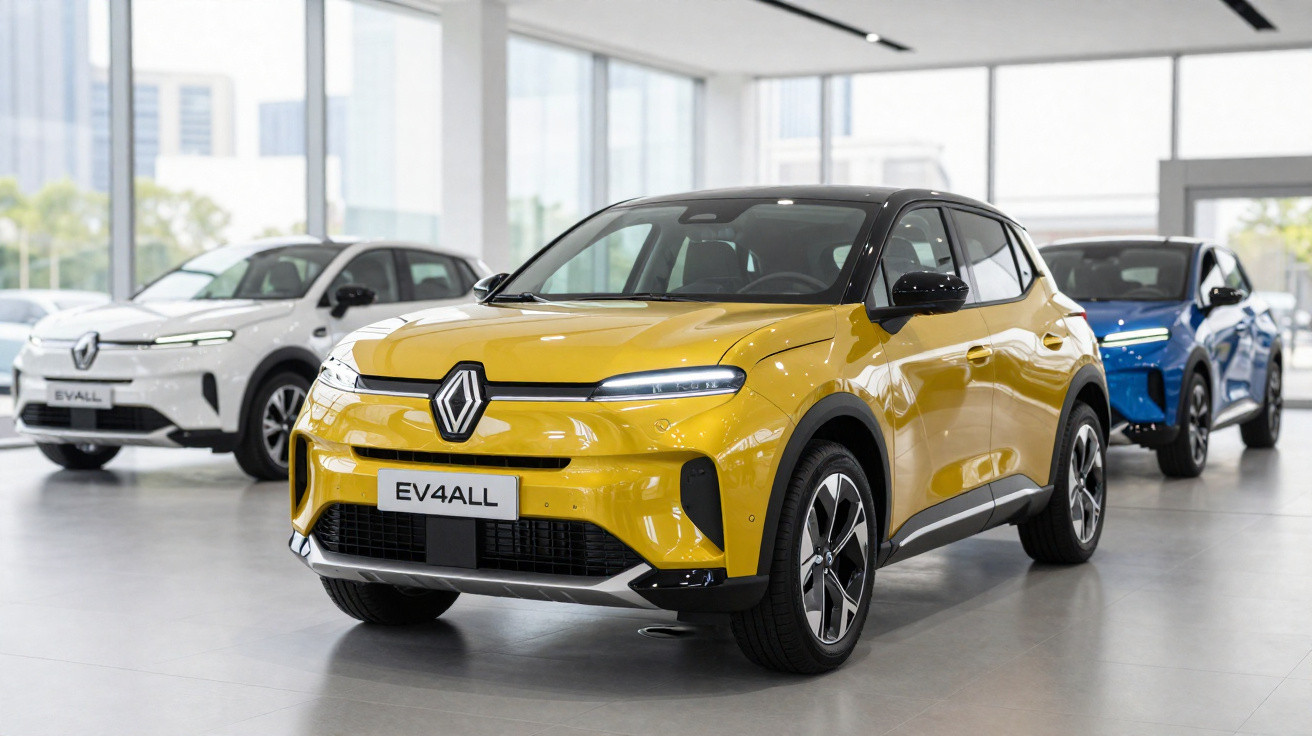
An electric car for everyone. It might feel like a new playbook for some manufacturers, but for Renault it has been reality “for more than a decade. We’re in the electric segment out of conviction”. In 2025, Renault’s plan moves into its next stage.
The ambition is clear: electric cars priced from €20,000 to €30,000, matching combustion-engined vehicles on purchase price while delivering all the benefits of electrification.
This new chapter is led by three key models: Renault 5 E-Tech, Renault 4 E-Tech and Renault Twingo.
Renault 5 E-Tech isn’t just about style
The Renault 5 E-Tech is more than the return of an icon. It underlines a distinct look and a clear positioning for a nameplate that is well known in Portugal. And Renault makes an unexpected request: close your eyes.
First, close your eyes and trust the range. Depending on the version you choose, WLTP range sits between 300 km and 410 km. With the average European driver covering 35 km a day, the maths does the rest.
And when it is time to plug in, it will not keep you waiting. The Renault 5 can be charged at home at speeds of up to 11 kW, which is enough to restore the battery’s capacity in just over 4 hours and 30 minutes. If you choose a rapid charger, the wait drops to 30 minutes.
There is also something else you will not see from the outside: software designed to support the driver. Created through a partnership between Renault and Google, it lets you manage the car’s functions in an environment that mirrors a smartphone.
Working with a major technology company brings additional benefits too, including natural voice commands. Almost everything can be adjusted without taking your hands off the steering wheel, from cabin temperature to navigation.
Lastly, another “invisible” point that matters more and more: sustainability. Built in France, Renault says all suppliers are within 150 km, helping to cut the environmental footprint of this 100% French model.
Renault 4 E-Tech: the modern “quatro latas”
More than 30 years on, Renault has revived one of the most emblematic cars in its history, the 4L, using the same recipe applied to the Renault 5: plenty of modernity, mixed with a touch of nostalgia-only here, with extra family-friendly space.
That added practicality is explained by the near 22 cm difference in length between the two cars, and it is reinforced by the new R4’s taller, less sporty roofline, despite both using exactly the same platform: AmpR Small.
The overlap between the pair does not stop there. The technology offering is largely identical-whether you look at the screens, the operating system or connectivity-and the mechanical line-up is shared as well.
On pricing, the Renault 4 will sit between the €25 000 Renault 5 and the €32 990 Megane E-Tech. Which one should you choose? This configurator can help:
New electric Twingo
Renault’s big promise for 2026 is the launch of the fourth-generation Twingo, which will be 100% electric and positioned as a definitive answer to the challenges of urban mobility.
Small, efficient and designed for everyday city use, it aims to appeal across generations: younger drivers who will likely enjoy its more irreverent image, and older buyers thanks to the many similarities with the original model that arrived in 1993.
With an estimated price below €20,000, the new electric Twingo is set to become one of the most affordable options in the EV market, without having to make compromises. The use of the AmpR Small platform promises not only efficiency and performance, but also a range tailored to city driving.
Renault is targeting a WLTP range between 300 km and 350 km, and the French brand also claims it will be the most efficient electric car in the segment, with average consumption of just 10 kWh/100 km.
An electric car for everyone
Renault’s commitment to making electric mobility accessible is not new: that is exactly what the French marque did with the Zoe and the Twizy. This latest push is even more significant, because it represents one of the manufacturer’s most important bets.
To make this vision possible, Renault chose to invest in a dedicated platform for 100% electric models. That decision has enabled lower production costs, improved efficiency, and the development of distinct vehicles able to meet the needs of different market segments.
With prices starting below €20,000 for the new electric Twingo and rising to around €30,000 for the new R4, Renault wants to ensure it has a suitable, competitive option for anyone looking to switch to electric mobility without breaking the bank.
Above €30,000, alongside the higher-spec versions, you will also find the Megane and Scenic E-Tech. An electric car for everyone. See the full range here and compare:

Comments
No comments yet. Be the first to comment!
Leave a Comment