
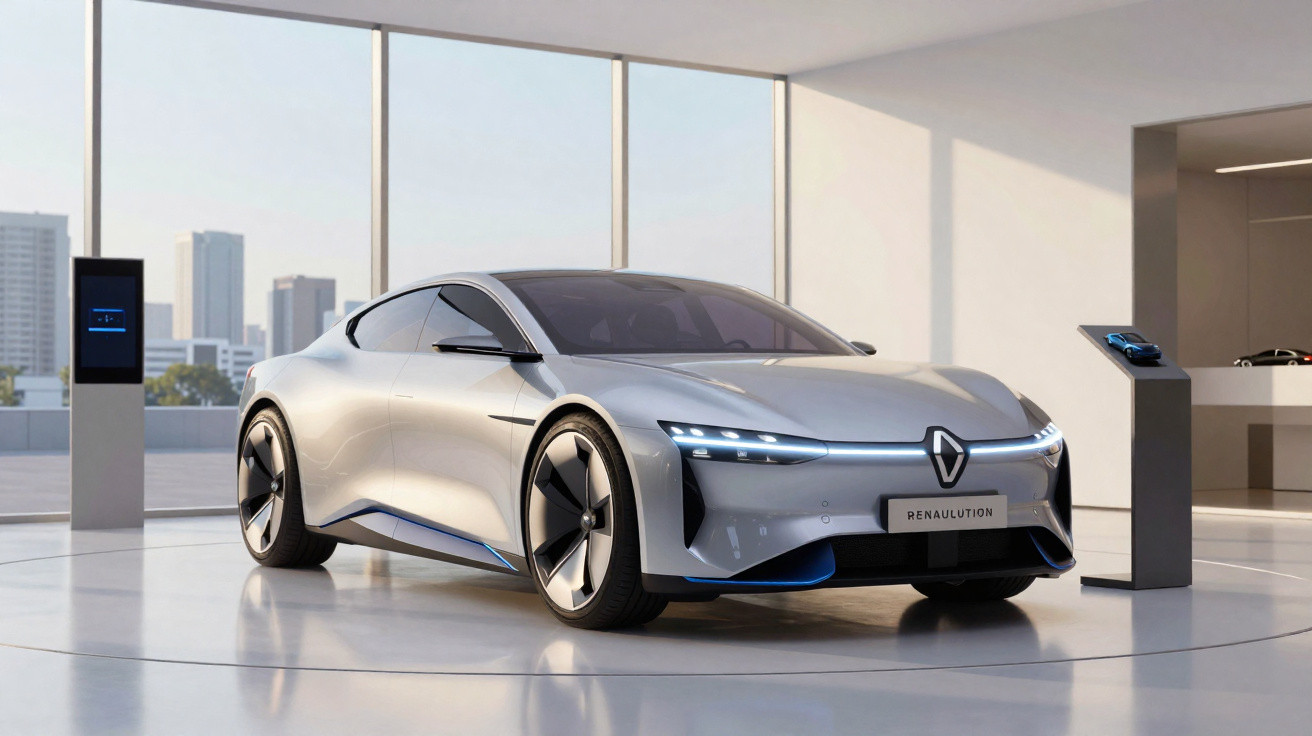
The new strategic roadmap for the Renault Group is called “Renaulution”, and it is designed to steer the group towards profitability rather than market share or sheer sales volume.
This plan is structured into three stages: Resurrection, Renewal and Revolution:
- Resurrection - concentrates on rebuilding profit margins and generating cash, running through to 2023;
- Renewal - follows on from that phase and aims to deliver “the renewal and enrichment of the ranges that contribute to the brands’ profitability”;
- Revolution - begins in 2025 and is intended to reshape the Group’s economic model, shifting it towards technology, energy and mobility.
Focus? Profit
With the goal of restoring the Renault Group’s competitiveness, the Renaulution plan redirects the organisation’s priorities towards value creation.
In practice, that means performance will no longer be judged by market share or sales volumes, but instead by profitability, cash generation and how effectively investments are deployed.
No shortage of new launches
Given that a car manufacturer ultimately relies on… building and selling cars, a major part of this plan inevitably depends on bringing new models to market.
Accordingly, by 2025 the brands within the Renault Group will introduce no fewer than 24 new models. Half of these will sit in the C and D segments, and at least 10 of them will be 100% electric.
Cost reduction is also essential - as outlined in a separate plan dedicated to that purpose. In line with this, the Renault Group intends to cut the number of platforms from six down to just three (80% of the Group’s volumes are based on three Alliance platforms), as well as reduce the number of powertrain groups (from eight down to four families).
Alongside this, any upcoming models that use existing platforms will reach the market in under three years, and the Group’s industrial capacity will fall from four million units (in 2019) to 3.1 million units in 2025.
The Renault Group also wants to concentrate on the markets that offer higher profit margins and enforce strict cost discipline, cutting fixed costs by €2.5 billion by 2023 and by €3 billion by 2025.
Finally, the Renaulution plan also sets out a reduction in investment and spending in research and development, from 10% of turnover to under 8% by 2025.
How will competitiveness be restored?
To rebuild the Renault Group’s competitiveness, the plan presented today starts by making each brand responsible for managing its own profitability. At the same time, it puts engineering at the forefront, giving it accountability for areas such as competitiveness, costs and time-to-market.
Still within the competitiveness agenda, the Renault Group also wants to:
- improve the efficiency of engineering and production in order to reduce fixed costs and improve variable costs globally;
- make better use of the Group’s current industrial assets and its leadership in electric vehicles on the European continent;
- leverage the Renault–Nissan–Mitsubishi Alliance to strengthen its capabilities in product development, activities and technologies;
- speed up mobility services, energy-related services and data-related services;
- improve profitability through four different business units, which will be “based on the brands, responsible for their activities, and centred on customers and the markets where they operate”.
Through this plan, the Renault Group expects to secure long-term profitability while also aiming to meet its commitment to achieve carbon neutrality in Europe by 2050.
On the plan, Luca de Meo, CEO of the Renault Group, stated: “We will move from a car company that uses technology to a technology company that uses cars, in which at least 20% of revenues, by 2030, will come from services, data, and energy trading”.
Comments
No comments yet. Be the first to comment!
Leave a Comment