
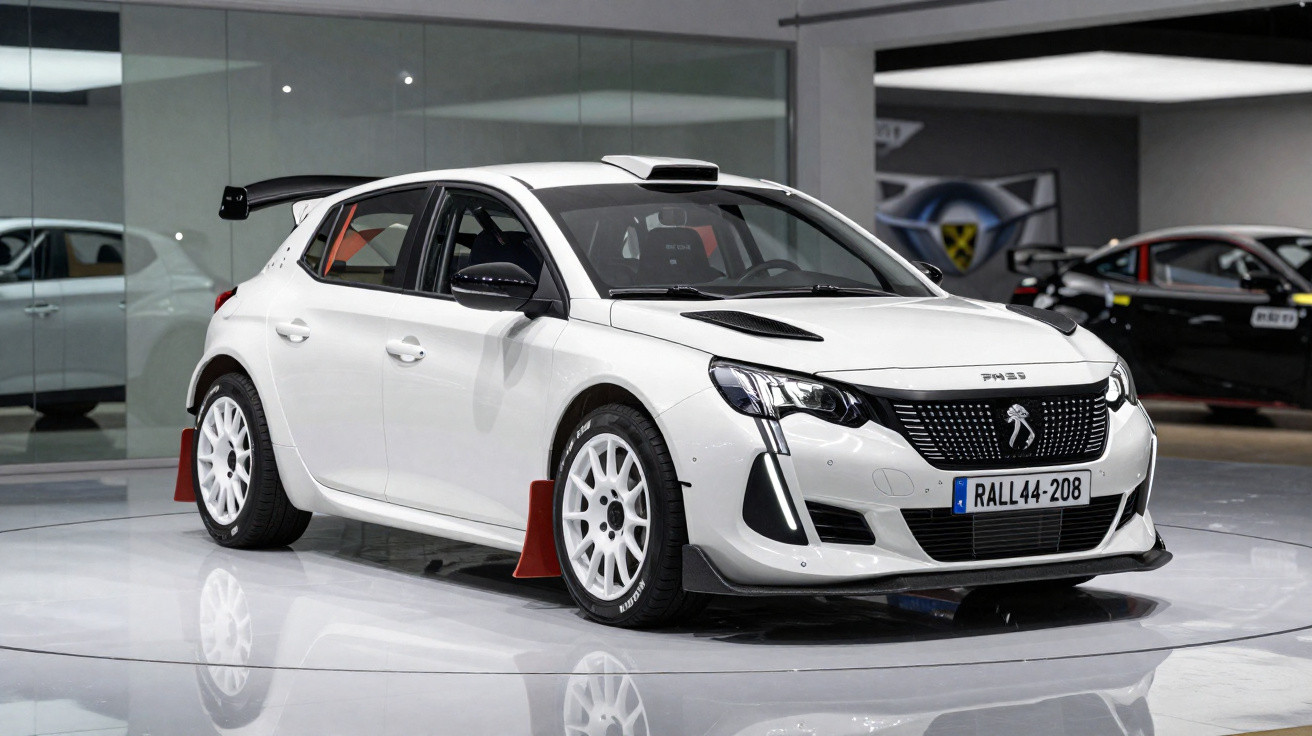
In 2020, the newest rally prospects will be honing their craft behind the wheel of the Peugeot 208 Rally 4. Peugeot Sport has been developing it in Versailles since the summer of 2018 for the new category introduced this year by the Fédération Internationale de l’Automobile (FIA). The 208 Rally 4 builds on the earlier 208 R2, which became the best-selling rally car ever, with more than 500 units sold since 2012.
Peugeot’s rally pedigree runs deep, both as a factory team and through its young-driver programmes, where some graduates have used the feeder categories as a springboard to worldwide recognition.
After Simca’s involvement in the 1970s and Talbot’s at the start of the following decade (both part of the French group’s brand universe), Peugeot set up a driver academy that came to be regarded as a benchmark from the 1990s through to 2008. That promotional formula helped shape the talent of a number of ambitious young drivers, some of whom went on to reach the very top on the global stage.
Two years ago, the French marque chose to revive the concept under a new name: Peugeot Rally Cup Ibérica. In practice, that means teams, drivers and events across Portugal and Spain, while sticking to the same core idea-acting as a launchpad for fresh talent, including those aiming to make it to the future World Rally Championship (WRC).
Ahead of the start of the 3rd season of the Peugeot Rally Cup Iberica, I had the chance to drive the new Peugeot 208 Rally 4. It wasn’t on a full-on rally stage, but rather on an oval circuit with a very uneven surface and a few weeds that lent it a certain rally-like atmosphere. The venue was the Terramar circuit, south of Barcelona in Sitges, which hosted the first Spanish Grand Prix for cars and motorcycles shortly after opening in 1923.
I completed just two laps, with an experienced driver alongside me as co-driver-Jean-Baptiste Franceschi, the reigning 208 Cup champion in France. That was enough to draw a few conclusions about the Rally 4’s behaviour at moderate pace. We then swapped bucket seats for another couple of laps-shorter, but considerably more committed-allowing a clearer sense of what the car can do when driven harder. The day also included seat time in Peugeot’s rally heritage machines-such as the T16 and the S16-as well as the original 205 GTi and the brand-new electric 208.
Fewer cylinders, more power
The first obvious difference from the road-going car is the Rally 4’s “war paint”. That matters even more because there are no major aerodynamic add-ons to pin the car to the tarmac (power and outright performance are relatively restrained by race-car standards).
Inside, there is little to take in beyond the huge handbrake lever and the five-speed SADEV sequential gear selector. Everything else is starkly functional: bare doors and a dashboard reduced to a small unit with a handful of essential functions (ignition, window control, horn, demisting, and so on).
And, of course, there are two rigid bucket seats with enhanced lateral support, five-point harnesses, and a steering wheel trimmed in a suede-like finish-both carrying Sparco branding, from the long-established specialist in competition equipment.
“Besides using a new platform, the Rally 4 differs from the R2 because it received the turbocharged 1.2 l three-cylinder engine in place of the naturally aspirated 1.6 l,” Franceschi explains. (The decision follows an FIA regulation change that banned engines above 1.3 l in this category.)
As a result, power could rise from 185 cv to 208 cv and torque from 190 Nm to 290 Nm, pointing to a naturally higher performance level-even if a little of the drama is lost compared with the naturally aspirated engine that would spin to nearly 8000 rpm. This three-cylinder is, in fact, the same unit as the road car’s, but here it runs a larger turbo and a more aggressive Magnetti Marelli calibration. That combination is what pushed output from the standard 208 1.2’s 130 cv up to 208 cv (and an impressive specific output of 173 cv/l).
Other key details: braking is, as you would expect, uprated; this front-wheel-drive car uses a limited-slip differential; and it runs adjustable Ohlin dampers. The Peugeot 208 Rally 4’s dry weight is 1080 kg so it can comply with the FIA’s 1280 kg limit (with driver and co-driver on board, plus all fluids required for the car to run).
Easy to drive
With a stiff thumbs-up from Franceschi’s left hand, I’m cleared to bring the engine to life. Immediately it adopts a deeper tone, far more present in the cockpit than in the everyday 208s we encounter on our roads. The clutch (heavy…) is only needed to select 1st gear; from there, it’s a matter of pulling the lever to work up through the gears and build speed towards the first line of cones acting as a series of bends.
The steering is very quick, so serious drivers don’t need exaggerated arm movements. Even so, the overriding impression at moderate speeds is how manageable the car feels-the goal is to understand how it sits on the asphalt, not to chase a lap record at Terramar… Especially because, at a price of 66 000 euros, plus taxes, the 208 Rally 4 is hardly a bargain, and the person next to me is far better equipped to attempt that kind of heroics while skimming around an oval with maximum banking of 60º, if that were the plan.
Throttle and brake are both delivered through very firm pedals that suit a physical but instinctive driving style. Standout traits include the engine’s eager response from low revs, helped by the car’s light weight, forced induction, and the crisp pick-up that is typical of three-cylinder engines.
Or tremendously fast and effective
Once Franceschi took over the wheel, what had seemed like encouraging pace and competent manners turned into a genuinely impressive display of chassis effectiveness at a frantic rhythm. There was even room for a few induced slides from the 2019 French Peugeot Cup champion to boost the artistic (and technical, for that matter…) score:
“overall the car ended up much less nervous than the R2 and easier to drive. It’s arrive at the corner, brake hard, turn the wheel and go full throttle and everything comes together with the greatest naturalness, which matters because many of the drivers will be amateurs and/or inexperienced”.
A driver’s word.
Peugeot 208 Rally 4 specifications
| PEUGEOT 208 RALLY 4 | |
|---|---|
| BODY | |
| Structure | Peugeot 208 monocoque, reinforced with a welded multi-point roll cage |
| Bodywork | Steel and plastic |
| ENGINE | |
| Type | EB2 Turbo |
| Bore x Stroke | 75 mm x 90,48 mm |
| Displacement | 1199 cm³ |
| Power/Torque | 208 cv at 5450 rpm/290 Nm at 3000 rpm |
| Specific output | 173 cv/l |
| Valve gear | Double overhead camshaft, 4 valves per cyl. |
| Fuel system | Direct inj. controlled by Magnetti Marelli ECU |
| TRANSMISSION | |
| Drive | Front |
| Drive | Front |
| Clutch | Ceramic/metal twin-plate, 183 mm diameter |
| Gearbox | 5-speed SADEV sequential |
| Differential | Mechanical with limited-slip |
| BRAKES | |
| Front | 330 mm ventilated discs (tarmac) and 290 mm (gravel); 3-piston calipers |
| Rear | 290 mm discs; 2-piston calipers |
| Handbrake | Hydraulic actuation |
| SUSPENSION | |
| Layout | MacPherson |
| Dampers | Adjustable Ohlins, 3-way (low- and high-speed compression, bump stop) |
| WHEELS | |
| Rims | Speedline 7×17 and Speedline 6×15 |
| Tyres | 19/63-17 and 16/64-15 |
| DIMENSIONS, WEIGHTS AND CAPACITIES | |
| Length x Width x Height | 4052 mm x 1738 mm x 2553 mm |
| Weights | 1080 kg (minimum) / 1240 kg (including drivers) |
| Fuel tank | 60 l |
| PRICE | 66 000 euros (plus taxes) |
Comments
No comments yet. Be the first to comment!
Leave a Comment