
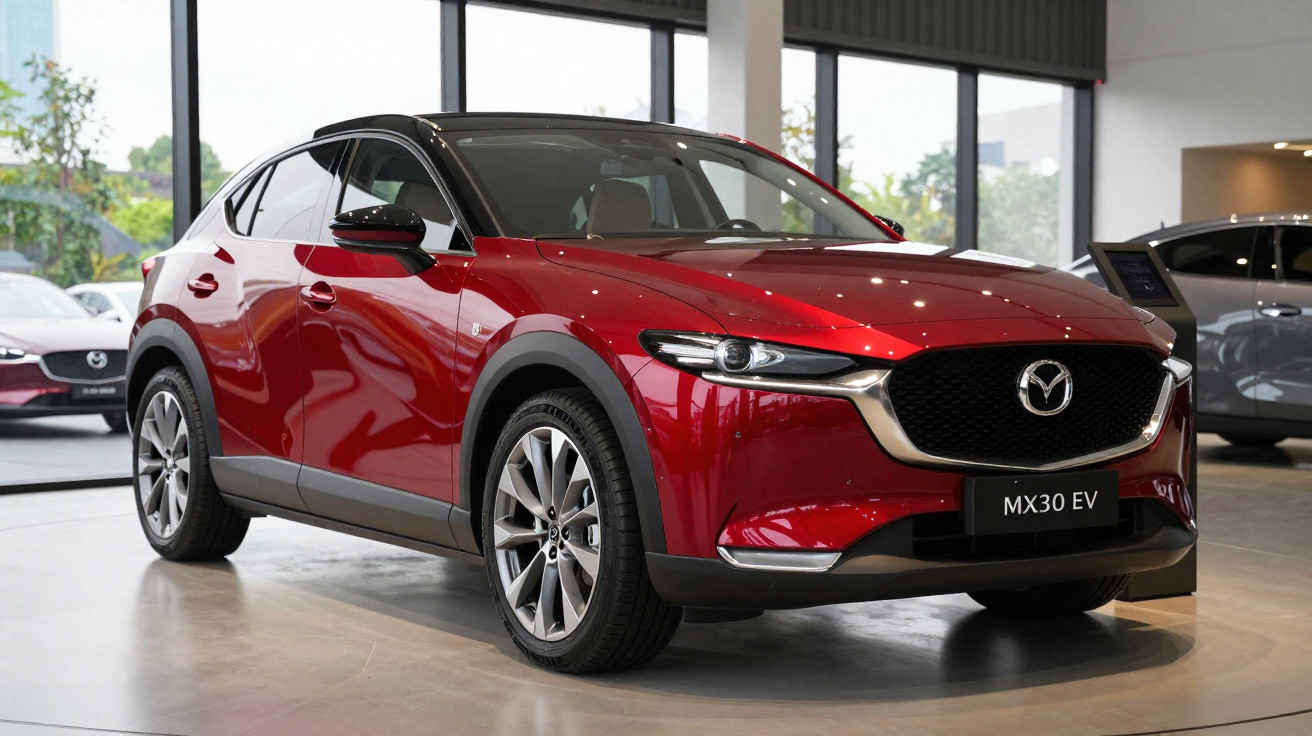
Around a year after its unveiling, the Mazda MX-30 is more than simply the first electric model from the Hiroshima brand - it also sets out Mazda’s own take on what an electric car should be.
Known for doing things “its own way”, Mazda remains one of the few manufacturers still pushing back against the creeping standardisation of the car world - and the MX-30 is a clear example of that. Starting with the styling, just as Guilherme Costa told us the first time he saw it in person, the MX-30’s proportions don’t immediately give away that it’s an electric vehicle.
The “culprit”? That long bonnet, which looks as though it was shaped to house an internal combustion engine - and in fact it will from 2022, when it gains a range extender. In Japan, there is already an MX-30 on sale with a petrol engine only. Further back, the main talking point is the rear-hinged, inverted-opening doors, which not only make the rear seats easier to access but also help the MX-30 stand out from the crowd.
Electric, but a Mazda first
Whether electric or combustion-powered, there’s something that defines modern Mazdas: the quality of their interiors and the restrained, uncluttered approach to design.
Unsurprisingly, the Mazda MX-30 follows that pattern. The cabin feels welcoming, and both the build quality and the materials - including Portuguese cork - are genuinely impressive.
Space and practicality on board
As for interior space, although the rear-hinged back doors do make entry easier, anyone travelling in the rear will feel more like they’re in a three-door car than a conventional five-door model. Even so, there’s more than enough room for two adults to travel in comfort.
Is it electric? You’d barely know it
Guilherme had said it before, and after driving the MX-30 for roughly a week I had to agree completely: if it weren’t for the lack of engine noise, the MX-30 barely felt like an electric car.
Of course, the 145 hp - and above all the 271 Nm of torque - arrives instantly. Even so, the way the controls respond and the overall feel sit closer to the world of combustion-engined cars.
On the road, the MX-30 sticks to the familiar Mazda playbook: precise, direct steering, strong body control, and a well-judged balance between comfort and handling.
And once you leave the environment that Mazda says suits electric cars best (the city), the MX-30 still doesn’t disappoint. It remains stable and consistently feels more at ease on A-roads and motorways than, for example, the smaller but equally distinctive Honda e.
A small (big) drawback
Up to this point, it’s clear Mazda’s approach to building an electric model has resulted in a car that looks different from its rivals and delivers a driving experience that’s not what you typically expect from a 100% electric vehicle.
However, as the saying goes, “every rose has its thorn”, and with the MX-30 that thorn is directly tied to Mazda’s view of where an electric car is best used.
As mentioned, Mazda argues that electric vehicles make most sense in the city, and for that reason it chose a smaller battery to reduce both costs and environmental impact.
With a capacity of 35.5 kWh, the MX-30 claims a WLTP combined range of 200 km (265 km in urban driving). Naturally, as you’ll know, these official figures are hard to match in real conditions - and during the test I rarely saw the range indicator predicting more than 200 km.
Real-world range and consumption
Is that enough for the kind of use Mazda had in mind for the MX-30? Absolutely. Whenever I used it in town, I could see the regeneration system doing its job properly, sometimes even allowing me to “stretch” the promised kilometres and achieve the quoted 19 kWh/100 km.
The issue is that we don’t always drive exclusively in the city, and in those situations the MX-30 shows the limits of Mazda’s “vision”. On the motorway I rarely managed consumption below 23 kWh/100 km, and as soon as you have to leave the urban area, range anxiety quickly becomes part of the experience.
Granted, with time and familiarity you start to realise you can actually go a bit further than you first think - but the Mazda may still require extra trip planning to make sure you’ll have somewhere to charge the MX-30 once you arrive.
Companies in the crosshairs
Like all electric cars, the Mazda MX-30 is particularly attractive to businesses, thanks to the various incentives available for purchasing it.
While exemptions from Vehicle Tax (ISV) and the Annual Circulation Tax (IUC) apply to all owners of electric models, companies can benefit even more.
To be specific, beyond the €2,000 state incentive that businesses can apply for, the Mazda MX-30 is exempt from Autonomous Taxation and also benefits from changes in the company’s Corporate Income Tax (IRC) code, allowing a higher provision for the permitted depreciation of electric vehicles.
Is it the right car for me?
The Mazda MX-30 shows that we don’t all have to use the same solutions to tackle the same “problem”. Built with city driving in mind, the MX-30 feels completely at home there, and it can also cope with a few (small) trips out into the suburban areas that surround our towns and cities.
With standout build quality and materials, plus styling that helps it rise above the crowd, the Mazda MX-30 is an ideal choice for anyone who places greater importance on image and perceived quality - and who can live without (some) range.
Note: the images show a Mazda MX-30 First Edition, which is no longer on sale. The price and equipment listed in the technical sheet correspond to the Mazda MX-30 Excellence + Plus Pack, in an equivalent configuration.

Comments
No comments yet. Be the first to comment!
Leave a Comment