
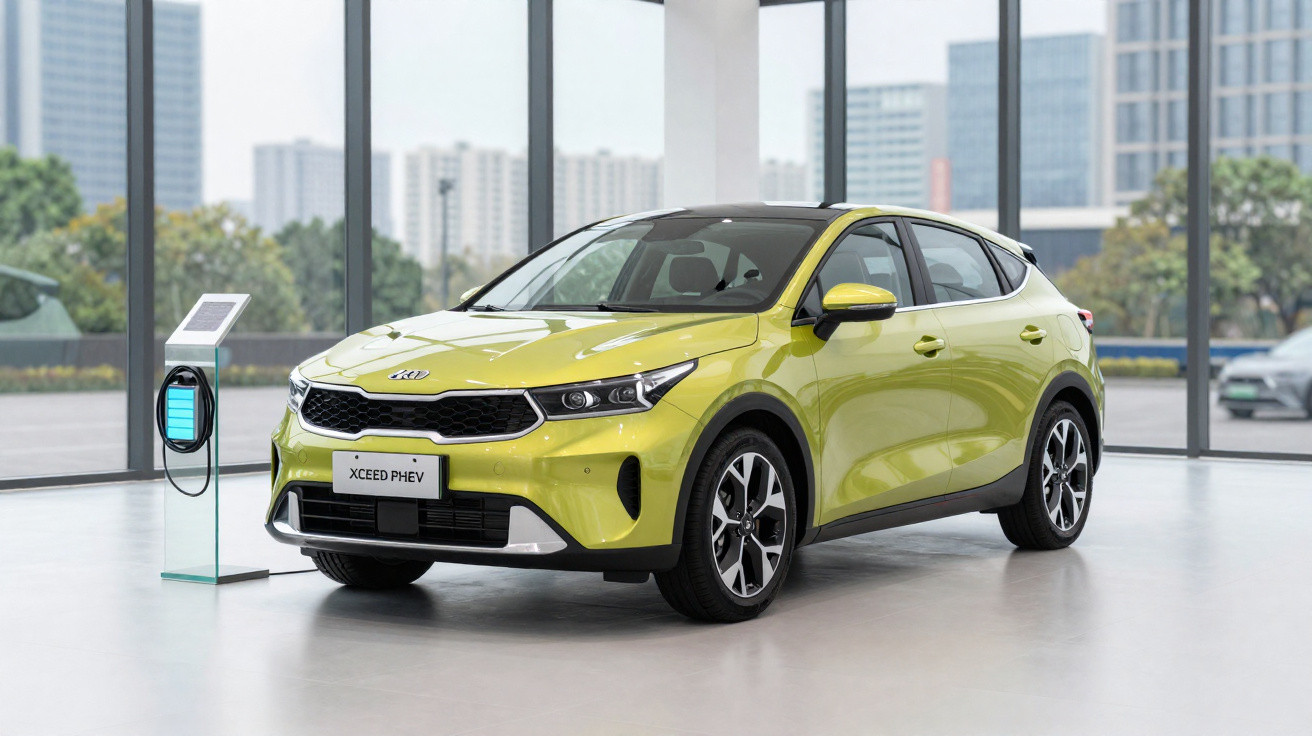
Somewhat controversial in recent times (unfairly, it has to be said), plug-in hybrids are nonetheless arriving in our market in ever greater numbers - and the Kia XCeed PHEV is yet another clear sign of that.
The plug-in hybrid version of the XCeed was promised from the moment the model was first introduced, and it… pledges lower fuel consumption and reduced emissions, as these versions are known for, along with several dozen kilometres driven solely on electricity. Time to see whether it delivers.
The same on the outside…
From the outside, only two details give this Kia XCeed PHEV away. The first is the essential charging flap set into the front wing, and the second is the set of wheels with a design unique to this version.
More aerodynamic, these wheels are noticeably smaller than those fitted to other XCeed variants (16” instead of the usual 18”) and they wear 205/60 tyres chosen with efficiency in mind (for both your wallet and the environment).
In every other respect, the dynamic, well-executed styling of the South Korean CUV (crossover utility vehicle) remains unchanged, and it still turns heads wherever it goes - even in a more understated colour like the one on the test car.
… and the same on the inside
Just like the exterior, the cabin of this XCeed PHEV is effectively identical to that of its “siblings”. Even so, a few details reflect the specifics of this version: there’s an extra control that lets us choose between hybrid/electric modes (HEV/EV), the infotainment system includes dedicated menus, and the instrument cluster displays information related to the hybrid system.
Otherwise, it stays in line with the rest of the XCeed and Ceed range. That means solid build quality, well-judged ergonomics (keeping physical buttons makes a big difference here), and several practical storage areas.
Is there anything that truly sets the XCeed PHEV apart from other XCeed models beyond the details mentioned? Yes - the boot, or rather its capacity.
While passenger space is unchanged and remains sufficient to carry four adults in comfort, boot volume drops from 426 litres to 291 litres. The reason? Beneath it sits the 8.9 kWh battery that powers the electric motor.
Heavier, but no less agile
On the road, the XCeed PHEV feels very similar to its pure-combustion “siblings”, proving predictable, secure and stable. It shows it can cope effectively with the roughly 200 kg extra compared with other versions (thanks to the electric machine and the unavoidable battery).
On top of that, the increased ground clearance lets us tackle rougher, more broken-up roads with greater confidence (reducing the chance of scraping the underside on a less visible dip) without compromising body control or comfort - which is actually helped by the taller tyre sidewalls.
Lower consumption is the real win
So far in this test, it’s clear the electrification of the XCeed has brought extra weight (it weighs 1594 kg, whereas the XCeed 1.4 T-GDi comes in at 1345 kg) and a smaller boot, which might make you wonder: what do you gain?
A noticeably smaller appetite, for a start. Fuel consumption is genuinely lower than in the equivalent petrol version. With the battery charged and in hybrid mode, I managed an average of 2.6 l/100 km on a mixed route. In town, good battery management allows you to cover long distances using… 0 l/100 km, because it’s moving purely on electric power.
Once the battery was depleted and the petrol engine became the main source of propulsion, the figures didn’t go much beyond 5.5 l/100 km, and in urban driving they hovered around 6.5 to 7 l/100 km.
To put that into context versus the XCeed fitted with the 1.4 T-GDi producing 140 hp and 242 Nm that we also tested, consumption ranged from 5.4 l/100 km at a gentle pace to 6.5 to 7 l/100 km when driven more briskly. In the city, the average settled at 7.9 l/100 km.
What about performance?
This XCeed PHEV is designed with efficiency as the priority, but the South Korean model can’t really be accused of being sluggish. With a combined maximum output of 141 hp and a combined maximum torque figure of 265 Nm - thanks to the “marriage” between the 44.5 kW (61 hp) electric motor with 170 Nm and the 1.6-litre petrol engine with 105 hp and 147 Nm - it proves more than adequate for everyday duties.
In “Normal” mode, throttle response is deliberately relaxed, favouring economy. Switch to “Sport” and the XCeed seems to “wake up”; with the electric motor’s instant torque delivery, it delivers perfectly acceptable performance.
Best of all, despite offering this “two-sided personality”, the South Korean CUV doesn’t punish fuel consumption excessively. What’s more, the six-speed dual-clutch automatic gearbox is far more pleasant than the CVT (or similar) units found in some rivals.
Is it the right car for me?
More economical than the petrol versions (and even Diesel, if the plug-in hybrid system is used as it should be), this XCeed PHEV ends up being one of the most appealing choices in the line-up.
That’s because, on top of the qualities already associated with the XCeed - attractive looks, robustness, a strong equipment list and an extended warranty (seven years or 150,000 kilometres) - this version adds running-cost efficiency that can be genuinely enviable.
It’s true the battery has reduced boot space, but it’s also true that the smoothness of operation and the low consumption (almost) make you forget that compromise.
For company-car drivers, the XCeed PHEV also combines tax incentives with urban savings typically linked to EVs, while retaining the versatility that, for now, only a combustion-engined car can offer.
For private buyers who might be put off by the high price of this XCeed PHEV, it’s worth bearing in mind that there is an ongoing promotion that brings it down to a far more reasonable level.

Comments
No comments yet. Be the first to comment!
Leave a Comment