
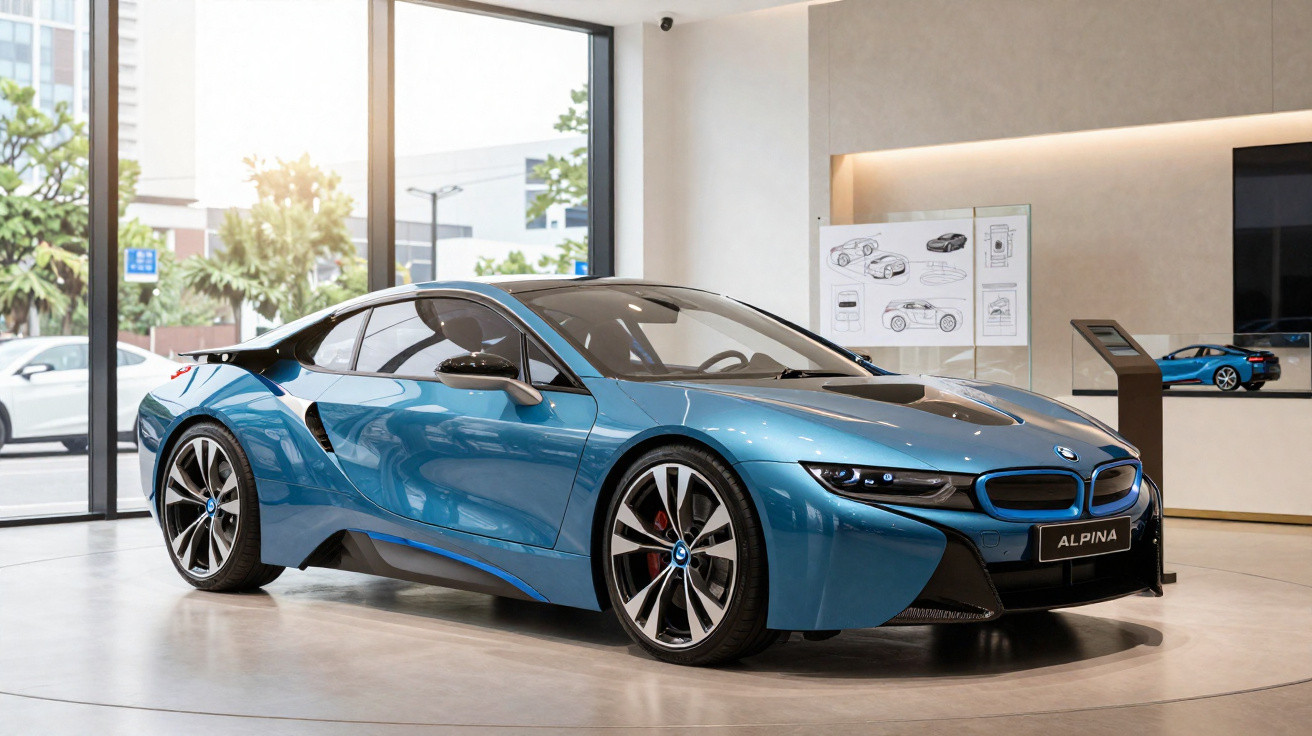
BMW i8: a plug-in hybrid sports car that still left people wanting more
BMW ended i8 production this year, bringing to a close the German brand’s first plug-in hybrid sports car. The i8 captivated people in plenty of ways - above all its design and engineering - yet one criticism never really went away: its 374 hp combined maximum output always felt a little short.
That is not to say the i8 was slow. Even so, for a car intended to point towards a new way of delivering performance - in this case, combining hydrocarbons with electrons - it always seemed to lack a more powerful and/or more focused i8 that could sit alongside pure combustion sports cars such as the Porsche 911 or the Audi R8.
That definitive, harder-hitting i8 never arrived, but it was certainly talked about - and, at least in one case, seriously pursued. Almost from the moment the BMW i8 became known, it was understood that Alpina was working on its own take on the exotic sports car. And, true to form, Alpina aimed to give the i8 a substantial step up in performance over the version everyone knew.
So why did we never get an Alpina i8?
At last, there is a clear explanation. In an interview with BMW Blog, Alpina CEO Andreas Bovensiepen confirms that developing “their” i8 was indeed real - but the project was eventually shelved after a series of obstacles emerged.
The engine swap that triggered a cascade of changes
Those issues ultimately traced back to one major decision: replacing the production car’s turbocharged 1.5-litre three-cylinder (rated at 231 hp) with the larger, more powerful turbocharged 2.0-litre four-cylinder used today in the BMW M135i. In this application, however, it would produce around 350 hp rather than 306 hp.
Bovensiepen says that, with the four-cylinder installed, the Alpina i8 would have delivered 462 hp of combined maximum output and 700 Nm of combined peak torque - a sizeable jump in power and torque and, presumably, in real-world performance.
Cooling, gearbox and chassis: the engineering knock-on effects
Once the bigger, stronger engine was in the picture, early cooling challenges appeared. Alpina first fitted a larger intercooler, but eventually had to add two more intercoolers mounted in the front wings to keep oil and the gearbox within their required temperature range.
When it came to the transmission, it was not simply a matter of keeping the production car’s six-speed automatic cool. It could not cope with the extra force from the larger engine, so Alpina turned to the eight-speed Aisin automatic that is paired with this engine today.
With a larger engine and transmission, further changes followed. Alpina had to design an aluminium rear substructure to carry the new hardware, and it needed to be stronger than the existing item - with the list of required modifications continuing to grow.
To the front axle, Alpina addressed the i8’s characteristic understeer by fitting tyres 50 mm wider than the skinny 195-section items on the standard model. The knock-on result was bodywork: new, larger wings had to be developed to house the wider rubber.
Extra mass and the problem of re-certification
Taken together - the bigger engine and gearbox, larger and additional intercoolers, and the reworked rear substructure - the Alpina i8 would also have gained roughly 100 kg.
That increase was not a concern for the i8’s carbon-fibre structure, which was stiff enough to handle the added power and mass without needing reinforcement. However, the extra 100 kg would have forced the Alpina i8 to be re-certified for safety - meaning expensive crash-tests would have to be repeated for homologation.
Even so, Bovensiepen says these modifications and the costs attached to them were not the main reason the programme was dropped.
The reason that “killed” the project for good
The decisive factor was calibrating the i8’s complex powertrain. The BMW i8 uses two physically separate drive units - the combustion engine drives the rear axle, and the electric motor drives the front axle, with no mechanical connection between them - yet they operate together smoothly, as though they were a single system. That only works because the software managing both drive units is optimised down to the “byte” specifically for that pairing.
In other words, by changing the combustion engine and its transmission, Alpina lost that finely tuned management and calibration. Rebuilding it would have meant starting from scratch. And doing so would have taken an enormous amount of time - because it is, in their words, very difficult - and it would also have been hugely expensive.
That was the point at which Andreas Bovensiepen and his team decided it was not worth committing the human and financial resources required to continue, if the end result could not meet Alpina’s usual standards. A prototype of this Alpina i8 was built and it did run, but it ultimately fell short in how well the two drive units worked together.
Perhaps that same complexity - and the additional cost it brings - also helps explain why there was never a BMW M version of the i8 either, not just an Alpina one.

Comments
No comments yet. Be the first to comment!
Leave a Comment