
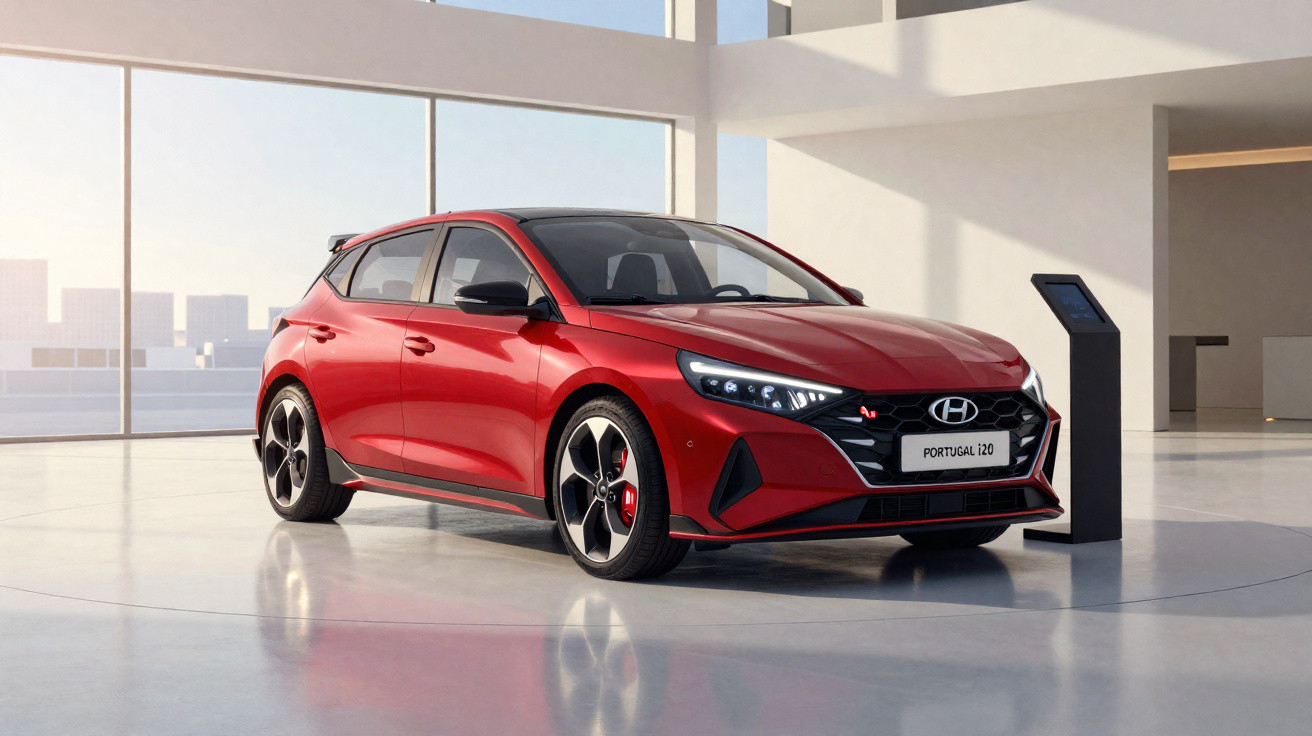
The new Hyundai i20 goes on sale at the beginning of January, but for anyone who would rather not wait, Hyundai Portugal is already running a pre-launch offer until the end of the year (31 December), with a special introductory price €1500 below the list price.
Even if you ignore that campaign, when sales start in Portugal the new Hyundai i20 will still carry a lower list price than its predecessor - something you do not often see.
Like-for-like versions in the new line-up are between €645 and €1105 more affordable, despite this third generation arriving with stronger credentials in efficiency, connectivity and safety. Style has also taken a step forward, with a much sharper look that follows the brand’s new Sensuous Sportiness design direction.
How much does the new Hyundai i20 cost?
Prices start at €16 040 for the 1.2 MPi Comfort and top out at €21 180 for the 1.0 T-GDI Style Plus with the 7DCT dual-clutch gearbox:
| Version | Price |
|---|---|
| 1.2 MPi Comfort 5MT | 16 040 € |
| 1.0 T-GDI Style 6MT | 17 800 € |
| 1.0 T-GDI Style 7DCT | 19 400 € |
| 1.0 T-GDI Style Plus 6MT | 19 580 € |
| 1.0 T-GDI Style Plus 7DCT | 21 180 € |
Portugal line-up
In Portugal, the initial range is built around two engines, three transmissions and three trim levels. Starting with the powertrains, only petrol engines will be offered; there will be no Diesel options and not even any electrified versions, despite electrification having been one of the South Korean brand’s strongest recent focuses.
First up is the 1.2 MPI, a naturally aspirated four-cylinder producing 84 cv, paired with a five-speed manual gearbox (5MT). It is familiar from the outgoing model, but it reaches the new Hyundai i20 with improved efficiency. Both fuel consumption and CO₂ emissions are lower by, respectively, 13,1% and 13,7%, settling at 5,3 l/100 km and 120 g/km.
A similar story applies to the 1.0 T-GDI: a turbocharged inline three-cylinder with 100 cv, available either with a six-speed manual (6MT) or a seven-speed dual-clutch transmission (7DCT). The updated 1.0 T-GDI posts consumption and emissions improvements of, respectively, 8,5% and 7,5%, landing at 5,4 l/100 km and 120 g/km.
As for trim, there are three lines: Comfort, Style and Style Plus. Comfort is offered exclusively with the 1.2 MPI, while both Style and Style Plus are linked only to the 1.0 T-GDI.
Even as the entry level, Comfort already brings 16″ alloy wheels, LED daytime running lights and rear privacy glass (tinted). Inside, it comes with manual air conditioning, a 10,25″ digital instrument cluster and Hyundai’s latest infotainment, operated via an 8″ touchscreen. Connectivity is a key highlight, with Android Auto and Apple CarPlay included across the range - but not wirelessly.
On the safety front, Comfort is already equipped with autonomous emergency braking and lane keeping assist (LKA). It also includes automatic high beam, a reversing camera, rear parking sensors and a driver attention warning.
With Style, wheel size increases to 17″ and three driving modes are added. The air conditioning becomes automatic and you also gain a rain sensor. Style Plus adds Full LED headlights, a smart key and a front armrest. Visually, the bodywork switches to a two-tone finish.
And the i20 N… when does it arrive?
We are fans of pocket-rockets, and when we saw the i20 N revealed by the same people who gave us the i30 N, we have to admit it left us eager for more. There is still no fixed date for the start of sales for the most rebellious version of the new i20, but it will happen during the 2nd quarter of 2021.
It should arrive slightly ahead of the well-received N Line versions - as has been seen on other Hyundai models - with a sportier look, which are due towards the end of the first half of 2021.
One version will not be coming to Portugal, however, according to Hyundai. That is the 48 V mild-hybrid variant featuring the new intelligent manual gearbox, the iMT, paired with the 1.0 T-GDI with 120 cv (or 100 cv, optionally). This electrified option claims 3-4% lower consumption and emissions, and its manual gearbox can decouple the transmission from the engine whenever you lift off the accelerator, without needing to select neutral. According to Hyundai Portugal, the cost-benefit balance of this version does not make sense for the local market.
Comments
No comments yet. Be the first to comment!
Leave a Comment