
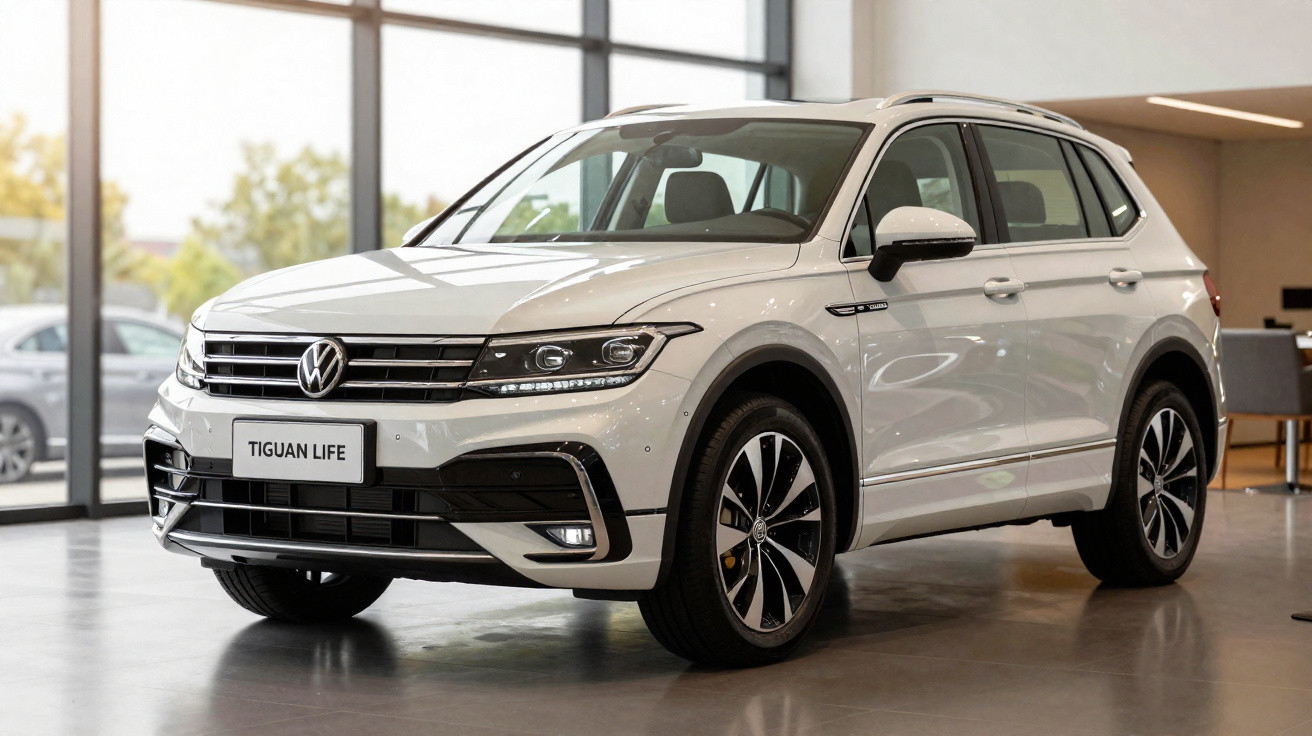
Unlike the usual press-fleet fare, the Volkswagen Tiguan tested here isn’t a range-topper loaded with every option going. This Tiguan 1.5 TSI (131 PS) Life is, in fact, the most affordable version of the SUV on sale in the Portuguese market.
Volkswagen asks a little over €34,000 for its (very) roomy, family-focused SUV, although “our” Tiguan ends up a touch pricier, nudging €35,000. That’s down to the options fitted - but there are only two: the white paint and the Digital Cockpit (digital instrument cluster).
On paper, its list price sits above that of its main rivals, but once you align like-for-like equipment, the Tiguan Life looks far more competitive. Even as the entry point to the range, it doesn’t translate into a bare-bones specification.
Quite the opposite: the Tiguan Life arrives impressively well equipped, and it even brings a few treats you wouldn’t normally expect on a base model. You get tri-zone climate control, a cooled glovebox, and a long list of driver-assistance systems that includes adaptive cruise control - and it will even park itself.
That stronger standard equipment offering across the Tiguan line-up was one of the key outcomes of its recent facelift. It didn’t just gain kit; it was also refreshed visually, with redesigned front and rear styling - bumpers, LED headlights (standard), grille, and LED rear lights. Most of the spotlight, though, went to the new Tiguan eHybrid - which we’ve already driven - and the sportier Tiguan R.
Does the “entry” engine convince as much as the equipment level?
Quick answer: no, not really. The Volkswagen Tiguan isn’t the smallest or lightest vehicle in its class. With more than 1,500 kg - and that’s with only the driver on board - the 1.5 TSI with 131 PS and 220 Nm can feel a bit stretched. It doesn’t take long to notice: on some inclines you’ll need to drop a gear to hold speed, and overtakes demand a bit more planning.
Performance is no more than modest, though there’s nothing inherently wrong with the 1.5 TSI itself. As in other models and versions we’ve tried (there’s also a 150 PS variant alongside this 130-ish output), it remains a capable and efficient unit. Its sweet spot sits between 2,000 rpm and 4,000 rpm, where it feels most alert (with virtually no turbo lag) and eager. Work it harder and it won’t complain about pulling beyond 5,000 rpm, where it reaches maximum power.
The engine is also well matched to the six-speed manual gearbox. The ratios are sensibly spaced and, even if the shift action isn’t class-leading for travel, speed, or feel, it’s still a pleasing setup overall.
On the other hand, the 1.5 TSI (131 PS) proved frugal on open roads at speeds below 100 km/h: figures around five litres per 100 km are achievable (it can deactivate two cylinders in certain conditions to save a few extra tenths). Ask for more - such as when you’re trying to overcome the Tiguan’s inertia in town - and consumption rises readily to eight litres per 100 km (and a bit). In mixed driving (urban roads, A-roads and motorway), the final average ended up between 7.0–7.5 l/100 km.
Volkswagen Tiguan with a French streak…
That feeling of the engine being slightly “short” is amplified by how naturally the German SUV settles into long-distance work, covering big miles in one go with the comfort and refinement you’d hope for. Yet my first kilometres behind the wheel were both intriguing and revealing: the Tiguan stood out for its smoothness, in both controls and ride. It felt more like a French offering than a German one.
That’s a notable departure from the usual perception of German cars as if they’ve been “carved” from a solid block, typically bringing heavier controls and a firmer, drier ride - especially against many rivals.
Not this Tiguan. Even when compared with the smaller, lighter Golf - which I also tested - the SUV not only has (much) lighter controls, but its suspension can make you feel as though you’re almost floating over many road imperfections. In my view, a lot of that comes down to the tyres it was wearing - more specifically, their size.
The Tiguan Life rides on 17-inch wheels as standard, wrapped in (modest) 215/65 R17 tyres. That contrasts with the larger and (it must be said) more eye-catching 19-inch wheels of the Tiguan R Line, for instance (255/45 tyres). It’s the generous 65-profile sidewall that provides the “air cushion” behind this SUV’s supple ride.
…but it’s solidly German
Even so, unlike some comfortable French alternatives, this comfortable German goes a step further in certain dynamic areas. The softness and ease don’t come at the expense of accuracy, control, or overall composure when you increase the pace on tighter, twistier roads. It’s precisely when you push it harder that you realise the apparently French smoothness still sits on top of the expected German solidity.
In those moments, it remains consistently precise, progressive and predictable. It responds quickly to steering inputs, and body movements are always well contained. The main gripe is the near lack of seat support, whether side bolstering or under-thigh support - although, on the upside, they’re genuinely comfortable. It’s more capable than entertaining, but the Volkswagen Tiguan is a family SUV first and foremost.
For the family
Beyond that, it’s still the Volkswagen Tiguan we’ve known since 2016, keeping the strong qualities that matter for family use - above all, the generous space on board. Access to the second row is easy, and once there you sit comfortably with plenty of legroom and headroom. The exception is the middle passenger, who has to contend with a firmer seat and a prominent transmission tunnel.
The rear seats also slide fore and aft, and you can even adjust the backrest angle. The boot is among the largest in the segment, rivaling some estate cars, and you can fold the rear seats down from the luggage area - a genuinely handy convenience.
It also remains one of the most solid-feeling interiors in the class, though there are a few “innovations” worth criticising - namely the new climate-control switches. Yes, they’re still separate from the infotainment screen, but they’re now touch-sensitive surfaces that are less user-friendly, demanding more precision and attention than traditional rotary knobs.
Is this the ~~car~~ Tiguan right for me?
The cheapest Volkswagen Tiguan you can buy turned out to be a pleasant surprise, both for its standard equipment and for its comfort, smoothness and refinement. However, its engine stops it short of a wholehearted recommendation. That’s not because the 1.5 TSI lacks strengths - it has plenty - but because the figures for this version are modest. If you use the Tiguan as intended, as a family vehicle regularly carrying people and luggage, 131 PS can feel a bit tight.
Without leaving petrol power, the answer is to step up to the 150 PS and 250 Nm version. In Portugal, though, it’s only available with the DSG dual-clutch gearbox - which many people actually prefer in this sort of vehicle. The downside is cost: the 1.5 TSI with 150 PS starts at roughly €37,500.
The other alternative is the equivalent Diesel model, the 2.0 TDI with 122 PS. Despite being less powerful on paper, it delivers an extra 100 Nm of torque, which makes a difference - especially when loaded. The problem is… the price, with the 2.0 TDI starting very close to €40,000. That’s really only for high-mileage drivers.
Comments
No comments yet. Be the first to comment!
Leave a Comment