
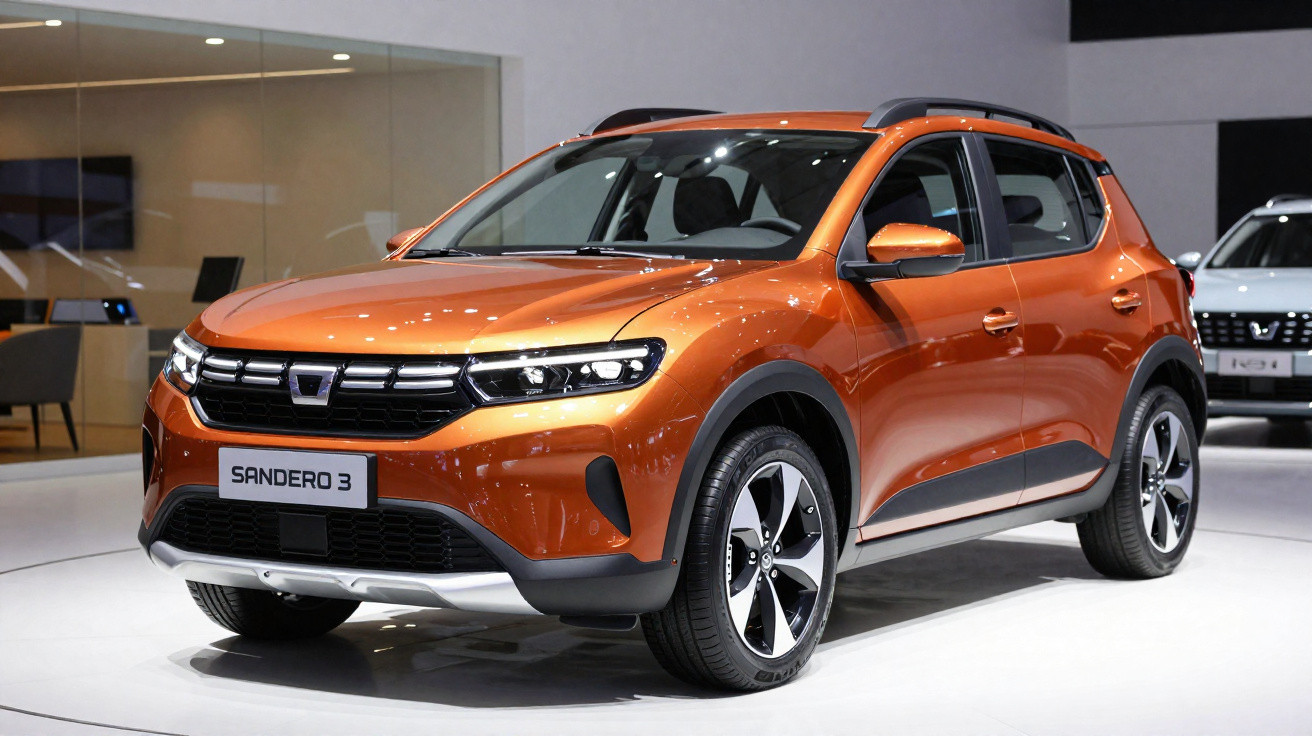
We have already covered in detail all the new features of this third generation, and we also know how much it will cost when it reaches Portugal at the end of January next year - orders open on 15 December - so it is time to get to the heart of it: can the new Dacia Sandero and Sandero Stepway genuinely stand up as alternatives to others in the segment?
In a quick, simplified verdict: YES. That is the clear takeaway from our first “in the flesh” encounter with the model’s third generation in Portugal.
Price remains one of the third-generation Sandero’s strongest cards. If anyone still doubted that price is one of the main deciding factors when buying a new car, it is worth remembering that the Sandero has been the best-selling private-buyer model in Europe in recent years - and it now holds that position in Portugal too.
Even so, while it is the cheapest car on sale in the country - prices start at 9000 euros - and sits many thousands of euros below its segment rivals, that gap is not mirrored in its strengths or its overall offering. This is especially true of the better-equipped versions which, although pricier, still come in at a headline-grabbing price and present themselves as fully credible alternatives to anything else in the class.
That is exactly what we found during this first dynamic drive, where Guilherme Costa introduces the Sandero Stepway ECO-G (the bi-fuel petrol and LPG version). Interestingly, it is one of the more expensive Sanderos in the range - 15 mil euros - yet it is also one of the most in demand. In Portugal, ECO-G versions already account for 35% of total Sandero range sales.
The most popular…
… will likely be the one I had the chance to drive: the Dacia Sandero TCe 90, paired with a six-speed manual gearbox and the Essential trim level, priced at under 11 500 euros. It is not the absolute cheapest Sandero (the 9000 euros one), but it is a much more well-rounded proposition.
It brings a useful 90 hp and 160 Nm - whereas the 9000 euros model uses the naturally aspirated SCe with 65 hp and 95 Nm - and it adds convenience equipment such as cruise control and… central locking, not forgetting Media Control (which I will cover in more detail below). On top of that, Essential opens the door to options you cannot get on Access, such as air conditioning or the Comfort Pack (driver’s armrest, height-adjustable seat and a steering wheel with reach adjustment). Both were fitted to the car I drove.
Perhaps the most intriguing equipment choice is the infotainment set-up. There are three systems available on the new Dacia Sandero, and Media Control is the entry-level option - and, in my view, the most compelling.
With Media Control you do not get the now-usual tablet-style touchscreen, which you can find on better-equipped Sanderos (an 8" screen on Media Display and Media Nav). Instead, the infotainment “screen” becomes your smartphone, slotted into a dedicated mount.
After installing the Dacia Media Control app, you gain access to a wide range of functions in your Sandero, from radio to phone to navigation - using apps you already have, such as Google Maps. The app can be partly operated through the steering-wheel controls, with information also shown on the monochrome trip computer in the instrument cluster. Alternatively, you simply use the app on your smartphone - which is, after all, a touchscreen - and it proves straightforward, with simple graphics, clear menus and large buttons.
It is a very clever solution from Dacia. As well as providing the everyday in-car functions people expect, it lets you keep full access to everything on your smartphone, without adding extra cost for the brand - or pushing up the car’s price. Could this be the future of infotainment systems?
Competent in everything
On the road, the new Dacia Sandero came across as thoroughly capable - more than I expected. Mention Sandero and “low cost” tends to spring to mind, but once you are inside and moving, that perception (almost) disappears.
The revised interior design is easier on the eye. The Comfort version (the highest trim) looks richer thanks to fabric trim on the doors and dashboard, and the Stepway adds splashes of colour too. Even so, despite the Essential’s plainer, more restrained look and lack of colour, it is not an unpleasant place to spend time.
Yes, you are surrounded by hard plastics that are not especially nice to the touch, but in truth they are no worse than those found in other, much more expensive cars in the same segment. On the plus side, assembly quality feels in line with the class - only rough cobbled streets really highlight its limitations.
Compared with the Renault Clio - the model it shares the most DNA with (both use CMF-B) - the Dacia Sandero does not reach the same levels of finish (especially in terms of presentation), perceived solidity and sound insulation. Even so, the gap is not as wide as the price difference between the two might suggest.
Comfort on the move was another pleasant surprise. This drive took me from Lisbon to Leiria (and back) across a mix of motorway and A-roads, with long stints behind the wheel. It is still a supermini, but comfort is a strong point, helped by the seats (with reasonable support) and the suspension, which makes longer trips feel perfectly manageable.
The 90 hp and, above all, the 160 Nm from the 1.0 turbo also proved adequate for that job. It is not a fast car, but it offered a very acceptable level of flexibility when paired with the new six-speed manual gearbox - the JT 4, produced exclusively at Renault Cacia - a clear step forward over the five-speed previously used with this engine.
It also turned out to be economical, with consumption hovering around 5.5 l/100 km on A-roads, rising by about a litre, or slightly more, on the motorway - despite driving without worrying about economy and in very poor weather conditions (rain and strong winds at times). The same cannot be said when you combine this TCe 90 with the CVT (continuously variable transmission). Not only does it become thirstier over the same routes - differences of a litre or even more - it is also slower and less pleasant to use when you need to pick up speed quickly.
Space is not an issue
Helping its road-going and family-friendly credentials is the room on board. It offers one of the largest boots in the segment and, in the second row, it is among the most spacious superminis - one of the few that can honestly claim it can carry three people (even if not in great comfort). The likely reason is its width: the new Dacia Sandero is the widest supermini in the B-segment.
At virtually 1.85 m wide excluding the mirrors, it is almost 12 cm wider than its predecessor, 5 cm wider than the Clio (already quite broad for a B-segment car), and it is a figure more commonly associated with… D-segment cars. It is nearly 2 cm wider than, for example, a Volkswagen Passat.
On the flip side, that slightly excessive width also plays a big part in the third-generation Dacia Sandero’s more robust, mature and even more sophisticated look - something that, as we found, is echoed in its attributes and abilities.
Dacia has a winner on its hands!
Comments
No comments yet. Be the first to comment!
Leave a Comment