
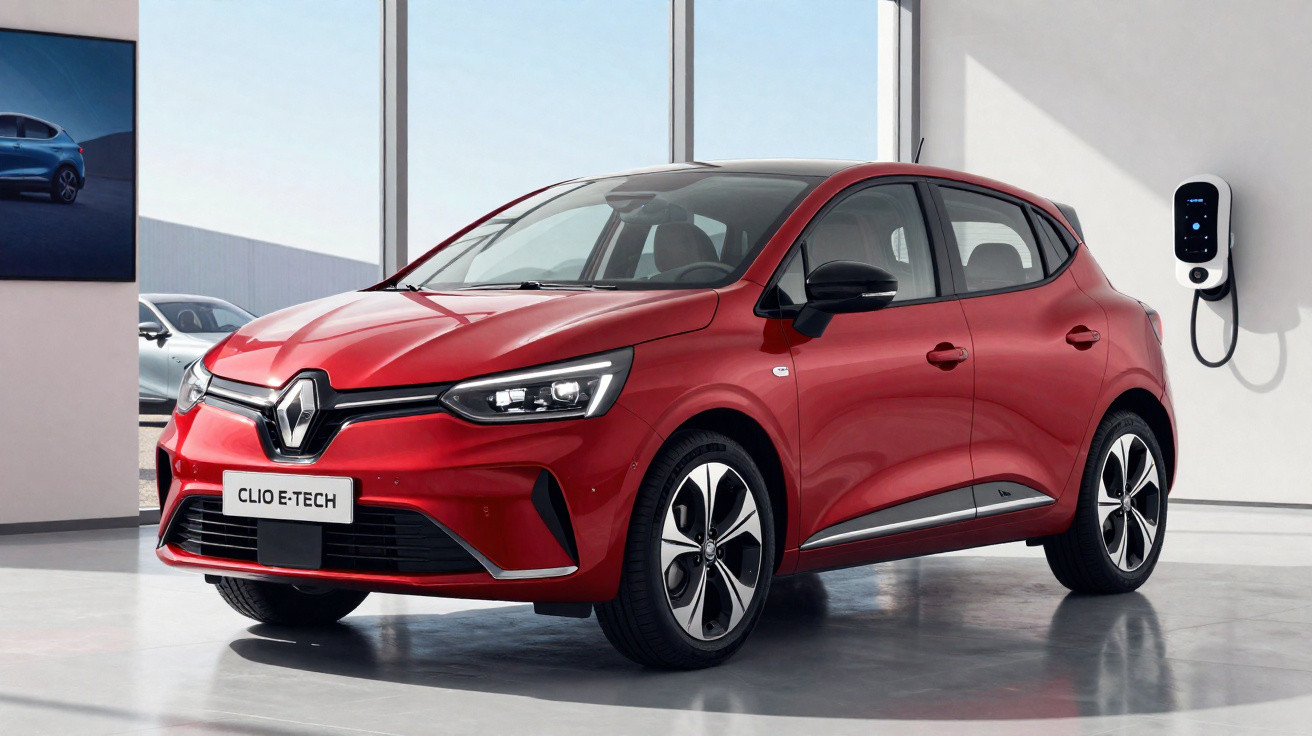
The Clio, which marks its 30th anniversary this year, is one of the best-known and most successful models in the B-segment - and it is even the segment’s sales leader - yet it, too, is being swept up by the electrifying winds of change across the industry. It now comes with a brand-new hybrid version: the Renault Clio E-Tech.
This hybrid variant joins an extensive engine line-up (the most complete in its history), which includes Diesel versions, petrol options and LPG. The only thing that seems to be missing is a 100% electric version, but for that Renault has the Zoe.
In this segment, there are still only a handful of models that have taken the hybrid route - there appear to be more 100% electric proposals - so the electrified Clio’s direct rivals boil down to the Toyota Yaris and the Honda Jazz.
All three are “full-hybrids” or complete hybrids, but they are not plug-in types - in other words, you cannot plug them into the mains. The battery recharges while driving, every time we decelerate, brake or go downhill. The battery fitted to the Clio E-Tech and its rivals is much smaller than that of a plug-in hybrid, which is why they do not usually quote an electric range.
Even so, Renault says that, in town, the Clio E-Tech can run for up to 80% of the time using only the electric motor. How is that possible? Because in urban driving there is more stop-start, so there are more chances to recover energy during deceleration and braking, allowing the electric motor to assist far more often.
The pay-off is very low fuel consumption. But is it really like that? To find out whether the Clio E-Tech delivers on everything it promises, it was time to put it to the test.
True to itself
Whether you look at the outside or step inside, the differences between the Renault Clio E-Tech and the rest of the range come down to small details that require a keen eye.
On the exterior, that means the usual badges and a uniquely styled bumper, while inside the changes are limited to additional logos and the hybrid-related displays in the 7” instrument cluster, plus an extra menu within the infotainment system’s 9.3” screen.
Beyond that, the perceived material quality puts the Clio towards the top of the segment in this area, and the build feels notably improved too: the lack of unwanted rattles shows clear progress versus the early cars of this generation that first reached the market.
Cabin space is unchanged, leaving the Clio E-Tech squarely in the segment average on this point. Finally, fitting the 1.2 kWh battery has reduced boot capacity from a reference 391 litres to a much more modest 254 litres. For comparison, the Yaris offers 286 litres, and the Jazz - which takes on an MPV-style shape - has 304 litres.
What’s it like to drive?
From a dynamic point of view, the Clio E-Tech keeps the French model’s credentials intact. It strikes an appealing balance between comfort and handling, with only a slightly light feel to the controls acting as a “brake” on a stronger sense of connection between car and road.
That said, paired with a well-sorted chassis and direct steering, this hybrid Clio also delivers the immediate throttle response (especially in “Sport” mode) that is typical of cars equipped with a hybrid system.
The “homework” done properly
Renault may be the newest brand to arrive in the “niche” of hybrid superminis; however, behind the wheel of the Clio E-Tech it becomes very clear that Renault prepared thoroughly for this “battle”.
To begin with, it brings more power than its two main rivals. Combining a naturally aspirated 1.6 l petrol engine with two electric motors produces 140 cv of maximum combined power and 144 Nm. That is more than the Toyota Yaris’s 116 cv and the Honda Jazz offers 109 cv.
Even if that does not translate, on paper, into superior performance - at least in the 0–100 km/h metric, where it is the slowest of the three, albeit only by a few tenths of a second - in the real world it is the Clio E-Tech that seems to have the strongest lungs, particularly when it is time to tackle steeper climbs or accelerate for overtakes.
Transmission duties are handled by an evolved multi-speed automatic gearbox using technology inherited from Formula 1, and its operation is pleasingly smooth.
In fact, “smooth” could easily be the watchword for the entire hybrid system: the handover between electric running and the combustion engine is almost imperceptible. What’s more, as I was able to confirm in town, the promise that the Clio E-Tech can drive around 80% of the time in urban use in 100% electric mode is delivered.
Only then do the city fuel figures I saw make sense, sitting in the 3 to 4 l/100 km range. Driven more briskly, consumption remains low, never rising beyond 5.5 to 6 l/100 km, and even on the motorway it is possible to achieve 4.5 l/100 km - just like a… Diesel.
Is it the right car for me?
With all the qualities that have made the Renault Clio a consistent leader in the supermini segment, this Clio E-Tech is the ideal choice for drivers who spend most of their time in urban environments.
That is where the hybrid system shines brightest and where it enables the biggest savings, without bringing the usual plug-in hybrid “inconveniences”, such as having to charge it.
However, do not think this Clio E-Tech only makes sense for city dwellers. It is also economical on open roads and, with a price not much higher than the combustion-only versions (but with more power), it stands out as one of the best options in the French supermini’s entire range.

Comments
No comments yet. Be the first to comment!
Leave a Comment