
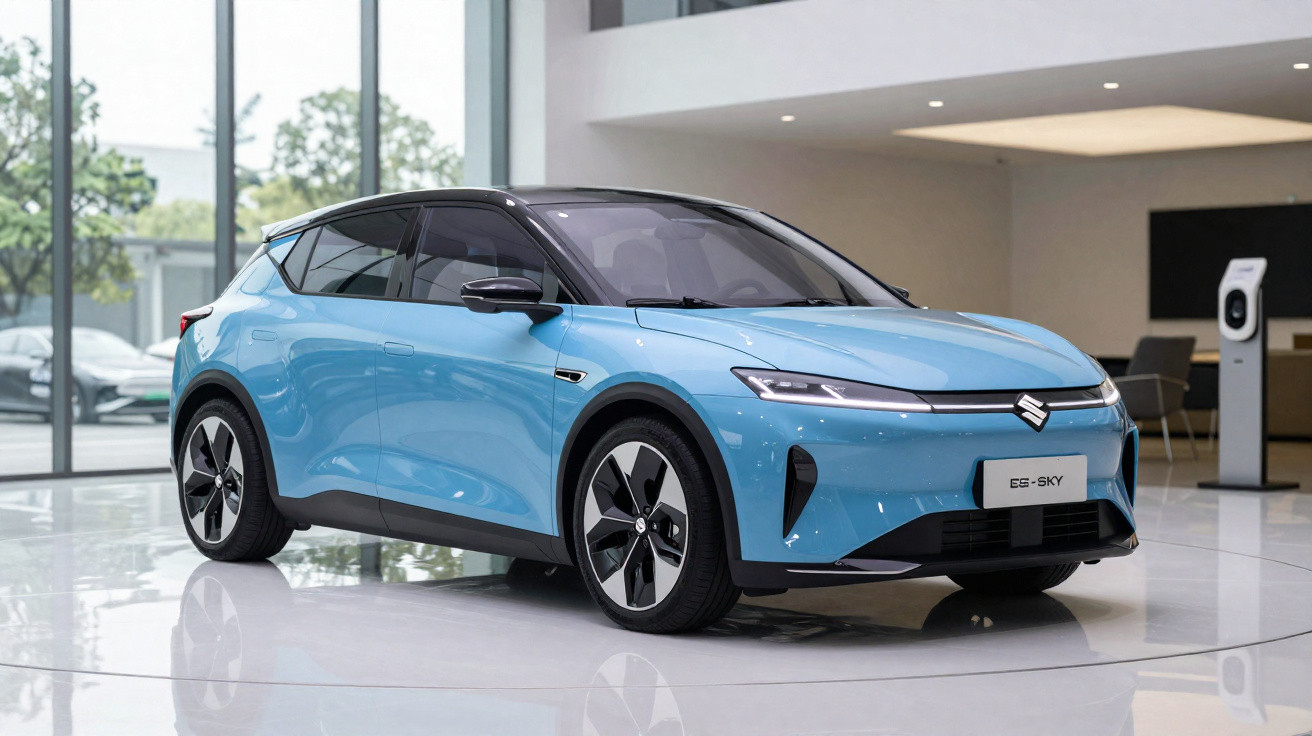
Suzuki has done it before and is getting ready to use the same playbook again. Around the turn of the century, the brand brought the Wagon R+ over from Japan to compete in the city-car class - a segment that was far larger and much more hotly contested than it is today.
Now, almost 30 years on, at a time when many people had all but written off urban cars as a near-extinct category, the Japanese manufacturer is turning its attention back to small town-focused models and is preparing a Renault Twingo rival.
Suzuki Vision e-Sky city car: concept and design cues
Due in 2027, the new city car is expected to be the production version of the 2025 Vision e-Sky prototype. Information remains limited for now, but test mules have already been spotted in Europe, suggesting it will retain the concept’s tall, five-door body and its notably “boxy” styling.
Although it is being aimed at cars such as the Renault Twingo, the upcoming Dacia Spring and the Volkswagen ID.1, Suzuki is likely to go for even smaller exterior dimensions, keeping very close to the limits that define Japan’s kei car class.
The Vision e-Sky prototype itself, for instance, matches those length and width restrictions precisely: 3395 mm long, 1475 mm wide and 1625 mm tall. The European version could be tweaked in places to satisfy EU safety requirements and type-approval rules.
Dimensions and European positioning versus key rivals
In concept, Suzuki’s forthcoming electric urban model appears closer in spirit to the Honda Super-N, which is already on sale in the United Kingdom. Both are rooted in Japanese kei cars and then adapted for Europe, keeping a compact footprint while pairing it with a high-roof silhouette.
Suzuki has not yet published production-model technical specifications, but when it first unveiled the Vision e-Sky it did state a driving range of more than 270 km.
Suzuki electric city car: a crucial bet
Speaking to Autocar, David Kateley, Suzuki’s UK director, stressed how important the car is for the company: “Segment A EVs are vital. It’s an entry into a different segment for us and I’m really excited about its potential”.
The expectation is that the new EV will be priced aggressively, landing at around €20,000 like its competitors and becoming one of the most affordable options on the market.
Unlike the Honda Super-N, Suzuki’s future electric city car will not be restricted to right-hand-drive markets and is set to be sold across mainland Europe.
Following the 2027 launch, Suzuki plans to expand its electric line-up with a third model in 2029 - most likely a B-segment crossover positioned between the new city car and the eVitara.
As for whether that third EV could be a Swift, Kateley was unequivocal: “It definitely won’t be an electric Swift”. When it comes to Suzuki’s best-known model, he instead pointed to the strong performance of the combustion-engined version.
“We’re very pleased with the popularity of the Swift. It shows there’s still a market for small combustion-engine cars that are enjoyable to drive”, he said.
Comments
No comments yet. Be the first to comment!
Leave a Comment